
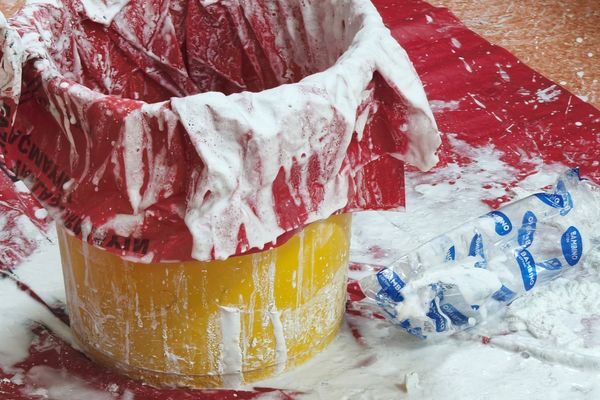
Leave a finished paint can for a few days and it bulges; open the lid and paint sputters out in bubbles, and the customer's first reaction on receiving it is to return it. This kind of bulging can is often the result of microfoam not fully removed before filling combined with secondary foaming during storage. Waterborne coatings already have high surface tension, and with emulsifiers, wetting agents, and thickeners adding to it, foam is both abundant and stable; whether the defoamer is chosen correctly directly determines whether the finished product can leave the warehouse without trouble.
Fast Foam Breaking, but Above All Durable Suppression
Many engineers focus only on the moment a defoamer breaks foam and overlook the durability of foam suppression. It is true that grinding, paint adjustment, and filling require fast foam breaking, but what actually makes the finished can bulge is microfoam slowly released during storage. Some products look impressive in a quick foam-breaking test but lose activity after two weeks, and the finished product foams again during transport or on the shelf. To evaluate a waterborne coating defoamer, you must look at fast foam breaking and long-term suppression together, not trust a few seconds of performance in the lab.
Microfoam Is the Hidden Killer
Large foam is visible to the naked eye and has a clear target for treatment; microfoam consists of small, densely dispersed particles hidden in the film, and once the film forms they become pinholes and haze. The stability of microfoam is often tied to the surfactants in the formulation, so simply increasing the defoamer dosage may not help and can easily ruin compatibility. The way to solve this is to choose a defoamer grade that effectively breaks microfoam and to combine it with process measures such as deaeration and standing, reducing the air entrained at the source. This is why demand for low-foam and foam-free products keeps rising in precision coating scenarios.
In terms of type, mineral-oil defoamers are low in cost and acceptable in compatibility but only average in heat resistance and gloss; silicone types break foam cleanly but demand caution about cratering and recoatability; polyether-modified products strike a compromise between compatibility and foam suppression and are a fairly reliable choice in waterborne systems. There is no standard answer to the trade-off; you can only return to the formulation itself and use gradient-dosage lab tests to pin down the grade and the addition level.
Storage Stability Cannot Be Compromised
The defoamers our technical team develops must withstand the test of storage in the finished product, retaining activity after high- and low-temperature cycles without separating out or stratifying. Waterborne systems are more sensitive to temperature, so when selecting a grade you should pay attention to accelerated-aging retest data rather than looking only at the specs at the factory gate. The compatibility balance is equally critical: too strong a compatibility weakens foam-breaking ability, while too weak a compatibility brings cratering and fisheyes, and the degree in between has to be found through gradient lab tests.
As low VOC, APEO-free, and biodegradable become common directions for upgrading coating additives, the technical bar for defoamers is also rising. For coating companies, only by selecting with foam breaking, foam suppression, microfoam control, and storage stability considered as a whole can the finished cans stay sound, reducing customer complaints and rework caused by can bulging and pinholes.