
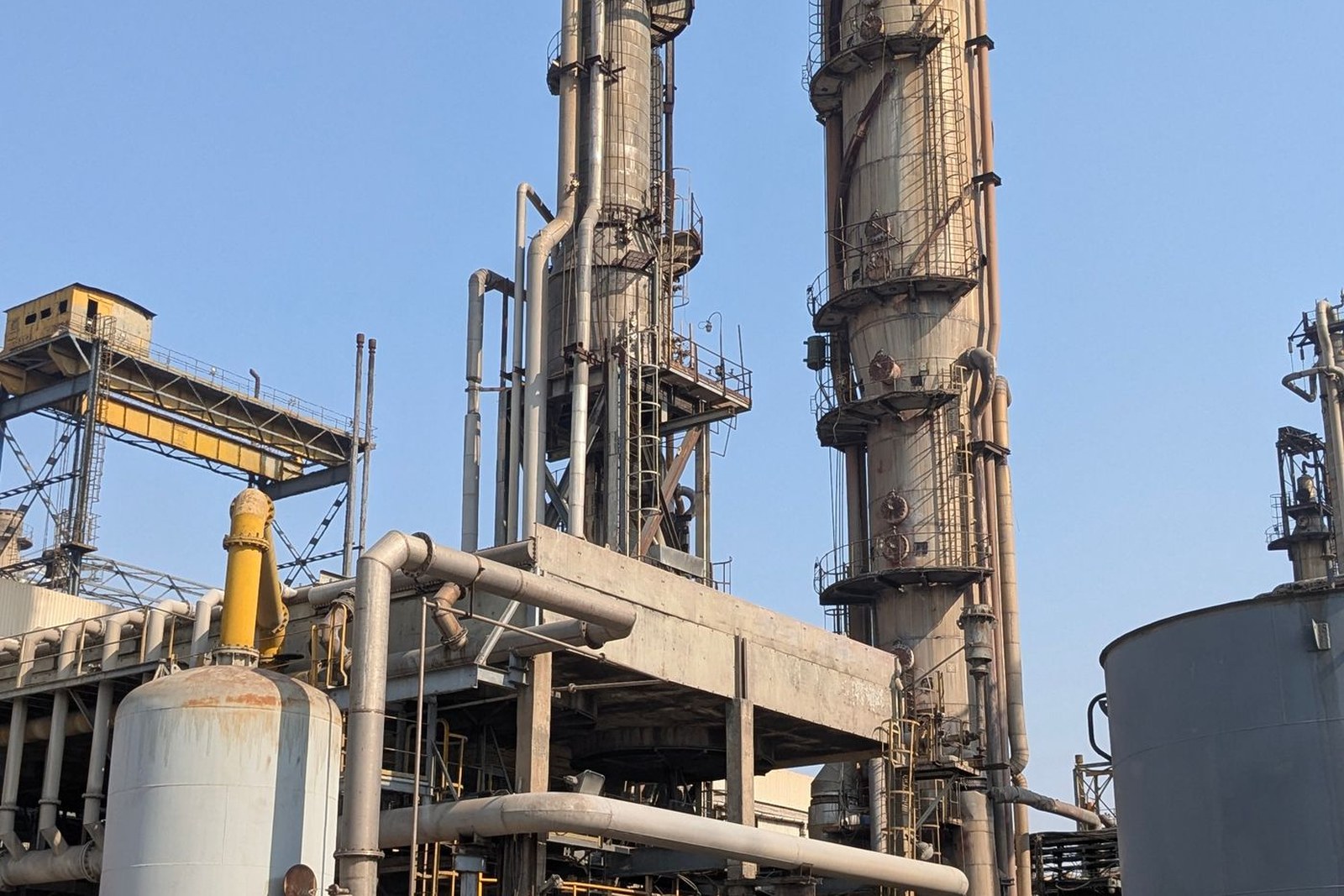
Live shot of towers and piping in a refining unit
Once the foam layer in the coking tower keeps rising with oil-gas entrainment, the differential pressure in the desulfurization section climbs accordingly; the risk of tower flooding and entrainment at the tower top grows batch by batch, and both the unit's throughput and energy consumption come under pressure together.
Chemi Tech launches the KM-600 series defoamer for delayed coking and desulfurization units in refineries, with the addition level set flexibly against feedstock residual carbon and tower-top temperature. This grade is a high-temperature, oil-fouling-resistant silicone defoamer whose foam-breaking does not decay at high temperature, with long-lasting foam suppression that simultaneously covers the foam at the tower top and in the desulfurization section. Based on measured foam-layer height and tower-top differential-pressure data, the suitable scheme for the KM-600 series can be determined.
Chemi Tech Defoamer Advantages
The Chemi Tech KM-600 series defoamer is formulated for delayed coking and desulfurization units in refineries. Its high-temperature resistance is outstanding — foam-breaking ability does not decay in high-temperature oil-gas environments; its oil-fouling resistance is strong, working stably in coking heavy oil and high-acid-value feedstock; foam suppression lasts long, a single dose covering the whole coking cycle; defoaming is fast, removing the foam layer before tower flooding; it is well compatible with in-tower media, without emulsification or phase separation, and does not worsen downstream coking; dosage is economical, adjusted against feedstock residual carbon, so the unit's energy consumption benefits directly.
Industry Pain Points and Solutions
Foam problems in delayed coking and desulfurization units mostly share one root cause: high-temperature oil-gas entrainment and foam-control components not resisting high temperature and oil fouling acting together, ending up in two places — a rising foam layer at the tower top and climbing desulfurization differential pressure.
Once the foam layer rises, the gas-phase space at the tower top is compressed, amplifying the risk of flooding and entrainment. The KM-600 dosage is set against feedstock residual carbon, keeping the foam-layer height stably within the safe range.
The differential pressure in the desulfurization section climbs with the foam layer, squeezing the operating flexibility of the absorber and making treated-gas quality fluctuate. KM-600 breaks foam without carrying oil fouling into downstream systems.
Handling flooding and entrainment ultimately converts into loss of unit throughput and energy consumption. Against changes in feedstock residual carbon and tower-top temperature, the dosage can be narrowed to an accountable range, directly lowering the unit's energy consumption.
Typical Conditions and Verification
Customer: a refining enterprise in Liaoning, applied to the coking tower and desulfurization unit of its delayed coking unit.
After checking against feedstock residual carbon and tower-top temperature, Chemi Tech set the coking-tower defoamer for this plant as KM-610, with the dosage based on feedstock residual carbon and tower-top temperature as the correction factor. Before that, the foam layer at the coking-tower top kept rising with the coking cycle, and the differential pressure in the desulfurization section climbed all the way. After commissioning, the change appeared first in the foam layer at the coking-tower top, then the differential pressure in the desulfurization section fell back step by step; tower-top operation turned stable, the unit's throughput returned to the normal level, and energy consumption dropped accordingly.
FAQ
Will adding a defoamer in the coking tower affect the stability of the absorbent in the desulfurization section?
This comes down to whether the foam-control components can break foam stably in a high-temperature, oil-fouling environment and whether they carry oil fouling into the desulfurization section. KM-600 has completed comparative tests on foam-layer height and differential pressure under delayed-coking and desulfurization conditions; within the recommended range it does not carry oil fouling into downstream systems. Actual dosage is based on feedstock residual carbon, with tower-top temperature and coking cycle as correction factors; Chemi Tech determines the suitable scheme from the side-by-side comparison of foam-layer height and tower-top differential pressure.