
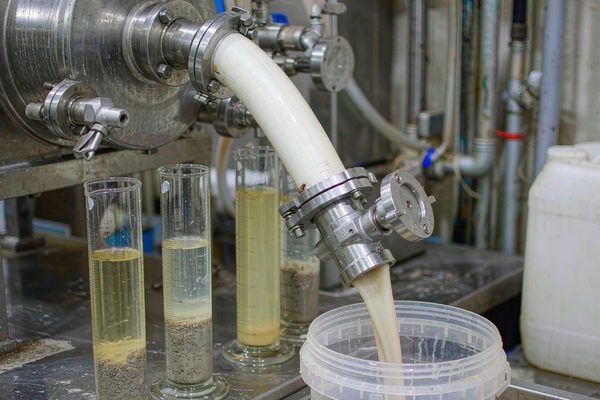
In a pesticide aqueous suspension concentrate plant, the slurry looks fine when it leaves the bead mill, but once it is diluted to the use concentration and left standing overnight it begins to separate, a sediment cake forms at the bottom, and shaking it back does not restore the original uniform state. What the site usually does is add a thickener; raising the viscosity slows settling a little, but the problem of clogged nozzles during spraying comes back. The stability of a suspension concentrate is built on the dispersant adsorbing onto the particle surface; suppressing settling with a thickener only trades one problem for another.
Whether separation is settling or floating points to a different particle size range
Clear water separating on top and a cake at the bottom after standing means the particles have flocculated and settled: the dispersant's adsorbed layer is not enough to provide steric hindrance and electrostatic repulsion. A thin slurry floating on the surface usually means the particle size distribution is too wide, with coarse particles settling first and fine particles floating up, which means the bead milling process was not even. When it only separates after dilution while the stock slurry is stable, the problem lies in the compatibility of the product with water: the dispersant's hydrophilic segment proportion is insufficient and desorbs on dilution.
Order of handling: check bead milling first, then the particle size, and adjust the dispersant last
First check the bead milling step: the zirconia bead size and fill rate, the number of passes and the discharge temperature all affect the particle size distribution, and when the discharge temperature is too high the particle surface becomes highly active and re-agglomerates easily. The second step is to measure the particle size distribution; only once the gap between D50 and D90 is narrowed does suspension stability have a foundation. The third step is to adjust the dispersant; the dispersant must be added before grinding and fully pre-dispersed, and adding it after the bead mill is the same as not adding it at all.
Three points in selection: anchoring groups, molecular weight, and compatibility with co-additives
The dispersant has to hold on to the particle surface, and matching the anchoring groups to the pesticide active ingredient is the most critical factor. Molecular weight affects the thickness of the steric barrier: when it is high the hindrance is strong but viscosity rises, and when it is low the hindrance is insufficient. The formula also contains antifreeze, thickener and defoamer, and the co-additives compete for the surface with each other, so compatibility must be confirmed through accelerated testing.
Chemitec's solutions
For water-based systems such as pesticide suspension concentrates, water-dispersible granules and seed treatments, Chemitec offers polymeric dispersant products that can be matched separately to bead-milling and high-speed dispersion processes.
Polymeric dispersants rely mainly on steric hindrance and adsorb more stably to pesticide active ingredients, making them suitable for suspension concentrates stored for a long time after bead milling; anionic types have strong electrostatic repulsion and are used in systems that are not sensitive to electrolytes; blend types are used for formulas with a wide particle size distribution.
A dispersant can only keep already-opened particles stable; opening the initial agglomerates depends on bead milling shear. If flocculation arises from insufficient grinding fineness, high water hardness or pH fluctuation in the system, simply changing the dispersant cannot solve the storage separation.
When the customer gives the technical team the formula composition, grinding equipment, target particle size, water quality and storage conditions, we determine whether the bottleneck is in the shearing step or the dispersion system, then give a type direction and a recommended dosage range. The starting dosage needs to be judged against the system conditions. For the dispersion direction, see the dispersant product line first, and for the addition step refer to pigment dispersant addition methods.
Summary
Flocculation after bead milling of a suspension concentrate has to be looked at separately: particle size distribution, dispersant adsorption and dilution compatibility each have their own troubleshooting direction. The dispersant must be added before grinding and fully pre-dispersed; if the process position is wrong, no matter how accurate the selection is, it is useless. Chemitec makes water-based dispersants for pesticide suspension concentrates and can provide samples and particle size test comparisons.