
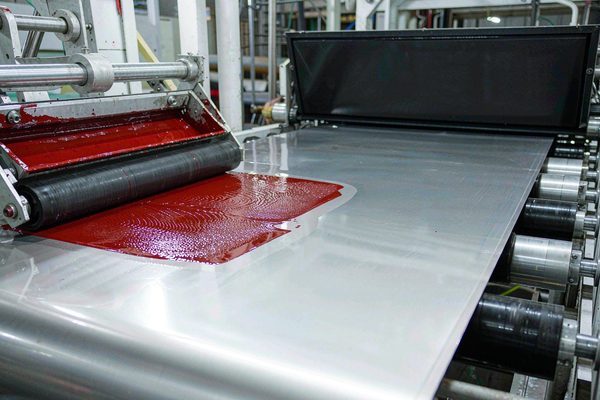
On a UV coating line, the coated panel has only about ten seconds of leveling time before it enters the UV lamp, and the finished panel often shows orange-peel texture and fine pinholes that are even more visible under light. What the site usually does is top up the coating with leveling agent; the pinholes are reduced somewhat but the orange peel remains, and the adhesion test drops half a grade. A UV-curing system has no solvent evaporation stage, so leveling can only rely on the surface tension adjustment of the film itself and that very short time, and the wrong additive instead brings craters.
Orange peel and pinholes appearing together mostly point to a surface tension gradient
Regular ripples on the panel surface running parallel to the roller coating direction are mostly stripe residue from roller transfer: the film viscosity recovers too quickly to flatten out. Fine pinholes with random directions, sharp edges and a shiny center usually occur when the coating's surface tension is higher than the substrate's and the film locally retracts. When both appear at the same time, first measure the coating's surface tension and the substrate's wetting angle; adjusting the dosage alone will not solve it.
Order of handling: check the substrate first, then adjust the coating weight, and determine the additive last
First confirm the cleanliness of the substrate; release agent and dust left on the panel surface directly cause craters. The second step is to adjust the roller coating weight; when the wet film is too thin there is not enough leveling time, and coating a little thicker noticeably reduces orange peel. The third step is to adjust the leveling agent; stir at low speed after adding, let it stand for a while to remove the air entrained by stirring, then run it through the roller.
Three points in selection: compatibility, migration, and effect on adhesion
Acrylic leveling agents are compatible with resins and reduce orange peel by adjusting surface tension with few side effects, making them suitable for topcoats and clearcoats. Silicone types have low surface tension and a direct leveling effect, but a little too much forms a barrier between layers, reducing recoat adhesion and interlayer bonding. Fluorocarbon types have the strongest spreading ability and markedly improve substrate wetting, but they are expensive and poorly compatible with some resins, making them suitable as a remedy for localized problems.
Chemitec's solutions
For UV coatings, UV-curing inks and 3C coating systems, Chemitec offers acrylic and silicone leveling agents that can be matched to roller coating, spraying and curtain coating.
Acrylic types have a wide compatibility window and are mainly used to improve leveling and surface uniformity, suitable where recoatability is required; silicone types are more outstanding in wetting and spreading and are used to solve surface defects such as orange peel and craters.
Leveling in a UV system is affected jointly by viscosity, film thickness, exposure energy and the application environment, and the leveling agent plays a supporting rather than a leading role. If orange peel or craters come from equipment parameters or curing conditions, increasing the dosage usually has limited effect.
The customer provides the formula composition, viscosity, film thickness, application method and curing conditions, and the technical team judges whether the problem lies in rheology or interfacial tension, then determines whether the leveling agent type needs to be adjusted. The specific plan needs to be judged against the system conditions. For applicable systems, refer to coating defect solutions and UV-curing leveling agent solutions.
Summary
The leveling window of a UV-curing system is narrower than that of a solvent-borne one, and orange peel and craters often come from substrate wetting and film surface tension, so adding leveling agent alone has limited effect. Stabilize substrate cleanliness and coating weight first, then choose the additive by defect type. Chemitec makes leveling agents for UV coatings and UV-curing inks and can provide samples and comparative test records.