
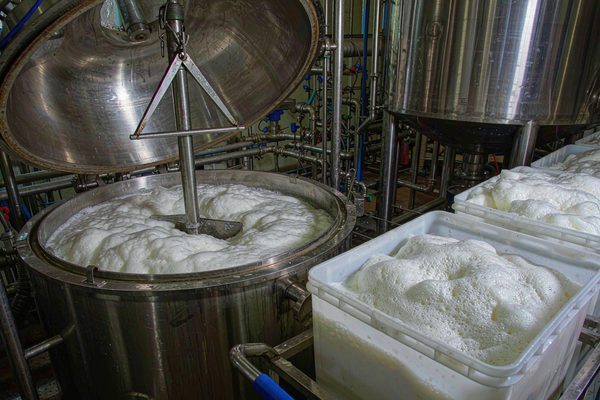
In a white emulsion glue plant, when the polyvinyl alcohol dissolving kettle heats up and stirs, the foam on the liquid surface builds higher and higher, and as it approaches the kettle mouth the only option is to slow the agitator, which lengthens the dissolving time. What the site usually does is add more defoamer to the kettle; the foam is suppressed but fish eyes and slight mottling appear on the glue film. The first hurdle for a defoamer in an adhesive system is compatibility: no matter how fast it breaks foam, if it separates out onto the glue film it is scrap.
Foam in the kettle and glue film defects appearing together point to additive compatibility
Foam in the dissolving kettle concentrated at the liquid surface and kettle wall, with large and loose bubbles, is mostly air entrained by stirring during PVA dissolution and is physical foaming. Fine, persistent foam in the drum after filling is related to the surface-active substances in the emulsion. If fish eyes and uneven gloss appear on the glue film after coating, first check the type and dosage of the defoamer.
Order of handling: change the charging first, then control stirring, and add the additive last
First change the way the PVA is charged: sprinkle the powder slowly along the kettle wall to avoid lumps and trapped air, and slow the heating rate, so that much less foam is naturally generated during dissolution. The second step is to set the agitator blade submersion deep enough so that no funnel-shaped vortex forms at the liquid surface; only then can the defoamer do its job. The third step is to add the defoamer in two portions, once in the middle of dissolution and once just before the glue adjustment is finished.
Three points in selection: compatibility, effect on bond strength, and heat resistance
PVA and PVAc emulsion systems are slightly acidic or neutral; the most direct way to check compatibility is to take a small sample, drip in the additive and let it stand to see whether there is oil floating, flocculation or separation. Mineral oil types break foam quickly in white emulsion glue and are reasonably priced, but a high dosage reduces bond strength. Polyether types are compatible and have little effect on the appearance of the glue film.
Chemitec's solutions
For white emulsion glue, VAE emulsion and water-based adhesive systems, Chemitec offers polyether, silicone and mineral oil defoamers that can be selected separately for reactor production and finished product letdown.
Polyether types are relatively compatible with emulsion systems and are unlikely to cause craters or glue film defects, suitable where clarity and bond strength are required; silicone types break foam faster in the reactor stage; mineral oil types are mostly used for filled adhesive grades with lower appearance requirements.
Compatibility is a system issue: the wrong type brings craters, mottling of the glue film or reduced bond strength. When the emulsion itself polymerizes unstably or has an abnormal particle size distribution, changing the defoamer will not solve the root problem.
When the customer gives the technical team the emulsion type, solids content, production process, current additives and finished product appearance requirements, we assess the compatibility risk and give a direction on type; after a small-sample trial confirms craters and bonding performance, it goes to production trials. The specific type needs to be determined against the system conditions. For the product direction, see the defoamers dedicated to water-based coatings first, and for the compatibility approach refer to high-temperature high-shear defoaming solutions.
Summary
Half of the foam in white emulsion glue comes from air entrained by stirring in the dissolving step and half from the foam-stabilizing components of the emulsion itself, and the two are handled differently. First put the charging method and stirring conditions right, then control foam by adding in portions, with the dosage set by the foam layer height in the drum and the glue film appearance. Chemitec makes defoamers for water-based adhesives and can provide samples and compatibility test comparisons.