
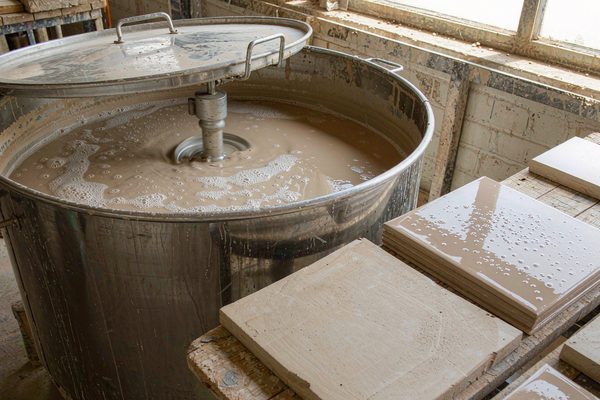
When milled glaze slip is put into the mixing tank and water is added to adjust specific gravity, a layer of foam floats on the surface; after glazing and firing, patches of pinholes and small pits appear on the glaze surface, and rework means re-spraying the glaze and firing again. What the site usually does is top up the glaze slip with defoamer and stir again; the foam subsides for the moment but the glaze pinholes remain. Most of the air bubbles in glaze slip are mixed in during ball milling and slip adjustment, so adding defoamer just before glazing only treats the symptom.
Whether the pinholes are round or elongated points to a different bubble location
Pinholes close to round with clean edges after firing are mostly openings left where bubbles burst in the glaze layer, with the gas coming from air entrained during ball milling and stirring. Pinholes that are elongated and distributed along the glaze flow direction are often related to the rheology of the glaze slip and the atomization of the spray gun during glazing, with bubbles forming as the glaze droplets spread. Clusters of small pits where the glaze layer meets the body mean you should check the body moisture content and dust on the bisque surface.
Order of handling: control ball milling first, then adjust the slip, and add the additive last
In the ball milling step, fix the ratio of material, balls and water; mill long enough, and let the glaze slip stand for a while after leaving the mill so the bubbles float up naturally. When adding water during slip adjustment, use a spray or add it slowly along the wall to avoid a water jet striking the surface and entraining air, and stir at low speed once the specific gravity is set. Only after these two steps should defoamer be considered: add it in the mixing tank after the mill discharge, adding while stirring until the surface foam stably disappears.
Three points in selection: whether it affects glaze gloss, heat resistance, and compatibility with the deflocculant
Glaze slip systems are slightly alkaline with a high solids content; when choosing a defoamer, first consider its effect on the fired glaze surface, since silicone residue forms crawling spots at high temperature and should be used cautiously in cover glazes, whereas polyether types burn out cleanly with little effect on gloss. Too much defoamer worsens the bond between the glaze layer and the body.
Chemitec's solutions
For water-based slurry systems such as ceramic glazes, body slips and decorative glazes, Chemitec offers silicone and polyether defoamers that can be selected separately for ball milling and slip adjustment.
Silicone types break foam faster under the high shear of the ball milling stage, suitable for slips that generate a lot of foam; polyether types are more compatible and are used as a top-up after slip adjustment to reduce the risk of glaze surface defects; blend types balance foam-breaking speed and glaze surface appearance.
Besides foam, glaze pinholes can also come from glazing thickness, drying rate and kiln atmosphere. When pinholes repeatedly appear at similar positions on the body, rule out the glazing and firing steps first, then judge whether they are related to entrained air in the slip.
When the customer gives the technical team the slip formula, ball milling parameters, glazing method and firing schedule, we judge whether the pinholes are related to entrained air in the slip and then give a product direction and advice on the addition step. Behavior varies widely with system conditions, so it is best to clarify the working conditions before matching samples. For the slurry system, see alkali-resistant defoamer solutions first, and for the addition position refer to defoamer addition methods.
Summary
Glaze pinholes mostly originate in the glaze slip preparation stage, with air entrainment in ball milling and high-speed beating being the main sources; the defoamer's role is to remove bubbles that have already formed and reduce the gas carried into the glaze layer during glazing. Adding it in the mixing tank is more useful than adding it just before glazing, and the dosage should be measured against the number of pinholes after glazing. Chemitec makes defoamers for ceramic glaze slip and can provide samples and glazing comparison records.