
In waterborne coatings, adhesives and industrial slurry plants, foam tends to break out in the hardest places to handle: the liquid surface swells rapidly the moment high-speed dispersion starts, foam builds up both before and after the pump during circulation, and after shutting down and settling for hours there is still foam clinging to the tank wall. The first reaction on site is to raise the dose, but past a certain point the foam actually becomes finer and more stable and even brings on pinholes and haze. More antifoam is not better; once it exceeds what the system can accommodate, the excess component turns from breaking foam into stabilizing it.
Foam getting finer after increasing the dose points to overdosing
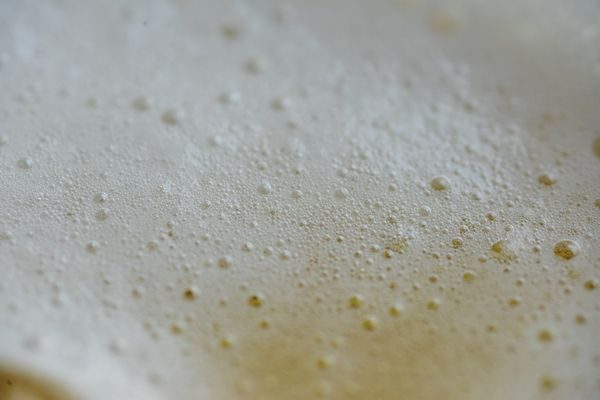
Foam turning from large bubbles into fine, dense microbubbles, whitening in colour and lasting longer is the most typical signal of overdosing; if reducing the dose makes the foam easier to break, overdosing can basically be confirmed. Free antifoam droplets are themselves surface-active, and once sheared into fine droplets they form a new adsorbed film at the air-liquid interface that strengthens the foam lamellae, making the foam finer, denser and harder to break.
Handling order: reduce first, then set the dose
For this situation, do not simply raise the dose; start at half the supplier's recommended value and run five or six steps of a gradient under the same system and shear conditions, comparing foam-break time and foam height after settling for two hours, then take the lowest value that still meets the target. The way it is added must be adjusted to match: high-viscosity systems should be dosed in the grinding stage, since topping up during late let-down tends to concentrate locally.
What to look at when selecting
Selecting on initial foam-break speed alone easily leads to mistakes; in high-shear systems with long circulation, persistence and compatibility are often more critical. Only when the dose has been brought very low and there is still no improvement does changing the type need to be considered. When selecting, list temperature, viscosity, shear intensity and circulation duration as fixed conditions, then compare break speed, foam-suppression persistence and the tendency to cause surface defects.
Chemitech's solution
For foaming in waterborne coatings, adhesives and industrial slurries, Chemitech supplies silicone, polyether and composite antifoam products covering production conditions across a range of viscosities and shear conditions.
Silicone types break foam quickly and have low surface tension, suiting medium-to-low viscosity systems; polyether types have better compatibility and stronger persistence, making them better suited to high-shear and long-circulation situations; composite products balance break speed against persistence and are used in systems that single-component types struggle to cover.
When selecting, pay attention to three things: addition point, dose and compatibility. The addition point should fall in a higher-shear step, and the dose should keep a safety margin. It should be noted that an antifoam only improves foam breaking and suppression; if the system itself carries a lot of entrained air, switching additives alone usually will not fully solve it.
Customers who have not yet settled on a product type can provide the system type, temperature, viscosity, pH, shear conditions and current additive information to our technical team; we will give a selection direction and arrange sample testing, first running a dose-gradient lab trial to confirm the dose and effect before moving to production-line validation. For application notes, see our antifoam for waterborne coatings; for the product range, see our antifoam product selection.
Summary
Foam problems are usually not caused by a single factor. Rather than continually increasing the dose, it is better to start from process conditions, system characteristics and additive compatibility, work out which link is failing, and then decide whether to adjust the dose, change the type or optimize how it is added. Chemitech can supply antifoam, dispersant and leveling agent products for different industrial systems and production conditions, with sample testing and product matching support. Verifying through lab trials against actual operating conditions usually yields a stable solution more readily than selecting by product name.