
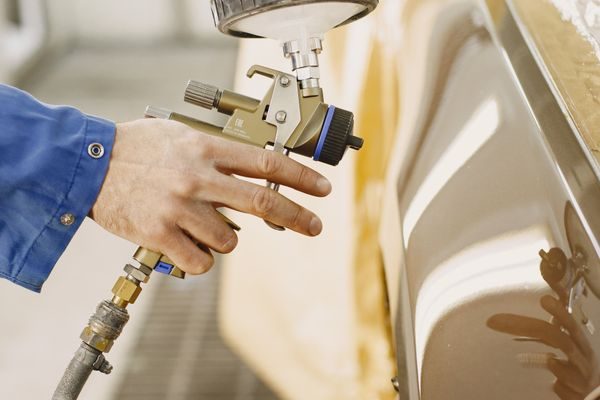
Whether the film is flat and smooth is the most intuitive indicator of coating quality. Because water has high surface tension and its evaporation rate depends heavily on ambient humidity, water-based coatings are more prone to orange peel, craters and brush marks after application, especially when sprayed. As a key additive that improves coating leveling, the leveling agent lowers and equalizes surface tension, helping the film form a flat interface before curing, an important part of raising the appearance grade of water-based formulations.
Mechanism: Regulating Surface Tension
After application, water evaporation creates a surface-tension gradient on the film, and the tension difference drives liquid flow; uneven flow produces orange peel. The leveling agent migrates to the film surface, lowers the tension gradient and lets the coating self-level before it loses flow. Understanding this explains why a leveling agent is not "the more the flatter": an excess may instead bring foam stabilization or interlayer adhesion problems, so selection and dosage are two sides of one coin.
Silicone and Acrylic: Each Has Its Strengths
Silicone leveling agents have strong surface-tension reduction, stand out in eliminating craters and improving slip, and are often used in high-gloss, high-distinctness-of-image systems; acrylic ones are known for good compatibility and recoatability, suited to applications needing multiple coats or later lamination. Both have their place, and selection should fit the specific formula and application process rather than favoring one type across the board. Some formulas even blend the two to take advantage of both.
Beyond Leveling, These Also Matter
Modern industrial coatings ask far more of leveling agents than a flat surface alone. Scratch resistance, smooth hand feel, crater prevention and sag resistance are all demands the downstream often voices. New-energy vehicle body coatings pursue a mirror effect, while 3C electronic coatings emphasize a low defect rate; these demanding scenarios are pushing leveling agents toward high leveling, low impact on recoating and multiple combined properties.
Balancing Compatibility in Water-Based Systems
Water-based systems impose harsher demands on leveling agents than solvent-based ones. The interactions among emulsifiers, coalescing aids and the leveling agent are more complex; insufficient compatibility easily causes craters and haze, while excessive compatibility makes it hard to migrate to the surface. Choosing a water-based leveling agent is about a just-right balance, usually settled by gradient tests combined with application simulation.
Selecting the right product for the system and pinning down dosage with gradient tests is an effective path to a flat film and stable application. In real production, the synergy of the leveling agent with the defoamer and wetting agent often matters more than choosing a single product, and formulation cases often teach the lesson of trading one property for another. Our technical team provides targeted formulation debugging support for water-based leveling agents, helping customers find the balance point between surface effect and recoating performance.