
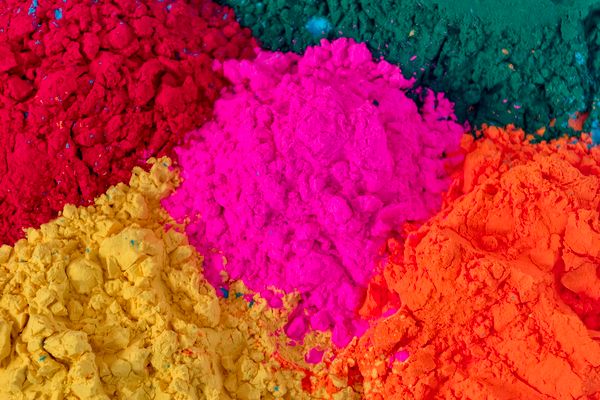
If a pigment paste loses color strength or thickens in the drum, the problem usually is not the pigment. It is dispersion. Titanium dioxide, carbon black and organic pigments all arrive as agglomerates, and breaking them apart with shear is only half the job. Keeping them apart through storage and application is where a well-chosen water-based dispersant earns its place in the formula.
Wetting, grinding, stabilizing
Dispersion runs in three steps: the liquid must wet the pigment surface, mechanical energy must break the agglomerates, and the dispersant must stop them re-forming. A good dispersant lowers the work of wetting and, through steric hindrance, holds the particles at a distance. That is why the same pigment can grind faster and stay pourable at a higher solids loading with the right additive, and why dispersion, not pigment quality, is usually the first place to look when color strength disappoints.
Polymer dispersants do the heavy lifting
Modern water-based dispersants are high-molecular-weight polymers with anchoring groups that bind to the pigment and solvating chains that extend into the water. Unlike simple ionic dispersants, they are less sensitive to pH and electrolyte swings, which makes them the dependable choice for organic pigments, high-surface-area carbon black and the growing field of nano-pigment pastes used in coatings and inks. The anchor-group design is what lets one dispersant grip carbon black while another is tuned for an inorganic oxide.
Measure, don't guess
A grind is easy to over- or under-dose, and the evidence shows up in the numbers. A Hegman grind gauge tracks fineness, a rub-up test reveals flocculation, and a viscosity curve shows whether the paste will still pump tomorrow. Matching the dispersant dose to the pigment surface area, rather than to a fixed percentage, is the difference between a stable colorant and one that thickens on the shelf. A dispersant that looks cheap on paper can cost far more once rework and scrap enter the equation.
The high-solid and nano trend
Formulators keep pushing toward higher pigment loading to cut freight and dilution, and toward nano-dispersion for finer color and higher chroma. Both directions stress the dispersant: higher solids mean higher viscosity to control, and nano pigments mean more surface area to stabilize. The dispersants that manage both are what separate a routine colorant line from one that runs lean and fast.
Dispersion is where color strength is won or lost, and it is controlled before the pigment ever meets the resin. Choose a dispersant matched to the pigment surface, dose it against a grind test, and the paste stays stable, bright and easy to pump. Get dispersion right once, and every downstream step from letdown to application gets easier.