
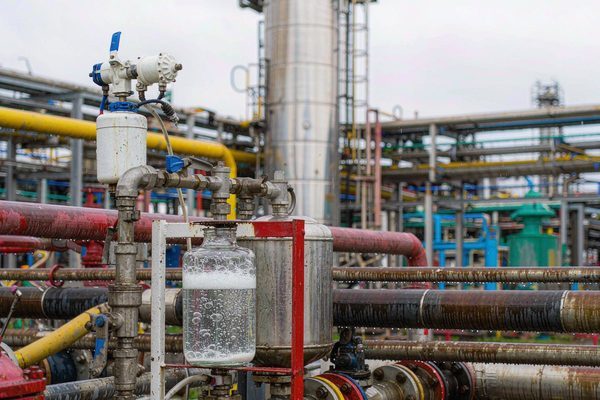
When the absorption liquid in a desulfurization tower starts to foam over, tower pressure climbs with it, foam hangs on both the circulating pump outlet and the gas-liquid separator, and the level in the regenerator begins to drift. The first reaction on site is to top up the circulating tank with defoamer; the foam is held down for two hours and then comes back, with amine consumption higher than usual. In most cases amine foaming is not about too little defoamer, and the first thing to establish is whether the inlet gas is carrying oil or the amine itself has aged.
Foam Colour and Location Tell You Where the Foaming Comes From
Opening the manhole on the circulating tank to look at the foam tells you more than watching the defoamer dosage. Black foam with an oil film, concentrated at the tower top and the gas inlet section, is usually related to heavy hydrocarbons carried in with the inlet gas. White, fine foam that rises evenly along the absorption section, together with a low regenerator temperature, usually means degradation products and heat-stable salts are accumulating in the amine.
Order of Action: Deal with Oil Carryover in the Inlet Gas First, Then Talk About Dosing
In order, do three things first: check the differential pressure of the lean and rich amine heat exchanger and the filters to confirm whether there is oil contamination or suspended solids; measure the heat-stable salt content of the amine and the turbidity after filtration; and bring the makeup water to the tower-top wash section back to its design value. Only then touch the defoamer. Put the dosing point in the turbulent section at the circulating pump inlet; continuous low-flow pumping is more stable than pouring it into the circulating tank in one go.
Three Points When Selecting: Compatibility, Temperature Resistance, Foaming Medium
Amine systems are alkaline, and the regenerator section can reach around 120 degrees Celsius. When choosing a defoamer, look first at compatibility with the amine: add a drop to a sample, let it stand, and check for separation or flocs. Then look at the temperature range. Silicone types are easily emulsified and carried away in high-temperature, high-shear conditions; polyether types resist temperature and shear better but break foam a little more slowly, and combining the two covers both.
Chemitech's Solution
For working conditions such as desulfurization amines, amine-based decarbonization of natural gas and tail gas absorption, Chemitech offers polyether, silicone-polyether and modified polysiloxane defoamers, with the type determined by system compatibility.
Polyether types are more compatible in alkaline amines and less prone to oil separation, suiting the high-temperature, high-shear parts of the regenerator section; silicone-polyether types balance spreading with temperature resistance and are widely used in amine circulation systems; pure silicone types are limited where the inlet gas carries a lot of oil.
A defoamer cannot deal with amine degradation or heat-stable salt accumulation. When the root cause lies in amine ageing, filter failure or oil carryover in the inlet gas, it can only hold the foam down temporarily, and as salt content keeps rising, corrosion and amine losses follow.
Give our technical team the amine type and concentration, the regenerator temperature, whether the inlet gas carries oil, the circulation rate and the current dosing method, and we will run a sample compatibility test and suggest a type and a dosing location. A common starting point for desulfurization systems is to look at alkali-resistant defoaming solutions, and for high-shear conditions to refer to high-temperature, high-shear defoaming solutions.
Summary
Amine foaming is mostly a surface-level symptom of a system problem: oil carryover in the inlet gas, amine degradation and filter failure all make the foam come back, and the defoamer is there to keep the operating window open and buy time to find the root cause. On selection, look at compatibility and temperature resistance first, then fix the dosing location. Chemitech makes defoamers for desulfurization and natural gas purification and can provide sample compatibility testing and dosing recommendations.