
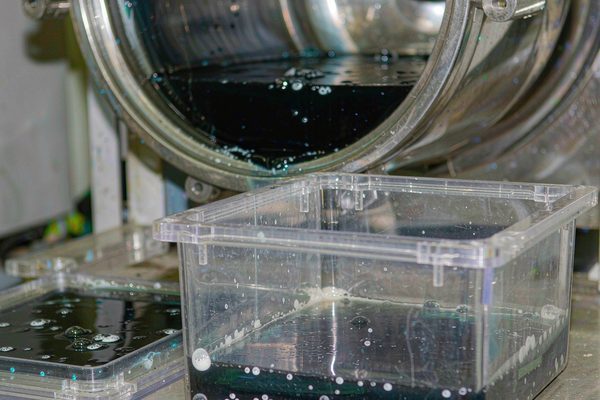
When epoxy potting compound is mixed and poured into the mold cavity, sectioning it after curing reveals voids of various sizes, insulation testing occasionally reports partial discharge, and the rework cost is far higher than the compound itself. The first reaction on site is to add defoamer to component A; the surface bubbles are reduced but the voids deep in the cavity remain. Part of the gas in a potting system comes from air entrained by stirring and part from curing shrinkage and adsorption on the filler surface, and the two gas sources need two different approaches.
The location of the voids determines whether it is entrained air or insufficient deaeration
Voids concentrated near the gate and at the flow end, irregular in shape and joined together, are mostly air entrained during mixing and pouring. Voids finely distributed around filler particles and appearing as dots on the cross-section are often related to moisture and low-molecular-weight substances adsorbed on the filler surface and require vacuum deaeration to be removed. Isolated large voids near the mold wall and the bottom of the insert usually occur when shrinkage during the exothermic curing stage is not adequately fed; the compound viscosity rises quickly and bubbles are fixed in place before they can float up.
Order of handling: change the mixing first, then apply vacuum, and adjust the additive last
First fix the mixing method and speed, with the blade submerged deep enough to avoid driving air into the liquid surface. The second step is vacuum deaeration: hold the vacuum until the surface is steady with no more foaming, then keep it for a while longer, with the time measured for the compound batch. The third step is to adjust the additive: the deaerator is added during filler wetting and the defoamer at the end of mixing, and adding them in the wrong place makes a big difference.
Three points in selection: compatibility, heat resistance, and effect on electrical properties
The insulation index of potting compound is sensitive to additives; start selection with a compatibility sample, let it stand to see whether there is separation and haziness, and measure volume resistivity after curing. For low-temperature curing systems, silicone types can be chosen: they break foam fast with a low dosage; for systems with high curing temperature or violent exotherm, polyether and silicone-polyether types are more stable, with less chance of silicone oil being emulsified out. Too much defoamer will concentrate at the interface and reduce shear strength.
Chemitec's solutions
For epoxy, polyurethane and silicone potting systems, Chemitec offers defoaming and deaerating additives that can be matched to atmospheric and vacuum potting processes.
Deaerating additives focus on the coalescence and rising of bubbles in the compound and suit processes with a standing or vacuum stage; defoaming types focus on the air knocked out during mixing and conveying and are used in steps with long mixing times and strong shear.
A deaerating additive can only improve the conditions for bubbles to rise; it cannot replace process parameters such as vacuum level and evacuation time. When the system has high viscosity and there is no standing or vacuum stage after potting, changing the additive alone cannot solve internal voids and incomplete filling.
When the customer gives the technical team the resin system, viscosity, potting method, vacuum conditions and curing schedule, we judge whether the bubbles come from mixing or poor venting and then give a direction on the additive and the addition step. The specific dosage needs to be judged against the system conditions. For the product direction, refer to coating defect solutions, and for the addition approach compare with defoamer addition methods.
Summary
Potting voids are the combined result of mixing, deaeration and curing, and it is unrealistic to solve them with one additive. First reduce air entrained by stirring, then use vacuum to remove the gas already adsorbed, and finally use an additive to finish. Chemitec makes defoamers and deaerators for potting compounds and resin systems and can provide samples and cross-section test comparisons.