
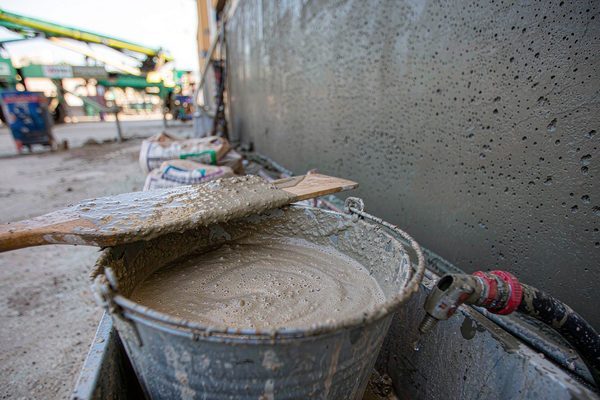
At a dry-mix mortar batching plant, two or three minutes of mixing with water brings a layer of fine bubbles to the surface of the slurry. Trowel it onto a wall and, once cured, it leaves densely packed air voids; with self-leveling compounds it is even more obvious, with the surface covered in pinholes. On site the usual reaction is to add more defoamer to the mixing water, but the slurry then turns sticky and loses flow, while the voids stay. Bubbles in mortar start forming the moment water goes in, and defoamer powder has to enter the system during the powder mixing stage; adding it afterwards has limited value.
Whether the Air Voids Appear on the Surface or in the Cross-Section Points to Different Causes
In a render or plaster layer, voids concentrate in the top surface layer, usually because there is too much mixing water or the sand grading is too fine, so bubbles reaching the surface cannot escape. In the cross-section, large and scattered voids usually point to an overdose of superplasticizer or air-entraining components, which lowers paste viscosity and produces a larger number of bubbles to begin with. On self-leveling surfaces, patches of pinholes are often related to the dosage of stabilizers and rheology additives: the yield value of the paste is too low, so bubbles rise to the surface and burst, leaving cavities.
Order of Action: Fix the Water Addition First, Then Adjust the Defoamer Powder Dosage
The first step is to go back to the mix design and fix the mixing water according to the design water-to-cement ratio, and to re-check the fineness modulus and clay content of the sand. Only once these two are stable should the defoamer powder be adjusted, starting from the lower end of the recommended dosage and running a gradient test to see which level reduces voids without collapsing flow. To judge whether the dosage is right, look at how the cross-sectional void ratio of the test cube relates to its 28-day strength.
Three Things to Look at When Selecting: Carrier, Dispersibility, and Compatibility with the Superplasticizer
Powder defoamers mostly use a mineral or water-soluble carrier to hold the active component. Different carriers disperse at different speeds in dry-mix powder and release the active at a different pace. Polyether types disperse well and suit flow-sensitive materials such as self-leveling compounds; silicone types spread quickly in low water-to-cement, high-viscosity pastes and are better suited to precast components and grouting materials. Adding them at the wrong point lets the superplasticizer be adsorbed first.
Chemitech's Solution
For dry-mix systems such as cement mortar, self-leveling compounds, repair mortars and tile adhesives, Chemitech offers powder defoamers and anti-foaming products, matched separately to dry-mix lines or on-site mixing.
Powder types blend easily with cement, sand and fillers in dry form, making them suitable for continuous production lines; anti-foam types focus on controlling foam for a period after mixing, for long application times; composite types balance foam breaking against compatibility.
Defoamer powder addresses the voids formed during mixing and vibration; it cannot replace mix design or vibration practice. When voids concentrate in load-bearing areas or come with below-spec strength, the problem usually lies in water dosage, grading and curing.
Give our technical team the formulation, water dosage, mixing equipment and application method, and we will judge whether the voids come from mixing or from the process, then suggest a product direction and the best point of addition. The system conditions need to be judged together, so we suggest confirming the direction with us first. For product direction, look first at defoaming solutions for building material systems; for the dosing point, refer to the defoamer addition method.
Summary
Air voids in mortar result from the combined effect of mix proportioning, mixing and admixtures. Defoamer powder can hold down the bubbles generated during water addition and mixing, but it cannot fix problems in the mix design itself. Chemitech makes powder defoamers for cement-based materials and can provide samples and dosage recommendations.