
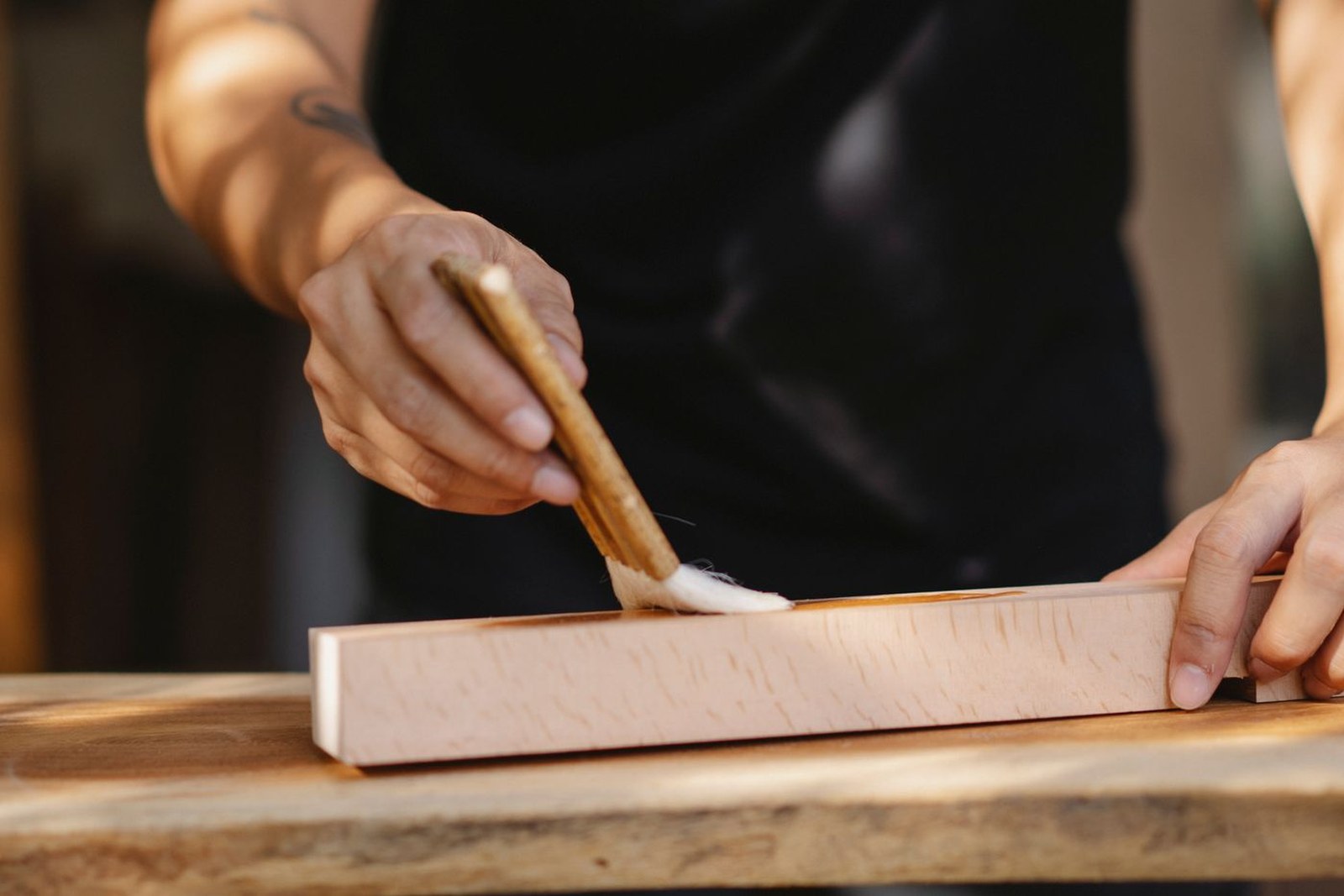
Hand-applying coating to a wood surface
Once the water-based primer for panel furniture goes onto the roller line, the coating spreads across the panel more slowly than it sets, orange peel piles ridge on ridge, and it shows up most clearly when a light bar rakes across the panel from the side; the hours spent sanding and touching up drag down the pace of the topcoat stage.
Chemi Tech provides levelling agents for water-based wood lacquer and furniture coating, drawn from the KMP-4100 series; the dosage is adjusted to the coating solids, the spray viscosity and the set-to-touch window. This grade is a levelling agent made specifically for water-based systems: its surface-tension reduction is marked, its dynamic surface tension is controllable, and its compatibility is excellent, so it does not trigger craters; the measured data for panel orange-peel grade and gloss reading is the basis for settling on the right KMP-4100 programme.
Advantages of Chemi Tech Levelling Agents
The Chemi Tech KMP-4100 series levelling agent is developed for water-based wood lacquer: its surface-tension reduction is marked, the coating spreads fully across the panel, and orange peel and roller marks flatten out step by step; its compatibility is excellent and it does not trigger craters, so there is no hidden risk to adhesion between recoat layers; its effect on gloss is small, and the gloss reading of the topcoat does not swing with the additive; its thermal stability is excellent, so it does not decompose or yellow in the baking stage and light-coloured films hold their hue; the dosage adjusts flexibly to the coating solids, and both the primer and the topcoat stage can be accommodated.
Industry Pain Points and Solutions
The levelling problem in water-based wood lacquer has its root in the mismatch between the coating's surface tension and the set-to-touch window, and it finally causes two big defects: orange peel and craters.
Roller marks are frozen onto the panel by the set-to-touch window, mostly because the coating does not spread enough. The KMP-4100 dosage is set by the spray viscosity, and it can effectively lower the orange-peel grade.
Craters appear as points because the coating cannot spread over low-surface-energy sites. KMP-4100 has good compatibility and does not trigger craters, leaving ample room for adhesion between recoat layers.
In the baking stage, the thermal stability of the additive directly decides how light-coloured films hold their hue. Once the coating solids, the spray viscosity and the set-to-touch window have been compared, the addition range can be drawn, and the panel hue after baking stays stable.
Typical Operating Conditions and Verification
Customer: a panel-furniture enterprise in Sichuan, for the water-based primer and topcoat lines for cabinet doors.
Under the side light-bar check the orange-peel defect was obvious, and panels sent back for sanding were stacked up in front of the topcoat line; white-lacquer batches occasionally yellowed after baking. The furniture plant put levelling correction on its quality-improvement list, and on the basis of a comparison between panel orange-peel grade and gloss reading, Chemi Tech settled on KMP-4100 as the right levelling programme, with the dosage set by the coating solids. After it went in, the orange-peel grade fell back into the acceptance band and the volume sent back for sanding dropped sharply; the white lacquer no longer shifted hue after baking; the pace of the topcoat line came back to normal.
Frequently Asked Questions
When the shop temperature drops, does the levelling window of a water-based lacquer stop being wide enough?
Orange peel comes from the speed difference between how the coating spreads and how it sets; the job of a levelling agent is to stretch that window out. KMP-4100 has completed spreading and gloss comparison tests under both winter and summer shop conditions, and within the recommended addition range the orange-peel grade is steadily controllable. The actual dosage has to be set together with the coating solids, the spray viscosity and the set-to-touch window; Chemi Tech settles the optimum dosage through a parallel comparison of panel orange-peel grade and gloss reading.