
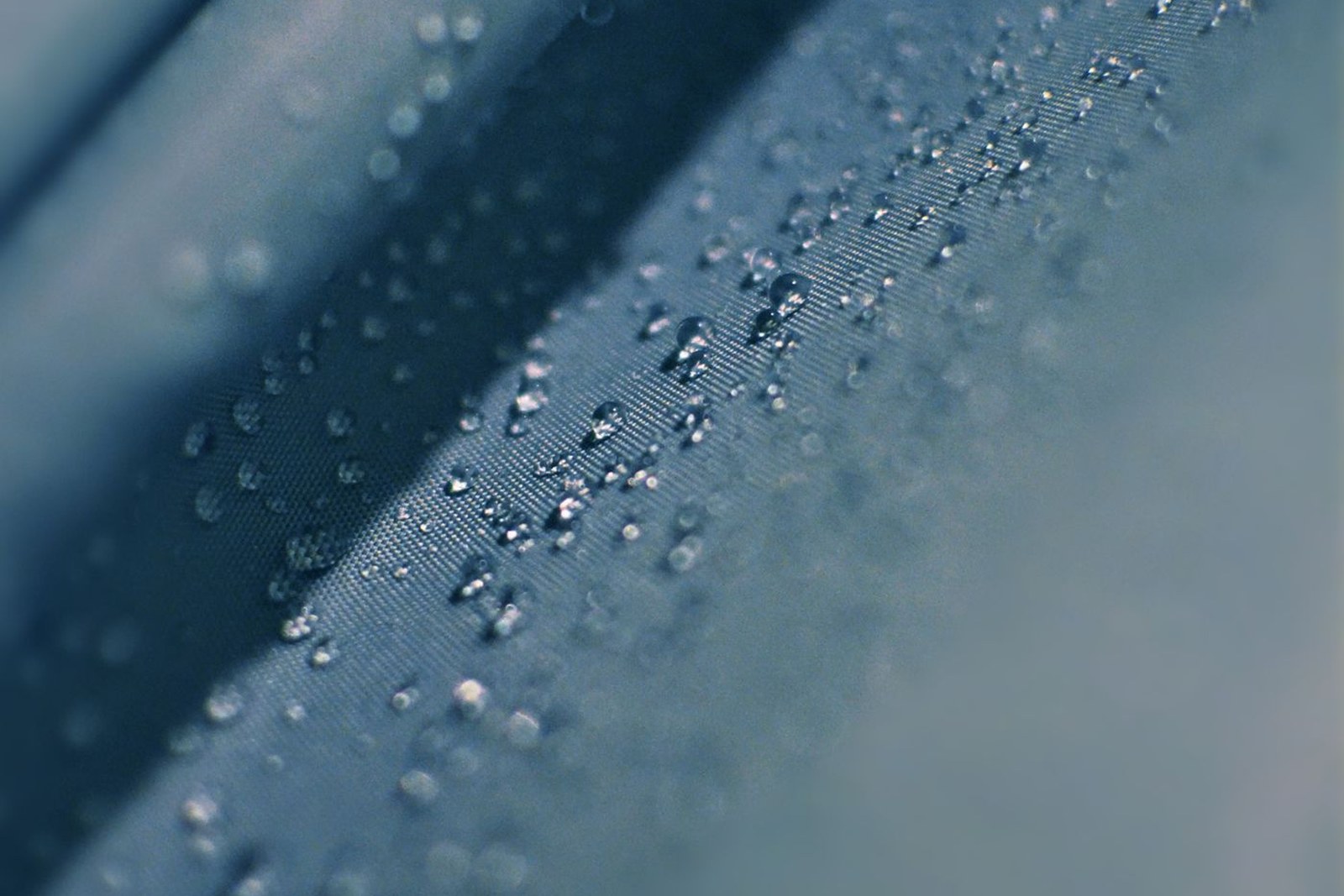
Close-up of water beads rolling off a fabric surface
Export outdoor fabrics have put perfluorinated compounds on their restricted-substances lists; conventional fluorine-based finishing will not pass the customer's testing, the water-repellency rating column is left blank, and the order stalls at the inspection stage.
Chemi Tech supplies the KMWF-102 series water repellent for export orders bound by perfluorinated-compound limits; the dosage depends on the substrate material, the concentration of the finishing liquor and the curing temperature. This grade is a water-based, fluorine-free formulation whose finishing liquor contains no fluorinated components, and it suits water-repellent finishing on fabrics that have to keep perfluorinated indicators under control; the measured data for wicking rise height and water-repellency rating is the core basis for putting a KMWF-102 programme into practice.
Advantages of Chemi Tech Water Repellents
The Chemi Tech KMWF-102 series water repellent is a water-based, fluorine-free formulation whose finishing liquor contains no fluorinated components, serving export orders bound by perfluorinated-compound limits; its water-repellency performance is stable, and both polyester and nylon substrates can be accommodated; its low-yellowing character keeps light shades from shifting in colour after curing; it is compatible with downstream processes such as calendering and coating, and the finished hand is neither stiff nor harsh; the dosage moves with the substrate material, covering both light and heavy fabrics.
Industry Pain Points and Solutions
The core problem in fluorine-free water-repellent finishing has its root in the mismatch between how the repellent film forms and the curing window, and it finally shows up as two big issues: a low starting water-repellency rating and wicking at the seams.
The starting rating of fluorine-free finishing runs low because the way the repellent film covers the fibre surface has changed. The KMWF-102 concentration is set by the substrate material, and it can effectively lift the water-repellency rating.
The curing temperature directly decides the quality of the fluorine-free film; if the temperature falls short, the film layer is discontinuous. Once the substrate material, the concentration of the finishing liquor and the curing temperature have been compared, the curing curve can be adjusted to the fabric weight, keeping the film continuous and even.
Rainwater wicks upward along the gaps between yarns, and damp marks appear at the seams first. After KMWF-102 finishing the wicking rise height is reined in, and the damp marks no longer creep along the seams.
Typical Operating Conditions and Verification
Customer: an outdoor-fabric finishing enterprise in Henan, for water-repellent finishing on export polyester ripstop.
The customer's inspection sheet lists perfluorinated items as the first thing under control, and the existing fluorine-based process has been shut down pending conversion; damp marks at the seams in the rain test are the other main deduction. Based on a comparison of wicking rise height and water-repellency rating, the finishing plant adopted KMWF-102 as its fluorine-free water-repellent finishing agent, with the concentration set by the polyester weight. After it went in, the water-repellency rating on the cured fabric came back to the standard for taking orders; the damp marks in the rain test stayed outside the stitching; the perfluorinated items submitted for testing fell within the limits, and the order cleared.
Frequently Asked Questions
Can the water-repellency rating of fluorine-free finishing hold steady at the level required for taking orders?
A fluorine-free system is not incapable of high water-repellency results; the boundary lies in how continuous the film is and how fully the curing is carried out. KMWF-102 has completed rating and wash-resistance comparison tests on both polyester and nylon substrates, and within the recommended range it performs steadily. The actual dosage has to be set with the substrate material, the concentration of the finishing liquor and the curing temperature taken together; Chemi Tech pins the finishing concentration down through a parallel comparison of wicking rise height and water-repellency rating.