
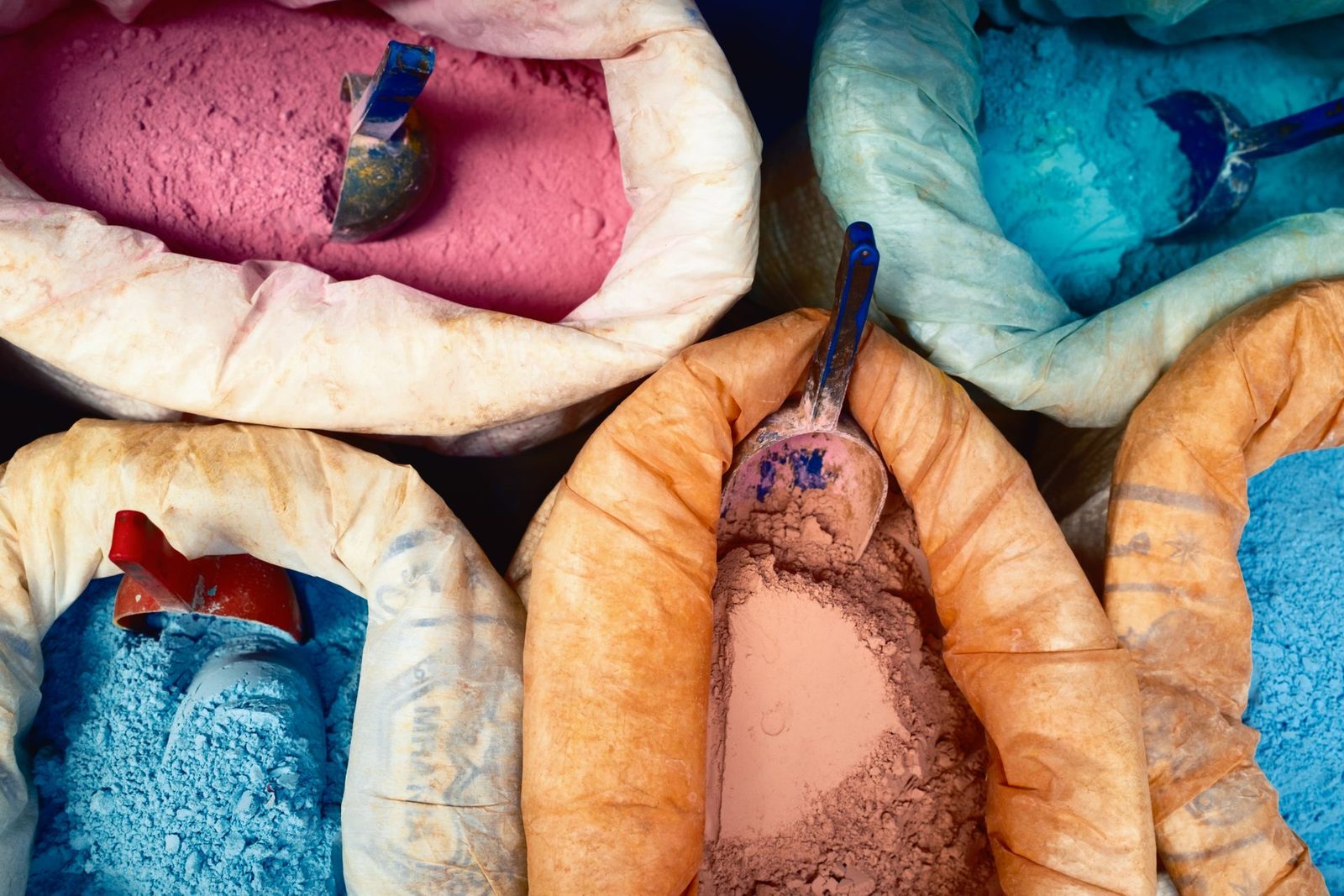
Close-up of pigment powder and packaging bags
Once the grind tank of a waterborne white primer is loaded up, titanium dioxide re-agglomeration appears with it: the bead mill current runs at its rated value, the scraper fineness gauge reading bounces back again and again, and the settled layer thickens after standing on the filling line.
Chemi Tech offers the KMK-201 series dispersant for waterborne inorganic pigment and titanium dioxide systems, with the dosage adjusted flexibly according to the pigment ratio and the grinding intensity, and the system's solids content and grinding time as corrections. This grade is a waterborne dispersant whose anchoring groups bind firmly to the titanium dioxide surface and do not desorb under high-shear grinding. Setting the measured bead mill current alongside the slurry fineness gives the suitable KMK-201 dosage.
Advantages of Chemi Tech Dispersants
Chemi Tech KMK-201 series dispersant is formulated for inorganic pigment and titanium dioxide systems. Its anchoring is firm, so the pigment does not re-agglomerate under high-shear conditions and the fineness drop stays stable; its viscosity-reducing effect is significant, so once the slurry's flow improves the bead mill current falls back and grinding hours shorten with it; its anti-settling and anti-floating performance is stable, with no skinning and no water separation at the tank surface through the storage period; its compatibility with emulsions and film-forming aids is good, with no thickening and no caking at the paint-tuning stage; and the dosage is economical, adjusted flexibly to the pigment ratio, suiting both primer and topcoat slurries.
Industry Pain Points and Solutions
Dispersion problems in waterborne titanium dioxide slurry stem mostly from the combined action of the titanium dioxide's high surface energy and insufficient grinding shear, and they end up showing in two places: fineness rebound and storage settling.
The current stays high and the fineness bounces back again and again, with grinding efficiency slowed by the re-agglomerated pigment. KMK-201's dosage is set by the grinding intensity, and it can drive the fineness down to the target value in one pass.
Floating and colour mottling appear after paint tuning, and batch-to-batch hiding power swings with it. KMK-201 anchors stably, and can effectively eliminate the separation of titanium dioxide from other pigments.
The settling rate in the warehouse stage is directly constrained by how firm the anchoring is. Factoring in the shifts in the pigment ratio and the grinding intensity, the dosage range can be locked in, keeping the tank bottom free of hard sediment through the storage period.
Typical Operating Conditions and Verification
Customer case: a waterborne industrial paint manufacturer in Anhui, for the grinding stage of white primer and midcoat.
The bead mill current repeatedly touched its rated ceiling, the fineness pass rate rose and fell unevenly, hard lumps formed at the tank bottom after the paint drum stood for two weeks, and reworked grinding batches kept occupying the line. Following comparison testing of the bead mill current and the slurry fineness, the plant selected KMK-201 as the primer dispersant, with the dosage set by the system's solids content. Once in use, the current fell back to the middle of the rated band; the fineness dropped into place in one pass; no hard sediment appeared at the tank bottom after half a month of storage, and reworked batches were cleared with it.
Frequently Asked Questions
After the titanium dioxide grade is changed, does the dispersion system need to be re-set?
Whether it can be carried over first comes down to laying the new grade's surface treatment alongside the original anchoring strength for comparison. KMK-201 has completed grinding and storage comparison testing across several titanium dioxide ratios, and its fineness behaviour stays stable within the recommended range. The actual dosage takes the pigment ratio as its baseline, with the system's solids content, grinding intensity and grinding time corrected one by one; Chemi Tech sets the precise dosage through a parallel comparison of the bead mill current and the slurry fineness.