
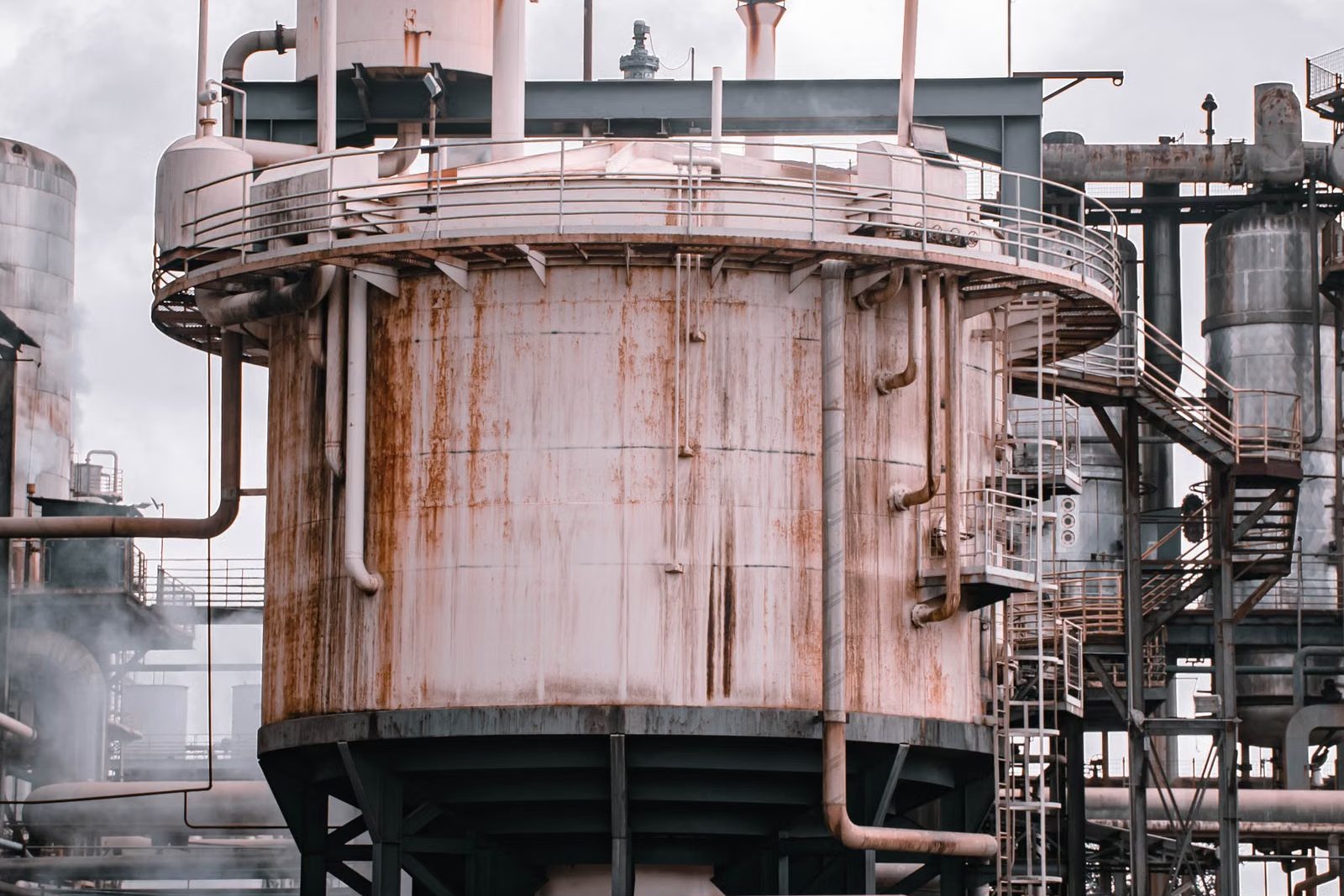
A white rusted industrial tank discharging white smoke to its side
In the reinjection treatment of oil and gas field produced water, free gas is released as pressure drops, the filter differential pressure keeps rising in step, the cavitation margin of the water-injection pump is compressed, the injectivity index of the injection well declines month by month, and pressure-differential alarms and pump-shutdown maintenance at the water-treatment station increase in step.
Chemi Tech supplies the KM-4110 series of defoamers for the foam conditions in the reinjection treatment of oil and gas field produced water; the dosage is adjusted flexibly by salinity, free-gas volume and treatment temperature. This grade resists salt and heat; it neither salts out nor separates in high-salinity produced water and causes no interference with flocculation and filtration. The measured data on filter differential pressure and water-injection-pump inlet-pressure readings are recorded side by side at the same treatment station, and the fitted dosage of the KM-4110 series is made clear accordingly; the dosage is given only after salinity and treatment temperature are listed and checked separately.
Advantages of Chemi Tech Defoamers
The Chemi Tech KM-4110 series defoamer is configured for the reinjection treatment of oil and gas field produced water. It resists salt, and its foam-suppressing ability does not decay as salinity rises; it resists high temperature, keeping its foam-breaking speed even above seventy degrees Celsius; it breaks foam fast, clearing the fine bubbles released by free gas within the settling section; its foam-suppressing duration is long-lasting, so no shift-by-shift top-up is needed in the buffer tank; its compatibility is excellent, coexisting in the same tank with common flocculants and scale inhibitors without disturbing the water-clarification reading; and the dosage is economical, rated by salinity and free-gas volume, so the chemical cost per cubic metre of water can be accounted directly.
Industry Pain Points and Solutions
The root of foaming in produced-water reinjection treatment lies mostly in the combined effect of free gas brought in by pressure release and high-salinity salts, while a too-short settling time carries microbubbles into the filter, finally concentrating in two places: the filter differential pressure and the injection pressure.
When salinity rises, the microbubbles in the produced water are stabilised by the salts and the filter differential pressure shows first. KM-4110 resists salt; once the two readings of salinity and temperature are cleared, its dosage is re-rated by the water quality of that station, and the rising trend of the differential pressure converges accordingly.
After the treatment temperature is switched, the same dosage gives markedly different foam-breaking speeds at the low- and high-temperature grades. KM-4110 resists high temperature; with fifty and eighty degrees Celsius compared side by side, the gap in foam half-life from thirty-five seconds out to fifty-two seconds narrows to within six seconds, and the dosage is rated to the fitted grade of that station.
As the residence time in the settling tank lengthens, microbubble regeneration consumes the foam-suppressing margin step by step and the water-injection-pump inlet pressure fluctuates accordingly. The KM-4110 series adds no extra degassing frequency on this item; once salinity, temperature and free-gas volume are all checked through, the precise dosage of that station is made clear and the water-treatment shift doses at that grade.
Typical Operating Conditions and Verification
Customer case: the produced-water treatment station of an oil and gas extraction enterprise in Shaanxi, applied to the defoaming stage before reinjection.
At this station the differential-pressure readings of the two filtration stages differed markedly, the pressure rose faster in the fine-media stage than in the coarse stage, and the water-injection-pump inlet pressure fluctuated more on the night shift. KM-4110 was selected for the plant as the defoaming grade for that station, with the dosage rated by salinity and free-gas volume. Reading changes after commissioning: the differential pressures of the two filtration stages converged; the between-shift fluctuation of the water-injection-pump inlet pressure narrowed to within one grade; the foam half-life fell from thirty-five seconds to twelve seconds; and the degassing frequency fell from twice per shift to once per day.
Frequently Asked Questions
If the KM-4110 series is dosed over the long term in high-salinity produced water, will it affect flocculation and filtration?
The key lies in whether salinity, free-gas volume and settling time fall within the assessed range of that station. The KM-4110 series resists salt and heat, coexists in the same tank with common flocculants and scale inhibitors without disturbing the water-clarification reading; the measured data on filter differential pressure and injection pressure are given side by side by Chemi Tech at two temperature grades, and dosing at the rated magnitude does not affect the suspended-solids removal reading. The actual dosage is further corrected by free-gas volume; Chemi Tech derives the fitted dosage from the comparison results of the two water-quality grades.