
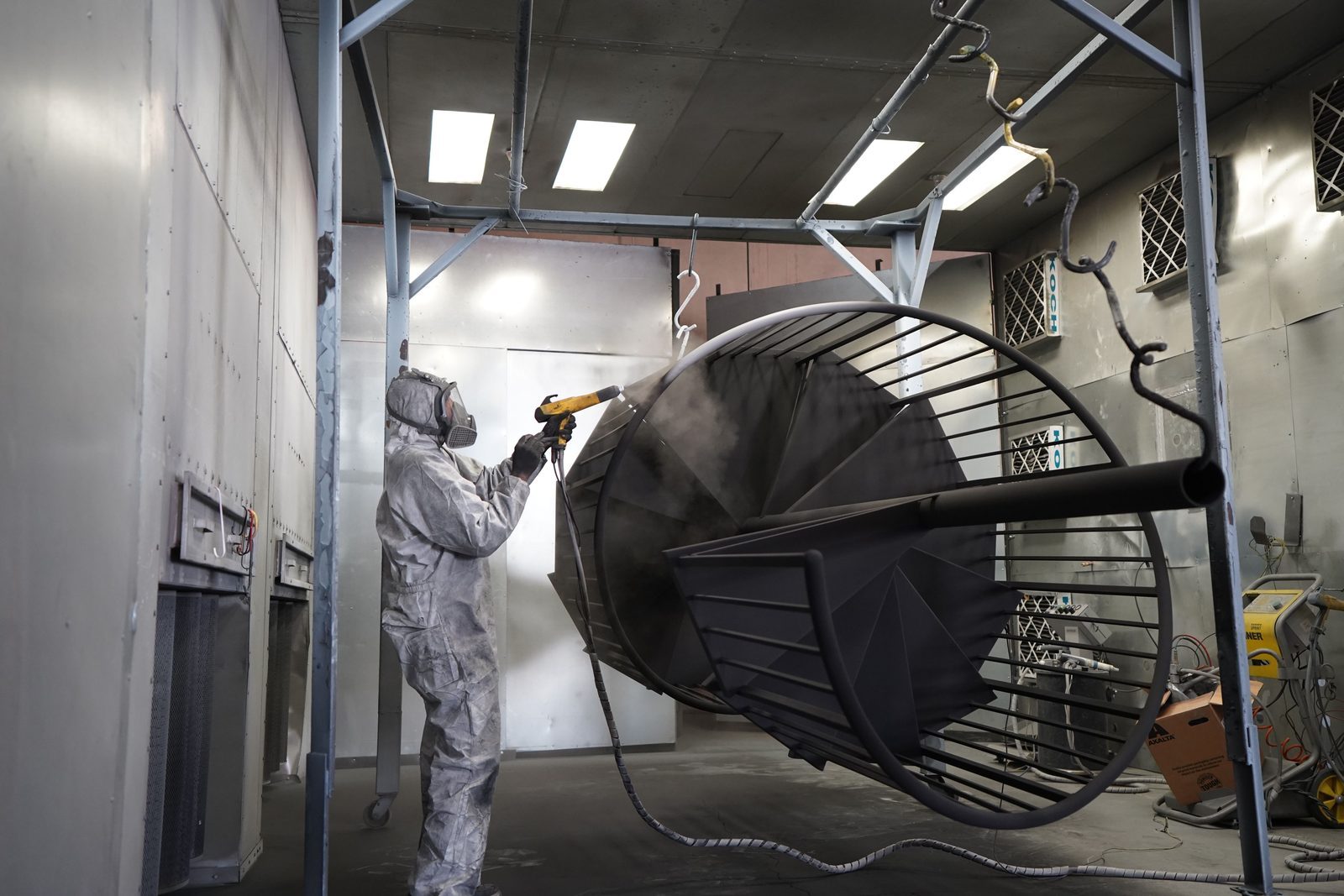
Workpieces on a jig being sprayed in a spray booth, the operator in full protective coveralls
Water-based industrial paint goes on and dries, the edge of the panel comes back as a bare ring, orange peel stacks layer on layer, and after recoating the intercoat adhesion fails as well, so a batch of panels is landed back on the spray station.
Chemi Tech makes leveling agents for water-based industrial paints, wood and furniture coatings and automotive paint systems, from the leveling agent KMP-2201 series. Which grade to add depends on the resin system, the drying method and whether the film will be recoated. Where the water-based system calls for both surface control and recoating performance, KMP-2201 is built in that direction; for solvent-borne systems or applications more sensitive to intercoat adhesion, KMT-458, an acrylic counterpart, fits better, staying clear in clearcoats and throwing no haze on pigmented coats. Give the resin type and the drying method to our technical department and we will set the dosage and the addition point for you and recommend the process parameters.
Advantages of Chemi Tech Leveling Agents
The Chemi Tech KMP-2201 series grades bring surface tension down markedly, holding the dynamic surface tension of a water-based system as well, so the panel opens out once the coat is sprayed. They are also compatible: added in, they cause no cratering and do not hurt intercoat adhesion, giving recoating a sound footing. The recoating window is left open as well, so there is no long wait between the two passes and the workshop keeps its turnaround rhythm. The effect on gloss is small, too, so a clearcoat system stays clear after dosing and pigmented coats show no haze. On top of that, heat stability holds through, with no breakdown and no yellowing in the baking stage.
A note from Chemi Tech: the behaviour above comes from a typical water-based industrial paint spray condition. Change the resin system or the drying method and the results move. Confirm on a small trial before scaling up.
Industry Pain Points and Solutions
The hardest part with leveling agents is that a defect on the panel is not necessarily down to them.
Watching the leveling agent alone and never the surface tension is what gets stepped on first. The moment edge pull-back and cratering appear, more leveling agent goes in, and by the end the adhesion has dropped off and there are more problems rather than fewer. Chemi Tech measures the static and the dynamic surface tension of the system together, to see first which stage the gap sits in.
The drying curve not keeping up comes next. Surface dry too fast and the coating sets before it has time to level, so orange peel will not press out. Chemi Tech's approach is to check the leveling time and the drying conditions together rather than looking only at how much additive went in.
There is one more point that is easily missed, and it only shows at recoating. The first pass passes, the second will not go on, and intercoat adhesion pulls straight off. Chemi Tech's approach is to put recoating performance into the verification items and to trial the interval between the two passes along with it.
The heat storage and recoating data comes from us. Surface tension, the leveling window and intercoat adhesion are worked through item by item, and changing two spray parameters on the line is all it takes to run with.
Typical Conditions and Verification
Customer: a water-based industrial coating producer in Guangdong, for the coating stage on furniture and hardware parts.
The plant's water-based industrial paint had been showing too much edge pull-back and orange peel, sprayed panels needed the edge touching up by hand, workers were touching up several dozen panels a day, and after recoating the intercoat adhesion occasionally failed. The solution Chemi Tech leveling agents provided was this: working from the resin system and the drying method, KMP-2201 was selected from the KMP-2201 series, and the dosage and addition point were re-banded to the spray rhythm. After the change the edge pull-back was essentially gone, the orange peel rating on the panel moved up a grade, and intercoat adhesion across the two passes passed consistently. The station that had been dedicated to edge touch-up became a sampling bench.
FAQ
Will a leveling agent spoil intercoat adhesion?
It can, especially the grades that pull surface tension down very low: wetting the undercoat is no problem, but at recoating the two layers cannot hold together. The KMP-2201 we supply to coating plants has been compared against recoating performance, and at normal dosage the adhesion does not drop. Give the resin type, the drying method and the recoating interval to our technical engineers, and the surface tension and intercoat adhesion data will come back together.