
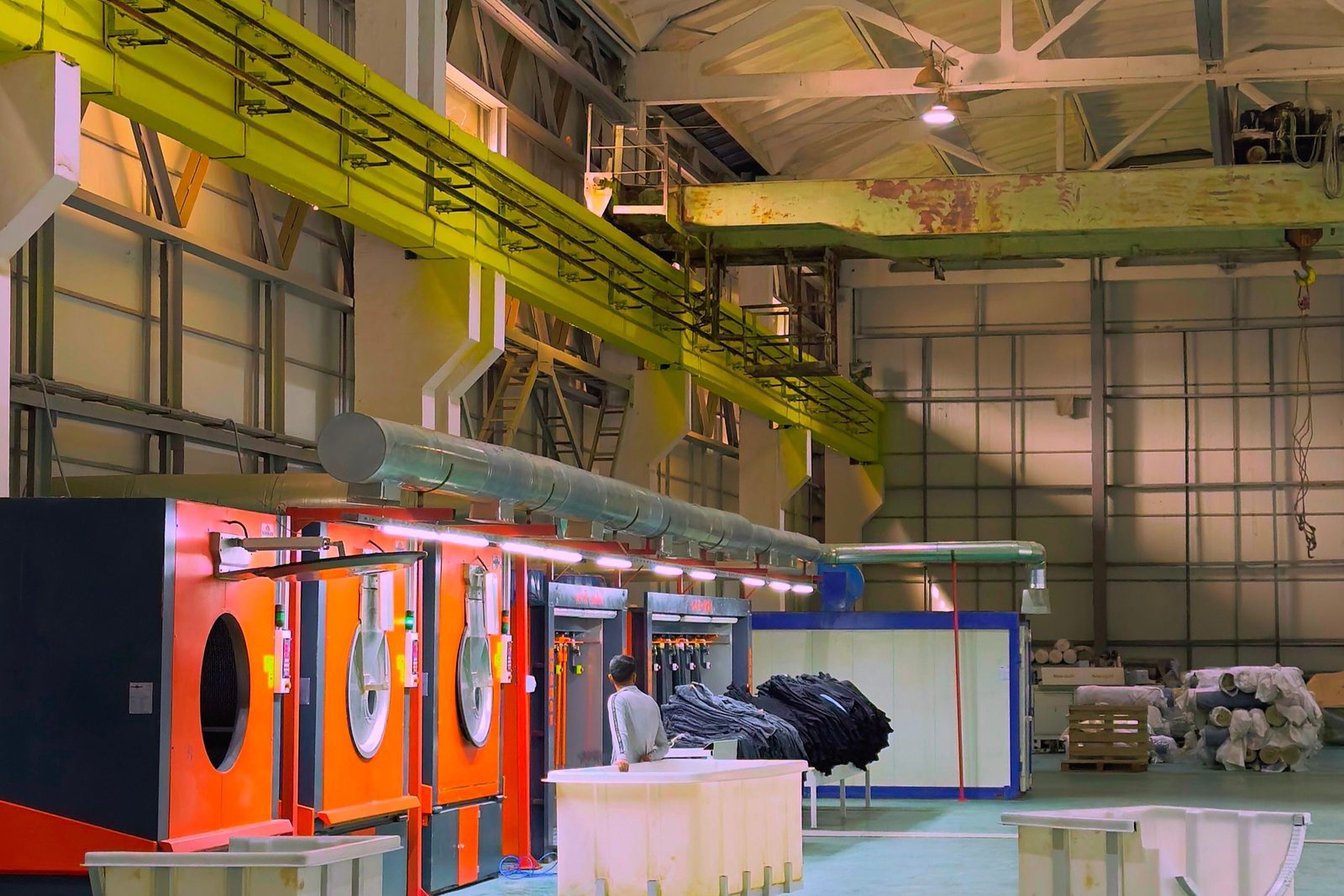
Dyeing machines and a travelling crane inside a dyeing and finishing workshop, the workshop bright and orderly
Warm the caustic in the scouring bath and the liquor climbs up the bath wall, the transfer pump draws liquid carrying foam, the upper fabric roll starts to float, and the evenness of that whole desize-scour-bleach batch is lost first.
Chemi Tech makes defoamers for textile scouring, desizing and soaping stages, from the defoamer KM-4110 series. Which grade to add depends on the alkali concentration, the process temperature and the water hardness in the workshop. Where the temperature is high and lasting foam suppression is also required, KM-4110, a modified polyether, is designed in that direction; on a line where temperature is not the main issue and the aim is simply to hold down mechanical foam, KM-3650, a compound alcohol type, is the more economical choice. Report the alkali concentration and the process temperature and we will run a round of foaming comparisons first, recommending the approach for you.
Advantages of Chemi Tech Defoamers
The Chemi Tech KM-4110 series grades cause no emulsion breakdown and no separation in hot caustic: the liquor is still uniform after standing a full day. Foam suppression lasts as well, so one charge covers the whole scouring cycle with no repeated top-ups in between. Nor is there any drag on fabric hand, so the scoured cloth does not stiffen and the softening stage downstream needs no parameter changes. They are compatible with the usual scouring agents and penetrating agents, with no interference in the same bath. Dosage is low as well, so the chemical oxygen demand of the effluent is not lifted by the chemical itself.
A note from Chemi Tech: the behaviour above comes from a typical high-temperature cotton scouring condition. Change the alkali concentration or the process temperature and the results move. Confirm on a small trial before switching lines.
Industry Pain Points and Solutions
Foaming in caustic and surfactant are natural partners, and pressing the foam down too hard takes the scouring effect down with it.
The first thing to appear when the formulation is touched is under-scouring. Some grades hold the foam down and press penetration and emulsification down along with it, and the core of the fabric roll is still dry. Chemi Tech puts capillary effect and whiteness into the same set of trials, rather than looking at foam height as a single item.
What is exposed next is stability at high temperature. Everything passes at ambient temperature, and the moment the process temperature is reached it separates, with a film of oil floating on the bath. Chemi Tech's approach is to write the process temperature ceiling into the verification conditions and to run the comparison at the actual temperature.
There is one more point that is easily missed: the soaping stage not being changed along with it. The scouring stage is switched to an alkali-resistant grade while the soaping stage still runs the old one, and the wash liquor downstream foams again. Chemi Tech's approach is to check the chemical compatibility of the desizing, scouring and soaping stages together.
We take the whole chain over: foaming comparison, high-temperature stability and compatibility with the scouring agent are all done in one round by us, and changing one figure on the process sheet is all it takes to go on the machine.
Typical Conditions and Verification
Customer: a knitted fabric dyeing and finishing plant in Shandong, for the high-temperature scouring and soaping stages of cotton knit fabric.
The plant's scouring bath runs a relatively high alkali concentration, the transfer pump repeatedly drew in foam after the temperature came up, the upper fabric roll floated, and the capillary effect of the desize-scour-bleach batch varied noticeably from batch to batch. The solution Chemi Tech defoamers provided was this: working from the alkali concentration and the process temperature, KM-4110 was selected from the KM-4110 series, the dosing points were set at both the scouring bath and the soaping bath, and the dosage was converted from the batch size. After the change the transfer pump no longer ran dry, the fabric roll stopped floating, and the batch-to-batch variation in capillary effect narrowed. The small stool the machine operator used to keep by the bath was moved away.
FAQ
Can a defoamer for a high-temperature scouring bath still be used in a low-alkali stage?
In most cases it is not worth it: a high-temperature alkali-resistant grade acts slowly in a low-temperature, low-alkali environment, the dosage goes up, and the cost looks poor, since the two stages simply want different things. The KM-4110 we supply to dyeing and finishing plants is set for the high-temperature strong-alkali direction, and there is a more economical route for the low-temperature stage. Give the alkali concentration, the process temperature and the downstream stages to our technical department, and we will lay out the dosing for the two stages separately according to your process sequence.