
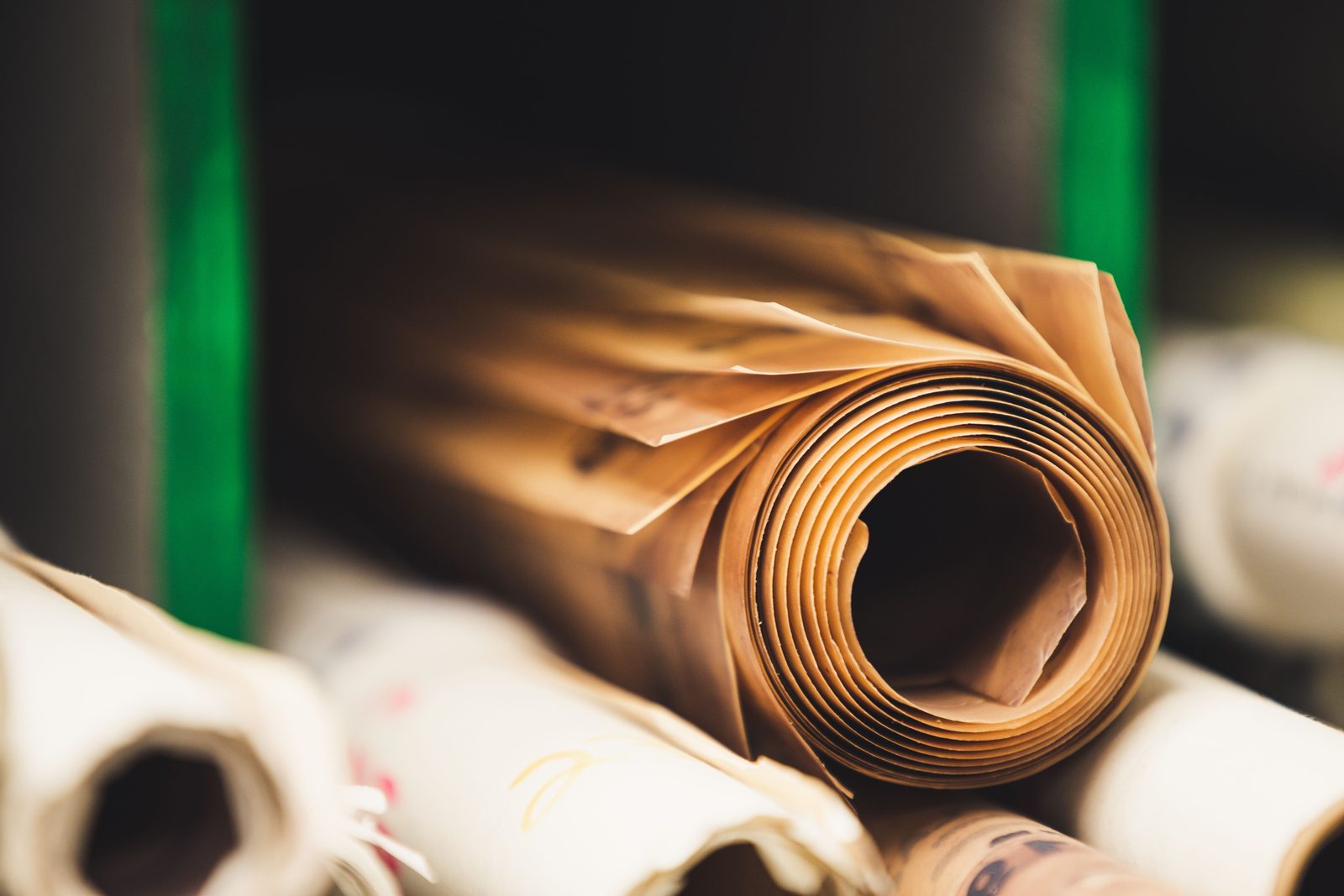
Paper rolls stacked in neat rows, the surfaces smooth
Once the white water from the paper machine house is pumped back into the circulation tank, the foam spills over the weir and keeps building on the tank surface. The air trapped in the stock has nowhere to go, and every pocket of it is a latent problem: by the time the furnish reaches the paper machine, the wet end foams first, the press section breaks sheet next, and a full shift of output is folded into the loss.
Chemi Tech makes defoamers for pulping, papermaking and coating systems, drawn from the defoamer KM-1003 series. How a grade is matched depends on the white water circulation volume, the pH of the stock, and the machine speed. KM-1003 is a silicone-free polymer system: it resists acid and alkali and tolerates high temperature, so a white water system running hotter or more alkaline holds up, and it can be diluted and compounded, which keeps the addition cost down. Send over the white water quality and the machine speed, and we will settle it against the operating condition and recommend a defoamer that fits.
Advantages of Chemi Tech Defoamers
Chemi Tech defoamer KM-1003 series breaks foam quickly: the bubbles are dispersed before the white water enters the circulation tank, and the air content in the stock comes down. The foam suppression also lasts a long time, so it does not rise back a while after knocking down, and the wet end liquid level on the paper machine holds steady. It also withstands high temperature and acid and alkali: the white water arriving from the cooking stage is not cool, and the active content does not fall away. On top of that, compatibility is good, so it does not fight the sizing agent or the retention and drainage aids, and the quality of the finished sheet is not dragged in. And there is a low addition level — it runs at a small proportion of the white water circulation volume, so the additive cost per tonne of paper stays limited.
A note from Chemi Tech: the behaviour above comes from a typical papermaking white water circulation condition. Change the stock system or the machine speed and the results move. Run a small trial before scaling up.
Industry Pain Points and Solutions
Sheet breaks on the paper machine are always booked against operating practice, and that is what the operators worry about too, but the root is usually in the air hidden inside the stock.
The first thing to go wrong is air carried in the white water. The foam seals air inside the stock; once it is on the machine the wet end blisters and the sheet is holed before it has formed. Chemi Tech's approach is to place the dosing point at the inlet of the white water tower, so the chemical spreads before the bubbles gather into sheets.
What follows is that raising the machine speed makes it more obvious. The faster the machine runs, the stronger the shear in the white water, and the bubbles come out finer and harder to knock down. Chemi Tech's approach is to tie the addition level to the machine speed and dose in steps, rather than running one number from low speed through to high.
One more point is that the circulating water gets thicker the longer it is used. With more white water reuse, impurities and dissolved solids concentrate and the foam becomes more stubborn. Chemi Tech's approach is to look at the defoaming and the suppression stages together: the defoamer knocks down the foam present first, and the suppression component then holds down what follows.
Typical Conditions and Verification
Customer: a woodfree paper producer in Indonesia, applying it to the white water circulation system in the paper machine house.
Once this mill raised the machine speed, wet end sheet breaks rose noticeably, the white water tank had to be watched and cleaned for overflow, and every shift stopped the machine several times. The solution offered by Chemi Tech defoamer was: against the white water quality and the machine speed, a suitable grade was selected from the KM-1003 series, the dosing point was moved to the white water tower inlet, and the addition level was set in three steps against machine speed. After the change the number of sheet breaks came down, the white water tank stopped overflowing, and the formation of the finished sheet steadied. The operators on the shift say that they used to clean foam several times a shift and now they only watch the speed gauge.
Frequently Asked Questions
Will the defoamer added to the white water affect the sizing of the sheet?
There are cases where it does: some chemistry holds the foam down and the sizing agent's action is discounted with it. The defoamers Chemi Tech supplies to paper mills have been compared against the sizing system, and at normal addition levels the sizing result is not affected. Which grade is the better fit comes down to the operating condition — give the white water quality and the machine speed to Chemi Tech and we will settle it for you.