
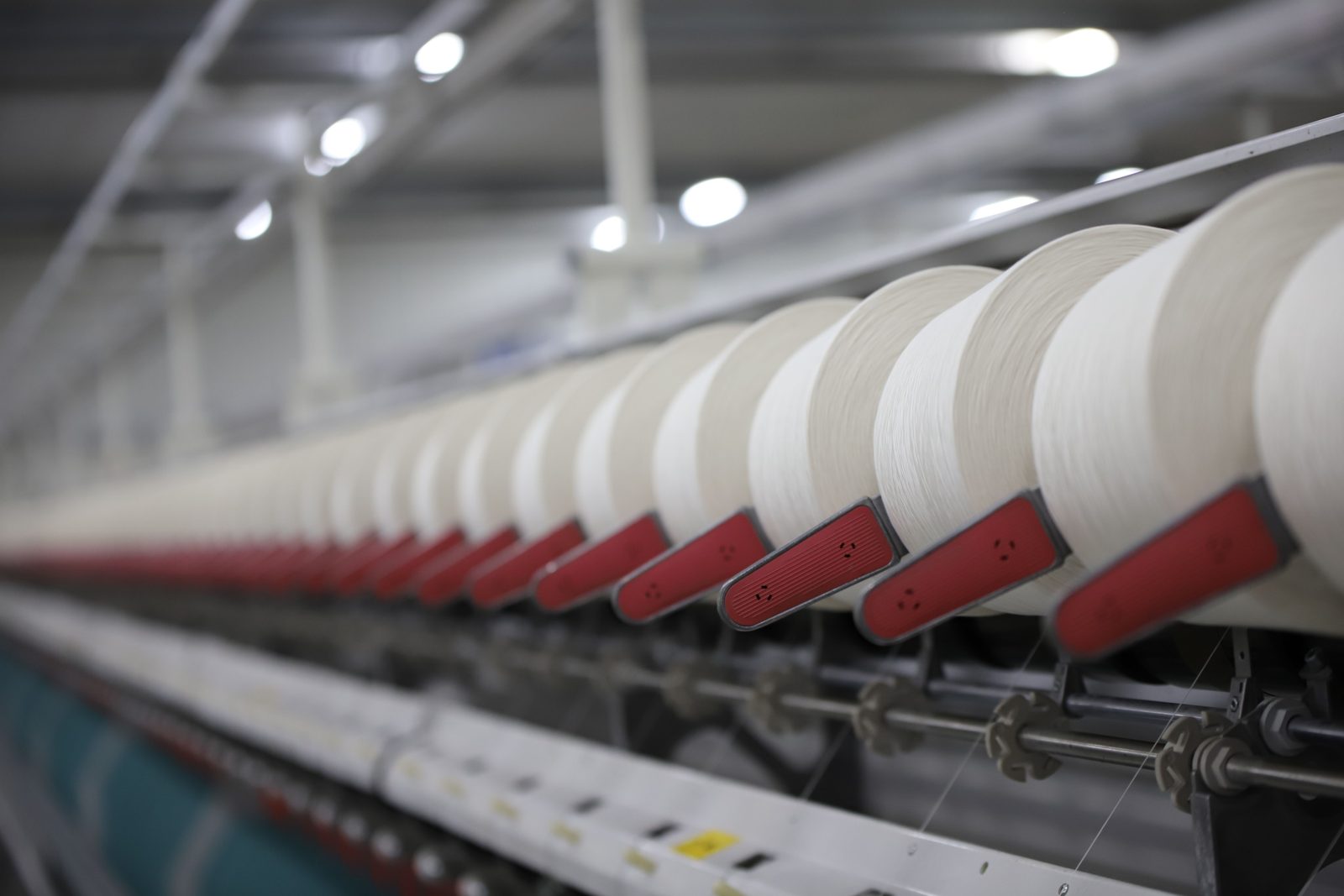
Rows of spindles on a textile workshop floor
Finish a nonwoven for water repellency and the surface looks dry, yet water still creeps in: the repellent layer has not formed a film, so the work was wasted. Once the downstream laminating and adhesive steps run, water passes through and takes the strength down with it, and the whole batch can only be downgraded.
Chemi Tech makes water repellent finishing agents for nonwovens, footwear materials and industrial textiles, drawn from the water repellent agent KMF-801 series. How a grade is matched depends on the fibre composition, the fabric construction and whether the test protocol the customer asks for is spray rating or hydrostatic head. KMF-801 is built in the direction of continuous repellency with handle kept in balance: film formation across the fibre surface is continuous, and it is not easily lost after washing. Where the perfluorinated item also has to be held down, the fluorine-free KMWF-01 series is the better route.
Advantages of Chemi Tech Water Repellent Agents
Chemi Tech water repellent agent KMF-801 series forms a continuous film on the fibre surface rather than relying on a layer floating on top, so it is not easily lost after washing. Its compatibility with the common binders and softeners is good as well, so a one-bath run does not fight and the bath throws no sediment. The handle is soft, too: the finished nonwoven does not go stiff or harsh, and the downstream laminating step does not need its parameters changed. Hydrostatic head keeps pace as well, with the spray rating and the hydrostatic head both falling inside the customer's thresholds. It contains no perfluorinated compounds, so the test protocol is cleared in one pass.
A note from Chemi Tech: the behaviour above comes from a typical nonwoven water repellent finishing condition. Change the fibre composition or the fabric construction and the results move. Confirm on a small sample before scaling up.
Industry Pain Points and Solutions
With water repellency on nonwovens, the hardest part is holding repellency without dragging the downstream processes with it — but if the base is not solved, the later processes are bound to run into trouble.
Testing spray rating without testing hydrostatic head is the most common basic problem. The sample passes on spray rating the day it is made, then goes through as a finished product and leaks as soon as the hydrostatic head is applied. Chemi Tech runs a round of validation on the finishing agent against each test standard, comparing spray rating and hydrostatic head together.
The difficulty that follows is the handle collapsing. Repellency goes on, the nonwoven goes stiff and harsh, and the downstream laminating will not hold. Chemi Tech's approach is to put handle and repellency into one comparison table and verify the boundary at both ends together.
The last problem is the water repellent agent not being compatible with the binder in one bath. It is also incompatible with the adhesive at the next process step, the bath throws sediment, and the fabric carries defect marks. Chemi Tech's approach is to run a one-bath validation of the water repellent agent with each of the common binders, and find the critical problem.
Typical Conditions and Verification
Customer: a nonwoven manufacturer in Fujian, applying it to the water repellent finishing of hygiene and packaging nonwovens.
The nonwovens from this plant took the repellent finish and passed the spray rating, then leaked as soon as the hydrostatic head was applied, and the downstream laminating would not hold either, so two lots were returned by the customer. The solution offered by Chemi Tech water repellent agent was: after comparing the fibre composition and the test protocol, a suitable grade was selected from the KMF-801 series for the customer, and the finishing process was recalibrated together with the curing conditions. After switching to the newer grade from Chemi Tech, the spray rating and the hydrostatic head both passed in one run, the handle held, and the downstream laminating stopped giving trouble.
Frequently Asked Questions
For water repellency on nonwovens, must the water repellent agent be switched to fluorine-free?
Not necessarily — in most cases a fluorinated system passes; what matters is whether the one-bath compatibility with the binder can hold up. The KMF-801 Chemi Tech supplies to nonwoven plants has been compared along the fluorinated route against the test protocol; if it is an export order that has to clear fluorine-free testing, then KMWF-01 is the better fit. Which grade to use is decided by Chemi Tech on the basis of testing your incoming sample, after which a customised formulation is given.