
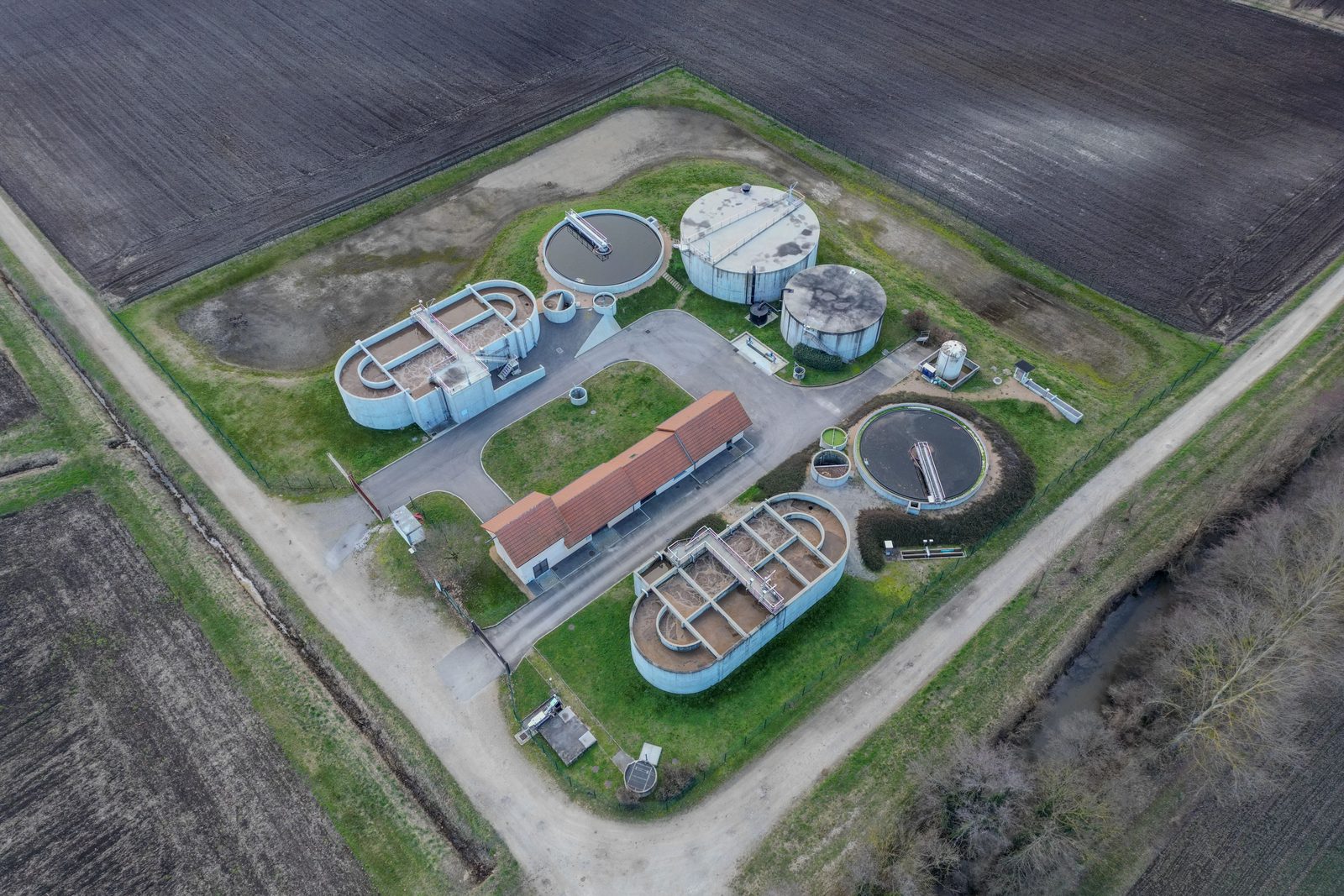
Aerial view of a biological aeration tank at a wastewater treatment plant
Once the foam in the aeration tank thickens, the oxygen the blowers push in cannot disperse, the sludge volume index climbs with it, the secondary clarifier starts carrying sludge, the suspended solids in the effluent go out of limit, and the person who ends up being chased for the data is whoever minds that wastewater station.
Chemi Tech makes defoamers for biological systems such as dyehouse wastewater and food processing wastewater, drawn from the defoamer KM-1200 series. How a grade is matched depends on the inflow volume, the aeration method and the sludge concentration in the biological tank. KM-1202 is a silicone-free system, non-toxic and harmless to activated sludge, resistant to acid and alkali, with long suppression, so it holds up in a setting that foams continuously like the aeration stage. Chemi Tech customises against the inflow volume and the aeration method and recommends a defoamer that fits.
Advantages of Chemi Tech Defoamers
Chemi Tech defoamer KM-1200 series breaks foam quickly: the foam is dispersed as soon as it piles up on the tank surface, and oxygen transfer is not blocked. It does no harm to the activated sludge, so the activity of the zoogloea does not fall because the chemical is present, the effluent parameters hold, and there is no need to watch the online data every day. It resists acid and alkali as well, so alkaline dyehouse wastewater and acidic food wastewater both keep their effect. That saves standing by the tank topping up again and again: suppression lasts long, and the make-up count across a shift can be counted on one hand. And it is environmentally degradable, so sludge haulage and downstream treatment carry no extra burden.
A note from Chemi Tech: the behaviour above comes from a typical dyehouse wastewater biological treatment condition. Change the influent quality or the aeration method and the results move. Run a small trial before scaling up.
Industry Pain Points and Solutions
When the aeration tank foams, the first thing to go wrong is foam accumulating: the air the blower pushes is blocked at the liquid surface, dissolved oxygen in the tank drops, the biomass cannot get at oxygen, and treatment efficiency slides with it. Chemi Tech's approach is to place the dosing point in the return section of the aeration tank, so the chemical disperses before the foam gathers into sheets.
The problem that follows is foam being carried off by the wind. It drifts onto walkways and nearby equipment, the floor turns slippery, and that is a very high safety hazard. Chemi Tech looks at the defoaming and the suppression stages together: the defoaming stage knocks down the foam present first, and the suppression stage then holds down what follows.
One more problem is that when a dyehouse changes product or a food plant rushes an order, the influent concentration rises, the foam turns more stubborn, and one dose does not hold for long. Chemi Tech's approach is to test in steps against the influent quality rather than running one number from low load through to high, which makes the test result more precise.
Typical Conditions and Verification
Customer: a dyehouse in Zhejiang, applying it to the biological aeration tank and secondary clarifier at the plant wastewater station.
In the season when this plant was rushing orders on a product changeover, the influent concentration rose, the foam in the aeration tank piled up to the weir and spilled over, the suspended solids in the secondary clarifier effluent went out of limit, and the environmental online data alarmed. The solution offered by Chemi Tech defoamer was: against the inflow volume and the aeration method, a suitable grade was selected from the KM-1200 series, the dosing level was stepped against foam layer height, and the dosing point was set in the return section of the aeration tank. After the change the foam layer came down, dissolved oxygen returned to the normal range, and the secondary clarifier effluent parameters came back to normal.
Frequently Asked Questions
Will the defoamer added to the aeration tank harm the activated sludge?
There are cases where it does: some chemistry holds the foam down and the zoogloea activity is inhibited with it. The defoamers Chemi Tech supplies to wastewater stations have been compared for toxicity against the biological system, and at normal addition levels sludge activity is not affected. Chemi Tech will recommend the product that fits on the basis of the inflow volume and the aeration method.