
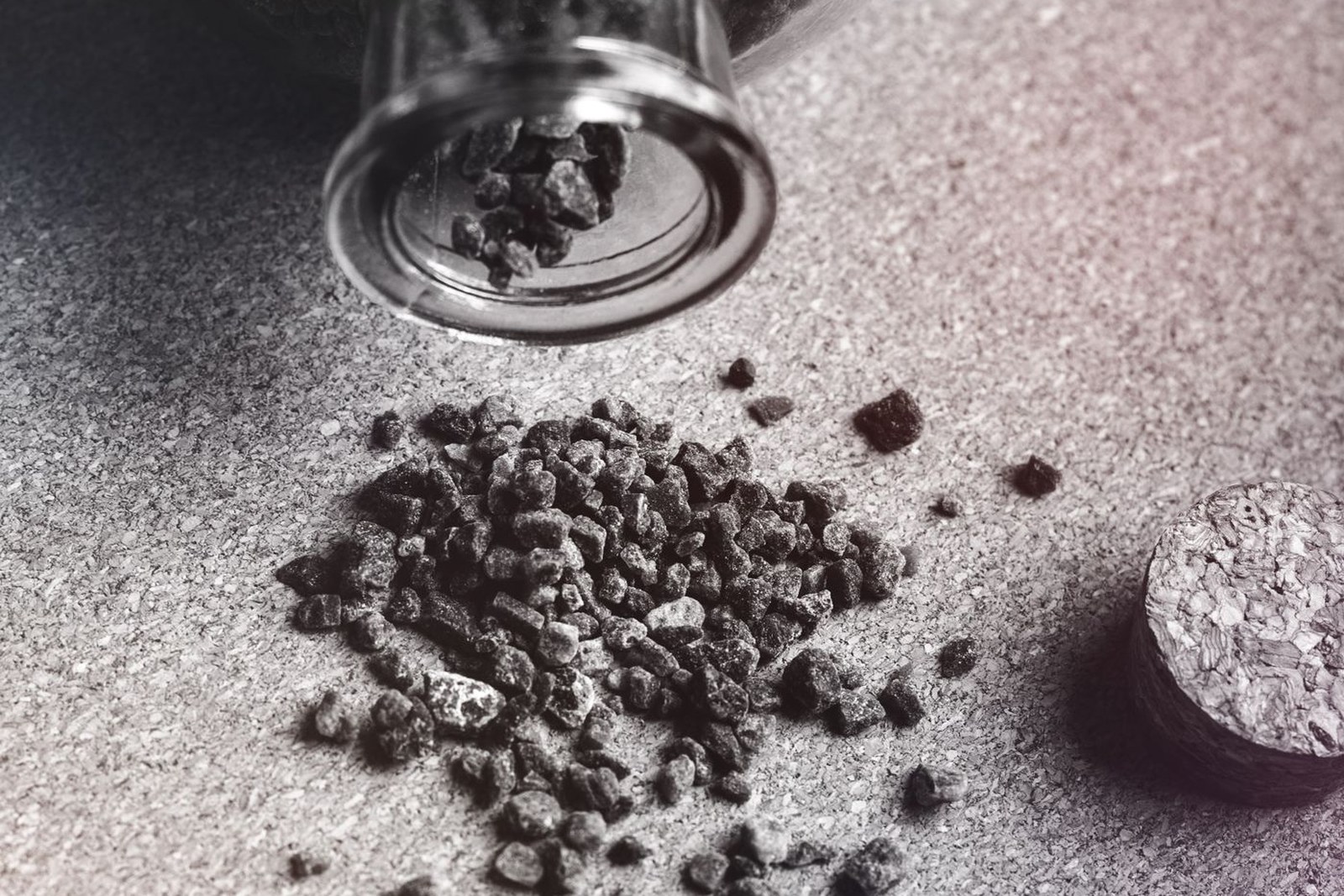
Black granules spilled around the mouth of a glass bottle
Carbon black has a large specific surface area in high-jetness colour paste and is hard to wet out; if the dispersant anchors too weakly, the pigment re-agglomerates after high shear, the paste viscosity climbs with it, the resistance in bead milling and let-down grows, and both jetness and tinting strength suffer.
Chemi Tech supplies dispersants for coating tinting and ink colouring systems, drawn from the dispersant KMK-210 series; the dosage varies with the pigment grade, the surface treatment and the target pigment content. KMK-216 is notably effective on carbon black, gripping the carbon black surface through its anchoring groups and not desorbing under high-shear milling, lowering viscosity and lifting tinting strength; KMK-212 in the same series suits the milling and let-down of carbon black paste. Chemi Tech verifies dispersion performance around the pigment grade and the target pigment content, and selects the fitted dispersant for the customer.
Advantages of Chemi Tech Dispersants
Chemi Tech dispersant KMK-210 series grips the carbon black surface through its anchoring groups and does not desorb under high-shear milling, so the paste stays stably dispersed; on top of that, it lowers viscosity and raises pigment loading, and the bead mill current holds steady; moreover, it adapts broadly to carbon black and organic pigments, and the paste neither re-agglomerates nor floods on storage; in addition, tinting strength and jetness hold steady, and the colour development comes out consistent.
Industry Pain Points and Solutions
Re-agglomeration in carbon black paste mostly does not come from too short a milling time, but from the dispersant's anchoring failing at high pigment content; the consequence is a viscosity that climbs and a jetness that is capped.
The point most to be feared is the ceiling on jetness. Carbon black has a large specific surface area and is hard to wet out; when dispersion falls short the jetness will not rise, and tinting strength is capped with it. Chemi Tech's answer is to add the KMK-216, which is notably effective on carbon black, at the feed end of the milling stage, so that the carbon black is anchored as soon as it is wet out.
The hardest part is re-agglomeration after milling. When the dispersant anchors too weakly, the carbon black comes back together after high shear and the paste re-agglomerates. KMK-212 from Chemi Tech anchors stably, and the carbon black paste does not re-agglomerate after milling.
Another lies in flooding on storage. After the paste stands for a time it floods and mottles, and jetness and colour stability drop. Chemi Tech verifies anchoring performance by pigment grade, and calibrates the dosage of the KMK-210 series together with the milling time, so the paste stays stable on storage.
Typical Operating Conditions and Verification
Customer: an ink manufacturer in Zhejiang, for the milling and let-down of carbon black paste.
At this plant, once the pigment content of the carbon black paste was raised the viscosity climbed, the paste re-agglomerated and flooded, and the jetness was capped over the long run. The solution Chemi Tech dispersant gave for the situation was: taking the pigment grade and the target pigment content into account, choose the KMK-210 series, set the point of addition at the feed end of the milling stage, and grade the dosage by pigment content. Once it was in use, the paste viscosity came back into a controllable range, with no re-agglomeration and no flooding, and jetness and tinting strength held steady.
Frequently Asked Questions
When a dispersant is added to carbon black paste, will residual components be left behind and affect jetness and tinting strength?
That concern has some basis, as a few types leave residual components in the paste while dispersing the carbon black. KMK-216 has been through dispersion and colouring comparisons at Chemi Tech across different pigment grades, and only the dosage at which colouring holds steady is recommended. The dosage is set by pigment grade and solids content, and Chemi Tech gives a recommended range after milling and colouring comparisons.