
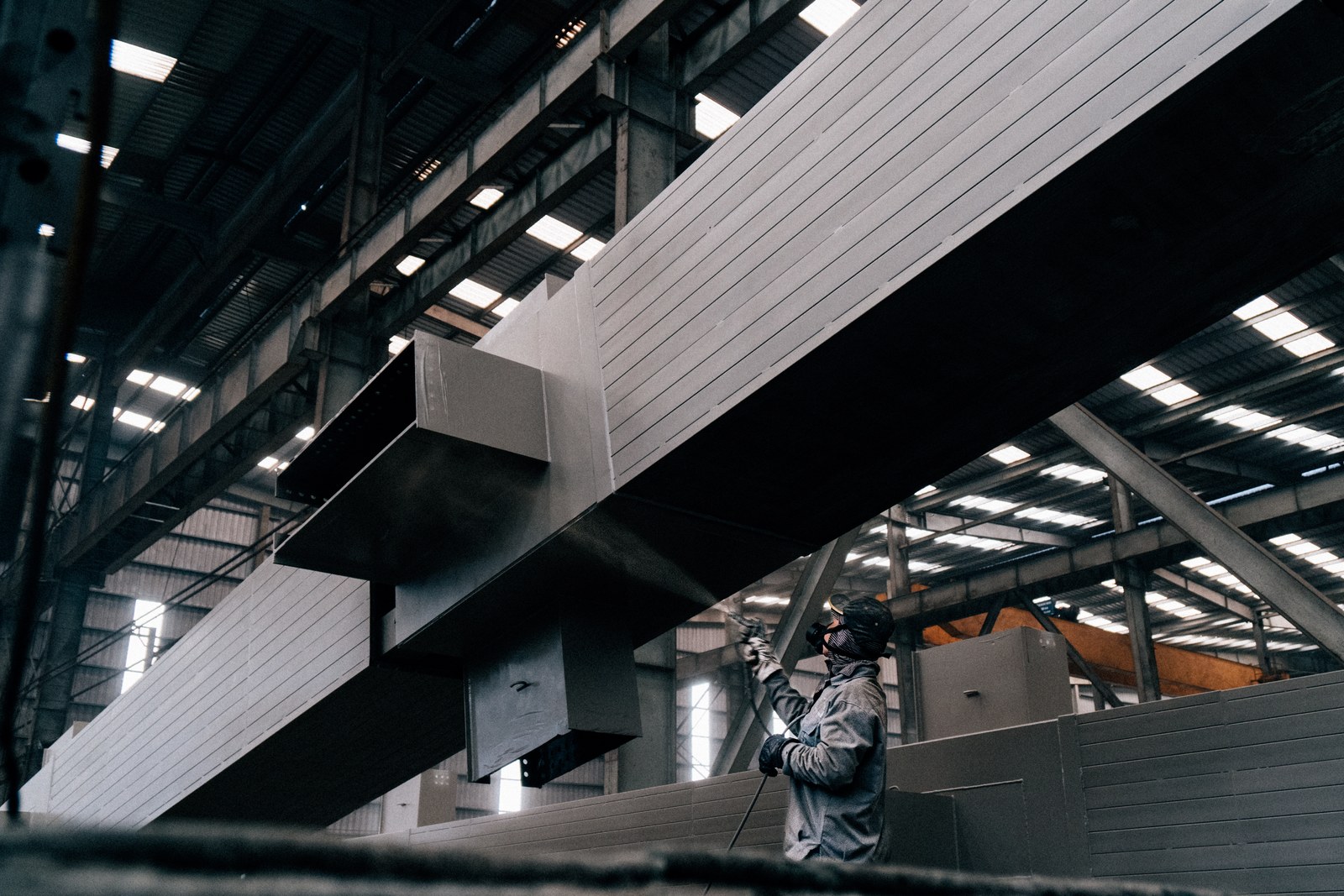
On-site photograph of steel members being spray-coated in a workshop
As soon as an epoxy primer for industrial anticorrosive coatings enters the bead mill, the pigment re-agglomerates under high shear, the grindometer reading keeps rebounding, the tank bottom settles on standing, and the primer's hiding power and anti-corrosion performance decline batch by batch.
Chemi Tech has introduced the KMK-410 series dispersant for epoxy primers, industrial anticorrosive coatings and coil coating systems, with the dosage adjusted flexibly according to slurry solids and grinding intensity. This grade grips the pigment surface through anchoring groups and does not desorb under high-shear grinding, delivering viscosity reduction and colour strength together, and adapting to both water-borne and solvent-borne systems. On the basis of measured data for slurry fineness and storage stability, the adapted KMK-410 dosage can be set.
Advantages of Chemi Tech Dispersants
Chemi Tech KMK-410 series dispersant is configured for epoxy and anticorrosive coating systems. Anchoring is firm, so pigment particles do not re-flocculate under high-shear grinding and the fineness reduction proceeds steadily; the viscosity-reduction effect is significant, with grinding current levelling off once slurry flow improves; dispersion stability is outstanding, so the slurry neither coarsens back nor settles during storage and hiding power holds steady; adaptability to inorganic and organic pigments is broad, so no frequent adjustment is needed after a batch change; and the dosage is economical, adjusted to slurry solids so an epoxy primer reaches specification in a single grind.
Industry Pain Points and Solutions
Dispersion problems in epoxy primers stem mostly from the combined effect of high pigment surface energy and insufficient grinding shear, and the consequences are concentrated in two places: fineness rebound and storage settlement.
Repeated fineness rebound slows the grinding rhythm, and batch-to-batch consistency of the slurry falls with it. With the KMK-410 dosage fixed by grinding intensity, fineness is driven down to the target value in a single pass.
Storage settlement leaves an epoxy primer caked hard at the tank bottom after standing, and hiding power drifts during make-up. KMK-410 anchors stably and effectively eliminates pigment re-flocculation.
Rework at the grinding and make-up stages ultimately turns into occupied equipment and lost material. By tying the dosage range to changes in slurry solids and grinding intensity, the slurry is kept from coarsening back throughout storage.
Typical Operating Conditions and Verification
Customer case: an industrial anticorrosive coatings manufacturer in Shandong, for the bead-milling stage of epoxy primers.
After this coatings manufacturer changed the iron red pigment grade, fineness on its epoxy primer rebounded repeatedly; on storage the tank bottom settled and caked, and hiding power drifted during make-up. The adaptation points followed from there: slurry solids and grinding intensity both sat in the normal range, and the water-borne epoxy system could be matched directly. KMK-410 was used as the dispersant for the epoxy primer, with the dosage fixed by slurry solids. Fineness then came down to target in a single pass; the slurry neither coarsened back nor settled during storage; the primer's hiding power held steady, and downstream complaints fell noticeably.
Frequently Asked Questions
When an epoxy primer changes pigment grade, does the dispersion system have to be re-established?
Both fineness and anti-corrosion performance in an epoxy primer hinge on whether the pigment is properly dispersed. KMK-410 has completed grinding and storage comparison tests across several pigment grades, and within the recommended range fineness performance is stable. The actual dosage takes slurry solids as its baseline, corrected one by one for grinding intensity and grinding time; Chemi Tech sets the adapted dosage through a parallel comparison of slurry fineness and storage stability.