
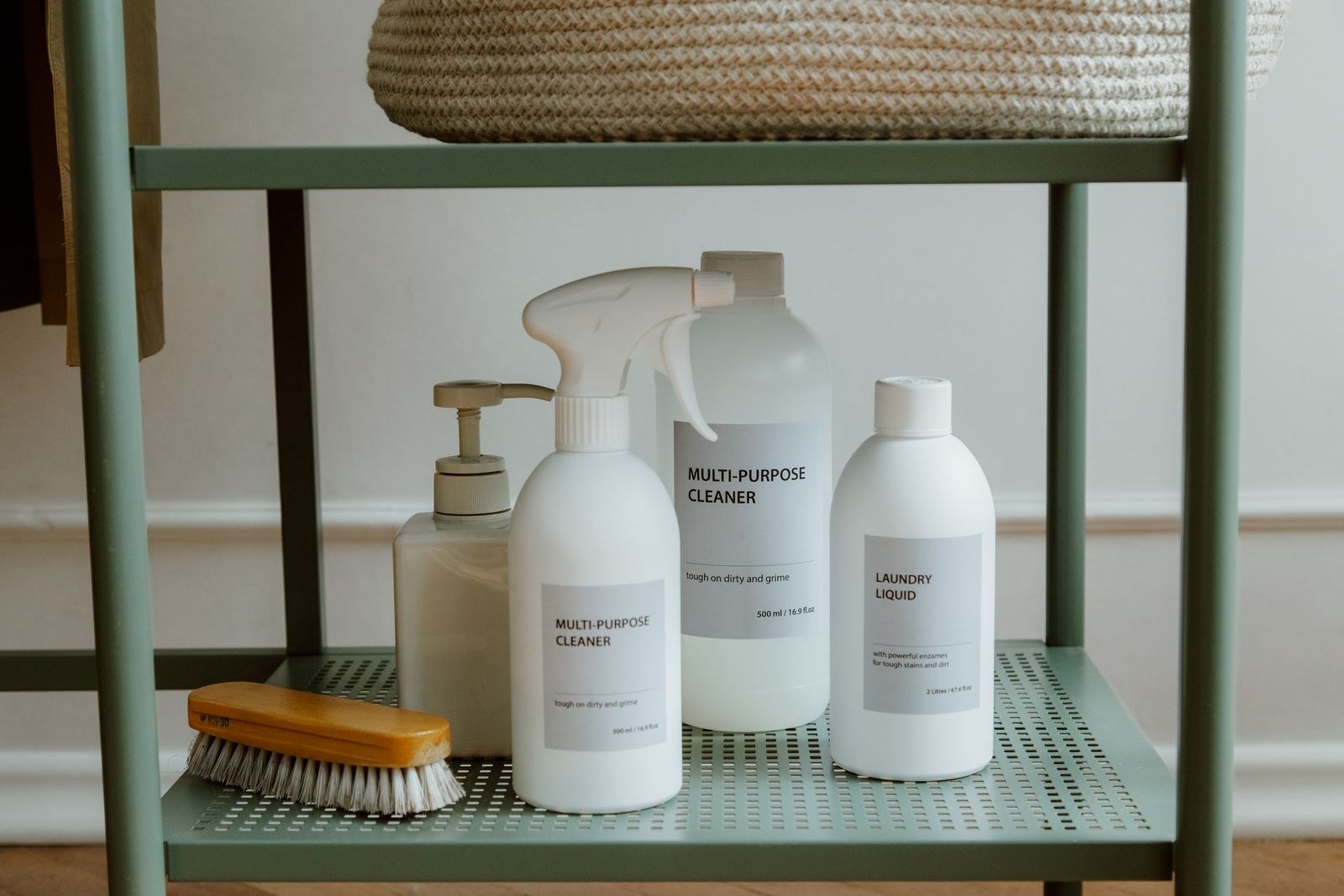
Bottles of cleaning products and spray bottles on a shelf, photographed on site
Once a detergent is heated and agitated in the blending kettle, foam lifted by the surfactant system accumulates through pumping and filling, the level reading loses its accuracy, strings of bubbles come out at the filling head, and both the net content of the finished product and the filling rate come under pressure.
Chemi Tech has introduced the KM-570 series defoamer for industrial detergents and precision cleaning formulations, with the dosage adjusted flexibly according to detergent alkalinity and surfactant content. This grade resists acid and alkali, shows no demulsification or separation under high temperature and strong alkali, holds its anti-foam effect for a long time, and is compatible with mainstream surfactants in the same system. Customers can determine the adapted KM-570 dosage on the basis of measured data for bath foam height and foam carry-over at filling.
Advantages of Chemi Tech Defoamers
Chemi Tech KM-570 series defoamer is configured for detergent formulation systems. It resists acid and alkali, keeping the liquor uniform under strong alkali and high temperature without separation or precipitation; the anti-foam effect lasts, so a single addition covers the whole run from blending to filling; defoaming is fast, with foam removed before pumping begins; compatibility with surfactants is outstanding, weakening neither detergency nor introducing silicone residue; and the dosage is economical, adjusted flexibly to detergent alkalinity and surfactant content so that bath utilisation stays stable and controllable.
Industry Pain Points and Solutions
Foam problems in detergent formulations stem mostly from the combined effect of air entrainment in the surfactant system and insufficient compatibility of the defoaming component, and the consequences are concentrated in two places: distorted level readings and foam carry-over at filling.
Once surface foam piles up, the level reading loses its accuracy, blending can only be topped up by experience, and the formulation deviation widens with temperature swings. The KM-570 dosage is set by detergent alkalinity, which holds surface foam steadily below the metering mark.
Foam at the filling head pulls down the accuracy of net content directly, the filling line is forced to slow down, and the rate drags with it. KM-570 resists acid and alkali and holds its anti-foam effect, breaking foam without weakening detergency.
Slower filling and rework top-ups all translate into cost per ton of product. By tying the dosage range to changes in detergent alkalinity and surfactant content, both top-up and speed-loss losses are reduced directly.
Typical Operating Conditions and Verification
Customer case: a precision detergent manufacturer in Zhejiang, for the blending and filling stages of alkaline degreasing detergents.
KM-570 was added on the basis of a comparison between bath foam height and foam carry-over at filling, with the dosage set by detergent alkalinity. Before that, whenever the plant raised output on a new product, surface foam increased noticeably, foam came out at the filling head frequently, and the net content of spot-checked samples drifted from time to time. After the change, surface foam fell back below the metering mark; foam at the filling head disappeared; the filling rate returned to normal and the first-pass rate of spot checks recovered.
Frequently Asked Questions
Does adding a defoamer to a detergent weaken the detergency of the formulation?
It comes down to whether the defoaming component is compatible with the detergent's surfactant system and whether it precipitates. KM-570 has completed compatibility and detergency tests under alkaline detergent conditions, and within the recommended range it neither weakens detergency nor introduces silicone residue. The actual dosage takes detergent alkalinity as its baseline, with surfactant content and service temperature set as corrections; Chemi Tech sets the adapted dosage through a parallel comparison of bath foam height and foam carry-over at filling.