
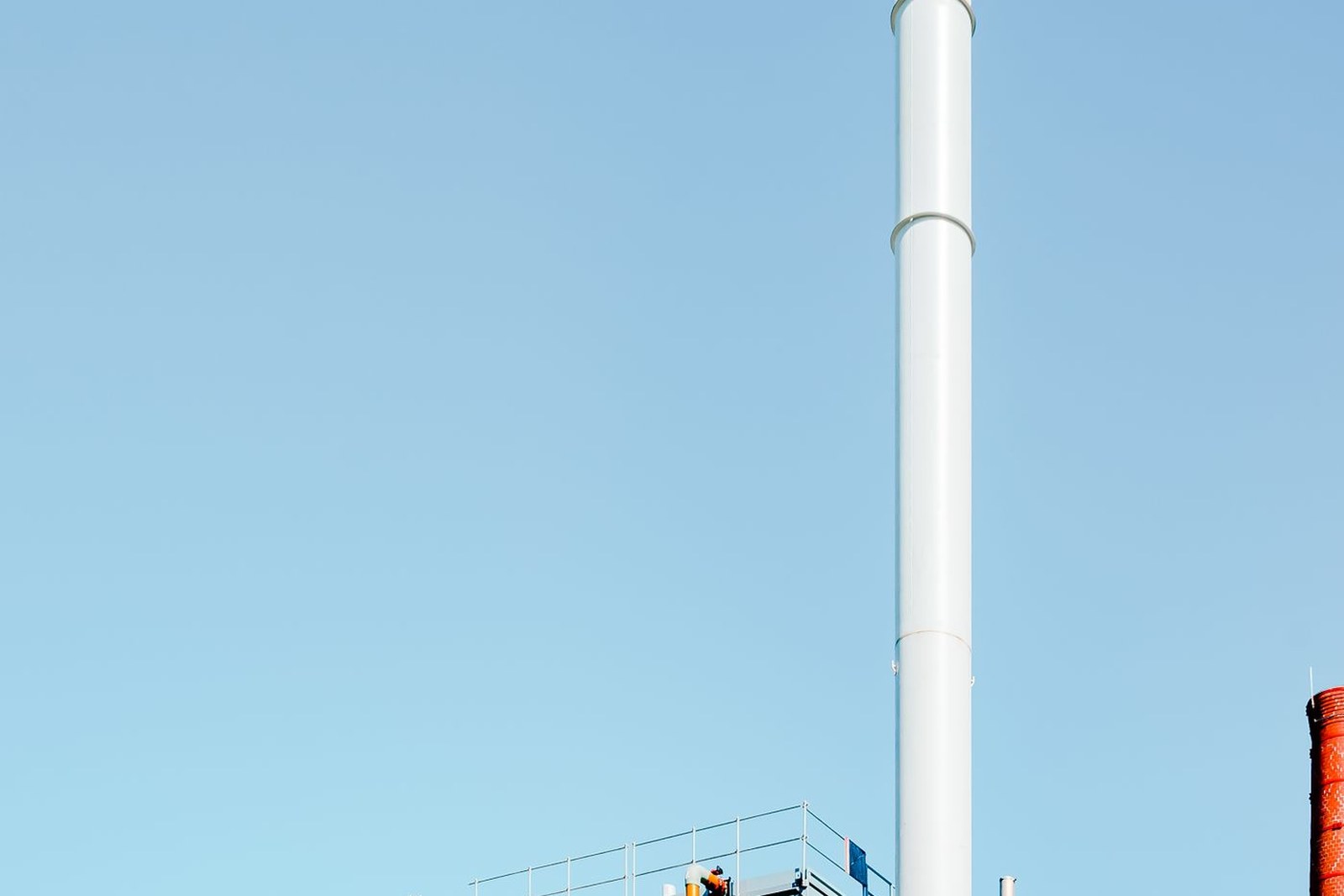
White chimneys in the plant area
After flue gas enters the decarbonization absorber it contacts the circulating solution countercurrently; once the solution foams and carries liquid, the CO2 absorption efficiency falls with it, and the regeneration heat consumption and the operating load of the unit rise together.
Chemi Tech supplies defoamers for decarbonization absorption and flue gas treatment units, drawn from the defoamer KM-237 series; the dosage is set by the circulating solution temperature, the load and the foaming tendency, and it can also be chosen for working conditions with larger load swings and a longer required suppression time. Chemi Tech runs defoaming comparisons around the absorption temperature and the circulating load, then fixes the full range of additive configuration by the unit's working conditions.
Advantages of Chemi Tech Defoamers
Chemi Tech defoamer KM-237 series is a heat-resistant defoamer that does not easily fail in the high-temperature stage of the regeneration tower; at the same time, its foam suppression is lasting, the foam in the absorption stage is continuously held down, and liquid carry-over falls accordingly; moreover, it is compatible in the same bath with the amine solution, and does not scale or deposit; and it is low-dosage and compatible with the absorption performance of the solution.
Industry Pain Points and Solutions
Foam in a decarbonization absorber is mostly caused by a stronger foaming tendency of the solution under high temperature and high load, rather than by an over-large circulation rate; the consequence is liquid carry-over and a drop in absorption efficiency.
The primary problem lies in suppression failing at the high-temperature stage of the regeneration tower. The regeneration temperature is rather high, an ordinary defoamer decomposes and fails in the high-temperature stage, and foam piles up again. Chemi Tech chooses the heat-resistant KM-237 defoamer, added to the circulation loop of the absorber, so that the agent keeps suppressing foam through the high-temperature stage.
Next is liquid carry-over under high load. After the unit raises its load the foam layer rises, the solution is carried out of the tower with the gas flow, and both the absorption efficiency and the solution loss suffer. In working conditions that need lasting foam suppression, the Chemi Tech KM-237 series defoamer keeps the foam layer in the tower stable even under load swings.
The last problem lies in interference with the solution system. If an ordinary defoamer is not compatible with the amine solution, heat-exchanger scaling and solution deterioration follow. Chemi Tech uses the KM-237 series defoamer, which is also compatible with other solutions, and can quickly bring the foam layer in the tower back into the normal range.
Typical Operating Conditions and Verification
Customer: a chemical fertilizer enterprise in Shandong, for the absorber and regeneration tower of a synthetic ammonia feed-gas decarbonization unit.
At this enterprise the decarbonization absorber's foam layer rose after the load was raised, the solution carry-over was obvious, the CO2 absorption efficiency fell, and the regeneration heat consumption rose. Taking the circulating solution temperature and the load into account, Chemi Tech chose the KM-237 defoamer for the enterprise and graded the dosage by load. After the customer added the KM-237 defoamer, the foam layer in the tower fell back quickly, the carry-over decreased markedly, and the absorption efficiency improved markedly.
Frequently Asked Questions
Will adding a defoamer to a decarbonization absorber interfere with absorption and regeneration?
When a defoamer is added to a decarbonization absorber, an ill-chosen grade may interfere with absorption and regeneration. Ordinary defoamers are poorly compatible with the amine absorption system and produce scale deposits that lower the heat-exchange efficiency and weaken the CO2 absorption capacity. Chemi Tech KM-237 defoamer is developed for decarbonization working conditions and has completed dedicated tests on system compatibility and high-temperature foam suppression. At the normal dosing rate the product does not scale or deposit and does not affect the absorption and regeneration reactions. The dosing point and rate must match the unit load and the solution temperature, and Chemi Tech can check the parameters one by one against the on-site operating curves.