
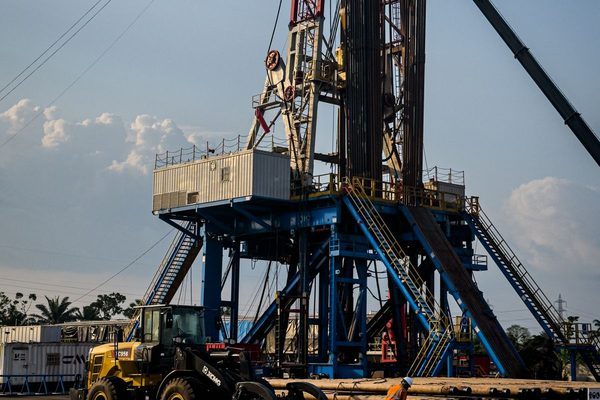
Business Introduction
Foam in drilling fluid is stubborn because it presses three things at once: high bottom-hole temperature, strong circulation shear, and the intrusion of formation salt and calcium. Once foam forms the density drops, and wellbore stability and cuttings-carrying capacity are affected with it; raising the dosage alone can hardly hold it down.
On the oil and gas and drilling-additive line, Chemi Tech provides polyether, organosilicone and siloxane-polyether defoaming options for water-based drilling fluids, completion fluids and oil-well cement slurries, matching the type to the system's salinity and temperature range; for severe conditions a fitted grade can be found in the KM series, such as KM-1240.
Product Advantages
First, it resists salt without failing and still works at high salinity. When calcium or salt intrusion occurs the active components are not readily carried away, and the foam rises back more slowly.
Second, its heat-resistance range is wide and its structure is stable under high bottom-hole temperature. Once the circulation temperature rises the emulsion does not break, and the defoaming capacity does not swing widely with temperature.
Third, its effect lasts long and one circulation needs fewer top-ups. The foam-suppressing components stay longer in the system and the top-up frequency falls, cutting the extra work of mixing fluid and tripping in and out.
Fourth, it is compatible with the system and does not disturb rheology or fluid loss. Once added it does not flocculate or thicken, and the rheological parameters and the fluid loss still follow the original design.
Note on the boundary of these effects: the judgements above come from typical water-based drilling fluid conditions; a change in the system's salinity or temperature range may give a different result, so a small-scale test should be run before use in bulk.
Market Pain Points and Solutions
The difficulty in water-based drilling fluid foam control is that salt intrusion makes the defoamer fail, the foam keeps regenerating under circulation shear, and the system compatibility is hard to judge; the three are tied together.
Pain point one: foam rebounds after calcium or salt intrusion. Once added the foam drops briefly and returns to the original level after one circulation. The approach is to choose salt-out-resistant components and take salinity as a pre-screening condition.
Pain point two: the defoaming capacity decays in the high-temperature section. Once the bottom-hole temperature reaches its limit the emulsion structure changes and performance slips markedly. The approach is to raise the system's heat-resistance limit and work back to the type from the bottom-hole temperature.
Pain point three: it clashes with the drilling fluid system. After adding, the rheology is abnormal and the fluid loss rises, and the site dares not keep dosing. The approach is to list compatibility as a pre-well verification item.
Chemi Tech uses a three-step benchmarking method: first take an on-site slurry sample to reproduce the foam and the temperature conditions, then run a machine test on a small circulation rig, and finally settle the type and the way it is added.
Typical Operating Conditions and Verification
The circulation temperature of a water-based drilling fluid changes with well depth: shallow layers mostly run from ambient to sixty degrees Celsius, while deep wells can reach around one hundred and twenty degrees Celsius; the foam peak often appears after drilling into a salt-gypsum layer and after a large make-up of fresh fluid.
The failure signals cluster in four places: the foam layer of the returning fluid thickens and carries liquid; the circulating equivalent density falls below the design value; the defoamer top-up grows larger each time; and bubbles on the shale shaker clearly increase. If two are hit, an on-site small-scale test should be arranged.
For on-site records at the same well depth and the same salinity, the technical team keeps the corresponding measured data that can be requested for comparison.
Frequently Asked Questions
Q1: Why does a water-based drilling fluid need a dedicated defoamer?
General-purpose products are mostly designed for ambient-temperature fresh water, and under high salinity and high bottom-hole temperature they tend to fail early and cannot hold down the foam that regenerates in circulation.
Q2: Once the defoamer is added, will the rheology and fluid loss of the drilling fluid change?
This is an item that needs separate verification. It is advisable to run a small-scale test with on-site materials at the fluid-mixing stage and to watch the rheology and fluid loss at the same time, rather than fixating only on how fast the foam height drops.
Q3: In replacing an imported brand with a domestic defoamer, what should be watched on site?
First record the top-up amount, the top-up frequency and the foam level of the original product as a baseline, then reproduce the equivalence with the same batch of on-site fluid, and only use it at scale after confirming that the density and rheology have not changed.