
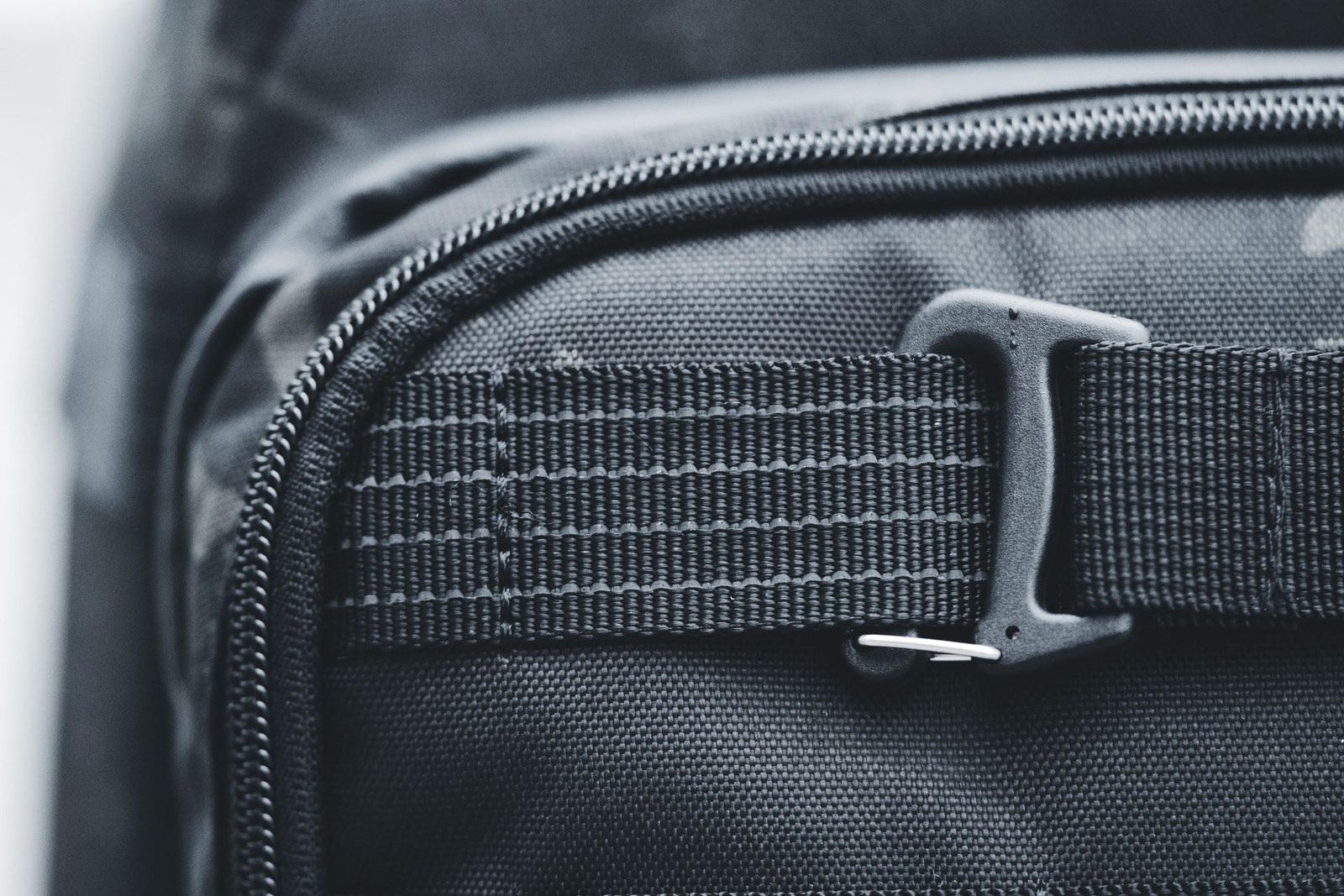
Close-up of backpack webbing
Outdoor bag and case ribbons and seams take repeated rain in the wet season, water creeps inward along the capillary channels of the yarn, wet patches bloom out at the seam, and customer complaints and returns rise with them.
Chemi Tech has introduced the KMF-4401 series water repellent for anti-wicking finishing of ribbons and seams, with the dosage adjusted flexibly according to the substrate weight and finishing concentration. This grade seals the yarn gaps, cuts off the capillary channel, and shortens the seam siphon height noticeably. Customers can determine a suitable KMF-4401 dosage from measured data on seam siphon height and water repellency rating.
Advantages of Chemi Tech Water Repellents
Chemi Tech KMF-4401 series water repellent is configured for ribbon and seam finishing. Pore sealing is continuous — a continuous water-repellent film forms on the yarn surface and the capillary channel is sealed tight; the hand stays soft and non-boardy, so the flexibility of the finished ribbon is unaffected; wash resistance is outstanding, with the water-repellent performance still standing above the order threshold after repeated washing; compatibility with resin finishing agents is good, so same-bath finishing needs no extra separation; and the dosage adjusts flexibly to substrate weight, covering both narrow and wide ribbons.
Industry Pain Points and Solutions
Water-repellent finishing problems in ribbon seams arise mostly from incomplete capillary-channel sealing and a mismatch of the finishing window, and the consequences are concentrated in two places: seam siphon wicking and a boardy hand.
Siphon wet marks at the seam are the first to appear, and the finished product keeps losing points on the seam item in water-repellent testing. The KMF-4401 concentration is pinned down by substrate material, and the seam siphon height can be shortened noticeably.
A boardy hand is the most common source of complaints about ribbon finishing, and the wearing experience of the bag or case suffers with it. KMF-4401 forms a soft film, and the finished ribbon keeps its original flexibility, so end-user feedback is stable and controllable.
The cost of water-repellent finishing is tied directly to the stability of the water repellency rating. By tying the dosage to changes in substrate weight and finishing concentration, an additive range can be defined, keeping both the hand and the water repellency of the finished ribbon covered.
Typical Operating Conditions and Verification
Customer case: a bag and case trim manufacturer in Zhejiang, for the water-repellent finishing line of ribbons and seams.
The customer added a seam rain test at inspection, the existing finishing formula never improved the siphon wet marks at the seam, and the pressure to fix it landed on the finishing workshop. After a comparison test on seam siphon height and water repellency rating, the trim plant adopted KMF-4401 as its water repellent for finishing, with the dosage pinned down by ribbon weight. After the change, the seam siphon height was shortened noticeably; the water repellency rating stayed above the threshold; the rating was still within the order spec after repeated washing, and orders were released on schedule.
Frequently Asked Questions
After water-repellent finishing, will the hand of the ribbon become noticeably boardy?
It all comes down to whether the water-repellent film forms continuously on the yarn surface and whether the capillary channel is sealed tight. KMF-4401 has completed hand and wash-resistance comparison tests on ribbons and seams, and within the recommended range the softness stays stable. The actual dosage takes substrate weight and finishing concentration as the baseline; Chemi Tech pins down the finishing concentration through a parallel comparison of seam siphon height and water repellency rating.