
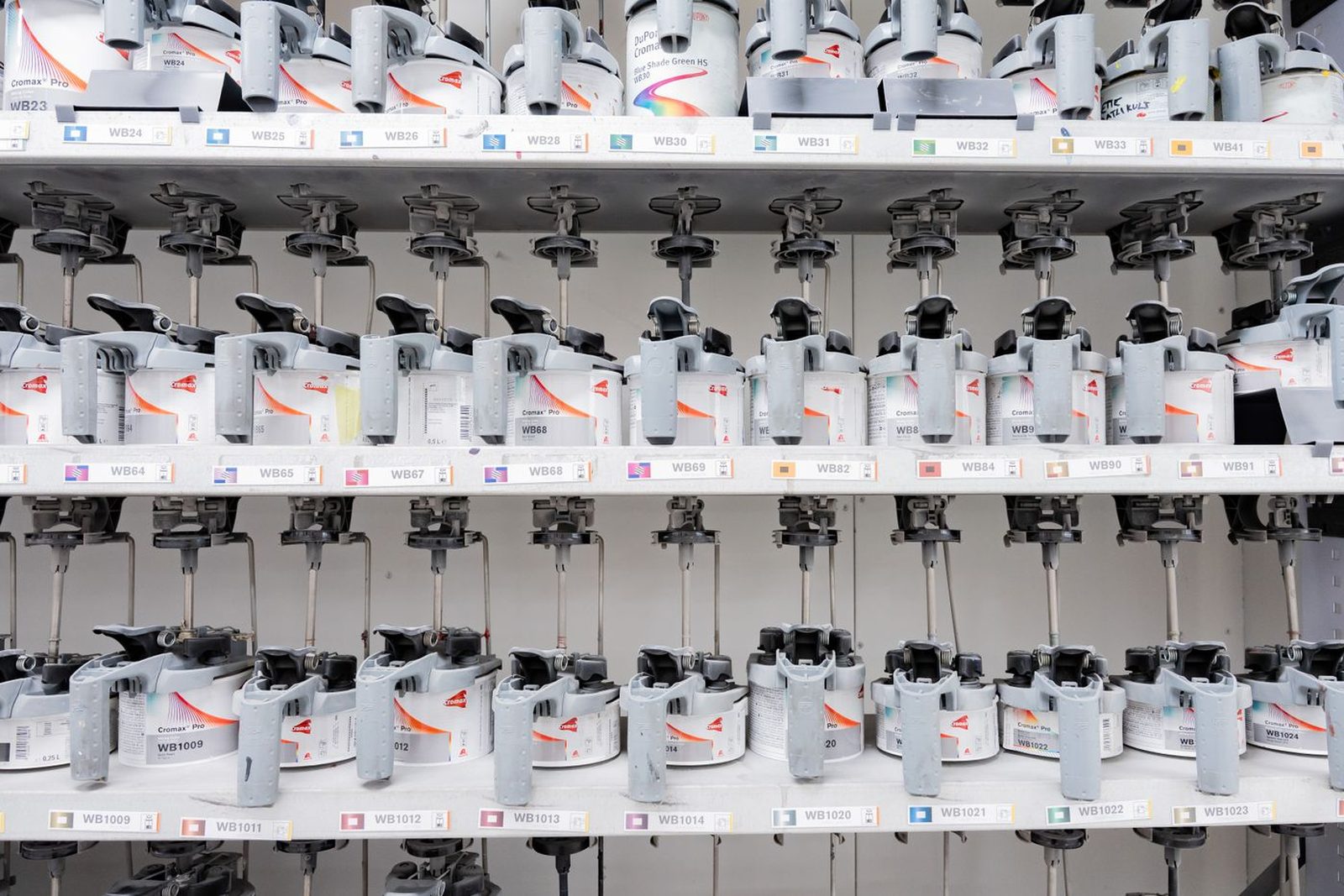
Industrial paint tinting and mixing equipment, photographed on site
Once water-based industrial paint entrains air at either the production or the application end, foam lingers in the kettle, bubbles are carried through tinting and filling, and pinholes and craters appear in the cured film batch after batch, with hiding power and gloss falling away behind them.
Chemi Tech has introduced the KM-2604 series defoamer for water-based architectural coatings, wood furniture coatings and industrial paint systems, with the dosage adjusted flexibly according to paint solids and dispersion intensity. This grade is a modified polysiloxane transparent emulsion with outstanding compatibility: the paint stays clear rather than turning cloudy, and the defoaming process does not damage the transparency of the film. Customers can determine the adapted KM-2604 dosage on the basis of measured data for kettle foam height and film pinhole rating.
Advantages of Chemi Tech Defoamers
Chemi Tech KM-2604 series defoamer is configured for water-based industrial paint systems. Compatibility is outstanding, so the paint stays transparent rather than cloudy and neither clear coats nor pigmented coats lose transparency; defoaming is fast, with foam in the kettle removed before filling begins; the anti-foam effect lasts, so a single addition covers the whole run from tinting through to application; foam is broken without craters, and pinholes and craters on the film surface are progressively eliminated; and the dosage is economical, adjusted flexibly to paint solids so that the coating schedule stays stable and controllable.
Industry Pain Points and Solutions
Foam problems in water-based industrial paint stem mostly from the combined effect of air entrained during dispersion and insufficient compatibility of the defoaming component, and the consequences are concentrated in two places: foam in the kettle and pinholes on the film.
Once foam piles up in the kettle, filling carries bubbles and both net content and tinting accuracy fall away. The KM-2604 dosage is set by paint solids, which presses kettle foam down steadily.
After the film forms, pinholes and craters are exposed and rework and touch-up coats eat into spray-booth hours. KM-2604 has outstanding compatibility, so breaking foam does not bring haze or craters back onto the film.
Rework and touch-up hours both translate into coating cost in the end. By tying the dosage range to changes in paint solids and dispersion intensity, the loss from rework is reduced directly.
Typical Operating Conditions and Verification
Customer case: an industrial coatings producer in Jiangsu, for the tinting and spraying stages of water-based industrial paint.
After this coatings plant switched to a low-viscosity water-based formulation, foam in the tinting kettle would not break; filling carried bubbles, and pinholes and craters increased in the sprayed film. The adaptation point became clear accordingly: paint solids and dispersion intensity both sat in the normal range, so the water-based system could be matched directly. KM-2604 was used as the defoamer for that formulation, with the dosage set by paint solids. After the change, kettle foam fell back to a normal level; pinholes on the film dropped markedly; and film transparency and gloss held steady, with downstream rework falling in step.
Frequently Asked Questions
Will adding a defoamer to water-based industrial paint make the clear coat cloudy or cut its transparency?
It depends on whether the defoaming component is fully compatible with the paint and whether it precipitates. KM-2604 has completed transparency and compatibility comparison tests in low-viscosity water-based formulations, and within the recommended range the paint does not turn cloudy, with transparency of clear and pigmented coats holding steady. The actual dosage takes paint solids as its baseline, with dispersion intensity and application method set as corrections; Chemi Tech sets the adapted dosage through a parallel comparison of kettle foam height and film pinhole rating.