
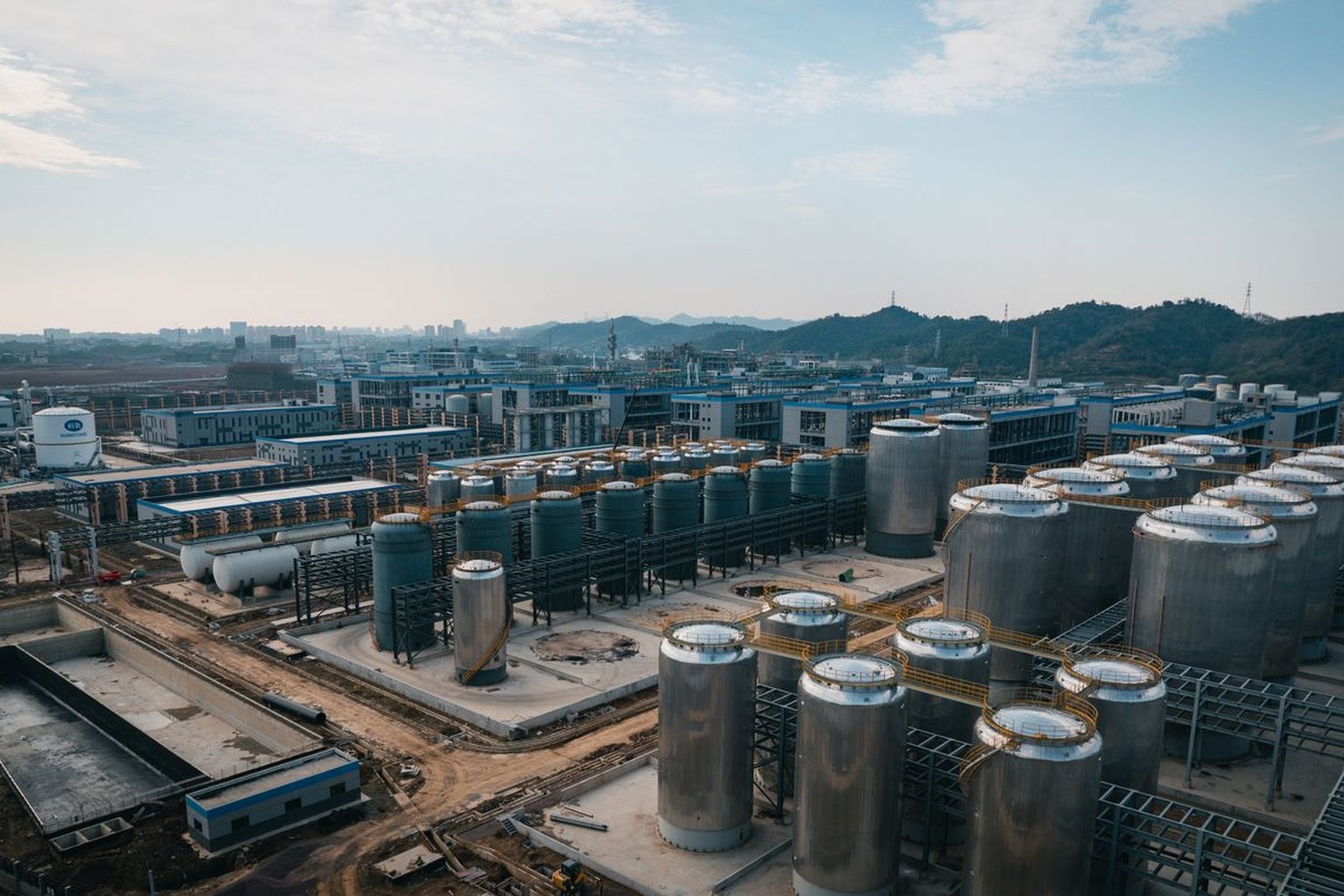
An aerial view of an industrial park plant building, photographed on site
Once a lithium battery slurry is run at higher speed in the mixing tank, foam accumulates through the high-viscosity paste, the slurry level reads wrong, bubbles are entrained into the electrode during coating, foil exposure and pinholes increase, and both the capacity and the safety performance of the finished cell come under pressure.
Chemi Tech has introduced the KM-1900 series defoamer for battery slurry and electrode coating systems, with the dosage adjusted flexibly according to slurry solids and mixing intensity. This grade is a silicon-free defoamer: it breaks foam without conducting, introduces no metallic impurities into the slurry, and does not interfere with the capacity or cycle life of the electrode. Customers can determine the adapted KM-1900 dosage on the basis of measured data for tank level and foil exposure rate during coating.
Advantages of Chemi Tech Defoamers
Chemi Tech KM-1900 series defoamer is configured for battery slurry systems. It is silicon-free and non-conductive, introducing no metallic impurities during defoaming so that the electrical performance of the slurry holds steady; defoaming is fast, with foam removed before the slurry is transferred; the anti-foam effect lasts, so a single addition covers the whole run from mixing through to coating; compatibility with the slurry is outstanding, with no precipitation or surface oil and no pinholes on the electrode surface; and the dosage is economical, adjusted flexibly to slurry solids so that the coating schedule stays stable and controllable.
Industry Pain Points and Solutions
Foam problems in battery slurry stem mostly from the combined effect of air entrained by high slurry viscosity and the conductivity of the defoaming component, and the consequences are concentrated in two places: a distorted level reading and foil exposure during coating.
Once the slurry foams, the level reading is distorted, batching can only be corrected by experience, and the formulation deviation widens with mixing intensity. The KM-1900 dosage is set by slurry solids, which holds tank level steadily within the metering scale.
Bubbles entrained in the electrode become foil exposure and pinholes at coating, and the capacity delivery and cycle stability of the electrode suffer with them. KM-1900 is silicon-free and non-conductive, so breaking foam introduces no metallic impurities into the slurry.
Foil-exposure rework and scrapped slurry both translate into cost per cell in the end. By tying the dosage range to changes in slurry solids and mixing intensity, the loss from coating is reduced directly.
Typical Operating Conditions and Verification
Customer case: a lithium battery producer in Guangdong, for the mixing and coating stages of lithium iron phosphate cathode slurry.
After this battery plant raised the speed of its slurry mixing tank, foam on the tank surface increased noticeably; foil exposure appeared from time to time on the electrode during coating, and the capacity consistency of spot-checked cells drifted with it. After a comparison test on tank level and foil exposure rate, KM-1900 was selected as the plant's slurry defoamer, with the dosage set by slurry solids. After it went into service, tank level fell back within the metering scale; the foil exposure rate dropped in step; capacity consistency of the electrode recovered and the coating schedule returned to normal.
Frequently Asked Questions
Will adding a defoamer to battery slurry affect the electrical performance of the electrode?
What matters first is whether the defoaming component contains silicon and whether it conducts. KM-1900 has completed electrical performance and cycle comparison tests under lithium iron phosphate slurry conditions, and within the recommended range it introduces no metallic impurities, with capacity delivery and cycle life holding steady. The actual dosage takes slurry solids as its baseline, with mixing intensity and coating speed set as corrections; Chemi Tech sets the adapted dosage through a parallel comparison of tank level and foil exposure rate.