
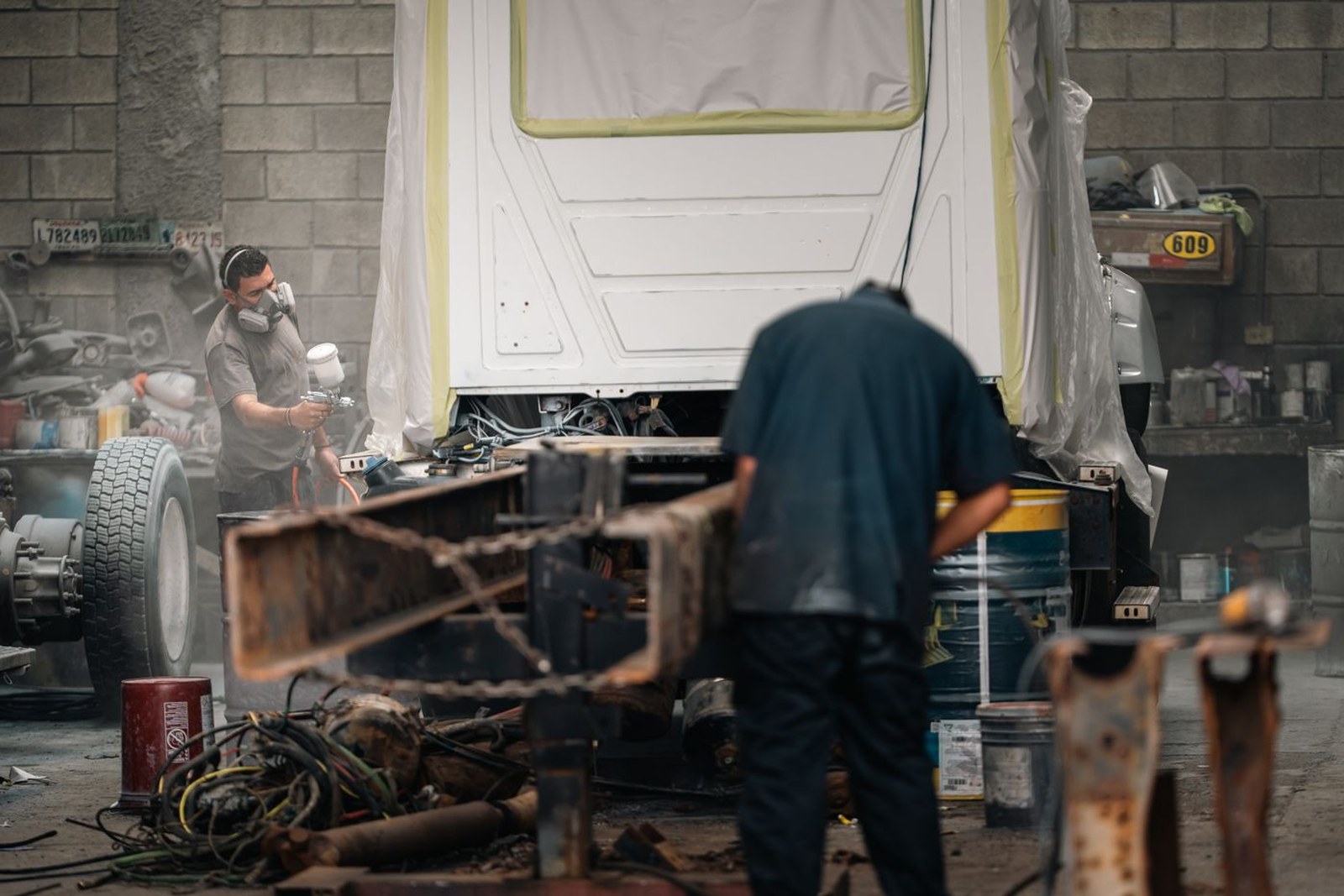
Live shot of spray painting on a vehicle cab
Once the water-based topcoat on automotive parts is sped up, the film cures before it can level between spraying and flash-off; orange peel repeats piece by piece across the panel, the ripple shows clearly under raking light, and rework and sanding hours climb accordingly.
Chemi Tech launches the KMP-4500 series leveling agent for automotive and water-based industrial coatings, with the addition level set flexibly against coating solids and spray beat. This grade is a water-based leveling agent that lowers surface tension markedly, keeps dynamic surface tension controllable, shows good compatibility without affecting intercoat adhesion, and leaves margin for recoating. Based on measured orange-peel grade and gloss readings on the panel, the suitable range of the KMP-4500 series can be defined.
Chemi Tech Leveling Agent Advantages
The Chemi Tech KMP-4500 series leveling agent is formulated for automotive and water-based industrial coating systems. It lowers surface tension markedly, letting the film spread fully across the panel and gradually flattening orange peel and edge pulling; dynamic surface tension stays controllable, with timely spreading under high-speed spraying; it has little effect on intercoat adhesion, leaving margin for recoating; it has little effect on gloss, giving even gloss after film formation; its thermal stability is good, with no decomposition or yellowing in the baking stage; dosage is economical, calibrated by coating solids, achieving one-pass forming.
Industry Pain Points and Solutions
Leveling problems in water-based industrial coating spraying mostly share one root cause: spray shear and surface-tension mismatch acting together, ending up in two places — repeated orange peel and edge pulling, and unstable recoat adhesion.
Orange peel and edge pulling replicate piece by piece across the panel, with clear ripples under raking light. Once the KMP-4500 dosage is calibrated by coating solids, film spreading can be pulled back open.
Unstable intercoat adhesion during recoating brings a delamination risk between the two spray passes. KMP-4500 leaves margin for intercoat-adhesion-sensitive systems.
Rework and sanding losses ultimately convert into per-part coating cost. Against changes in coating solids and spray beat, the addition range can be defined to secure one-pass forming.
Typical Conditions and Verification
Customer: an automotive parts enterprise in Guangdong, applied to the topcoat spraying line for bumpers and trims.
With insufficient dosage of ordinary leveling agents, orange peel does not improve noticeably and appears in patches once speed is raised. This spraying line had been using additives dominated by static surface tension. After rectification, KMP-4500 was set as the leveling agent for this plant's topcoat, with the dosage calibrated by coating solids. After the switch, the panel showed: orange peel fell back to the qualified grade, edge pulling basically disappeared, intercoat adhesion between the two spray passes passed stably, and gloss readings stayed stable.
FAQ
After the automotive topcoat is sped up, should the leveling agent dosage be increased accordingly?
The dosage of the leveling agent can only be discussed after the coating solids and spray beat are worked out. KMP-4500 has completed comparative tests on orange peel and intercoat adhesion under multiple solids conditions, with thermal stability that does not decompose or yellow through the baking stage. Actual dosage is calibrated against coating solids and spray beat; Chemi Tech defines the suitable range from the side-by-side comparison of panel orange-peel grade and gloss readings.