
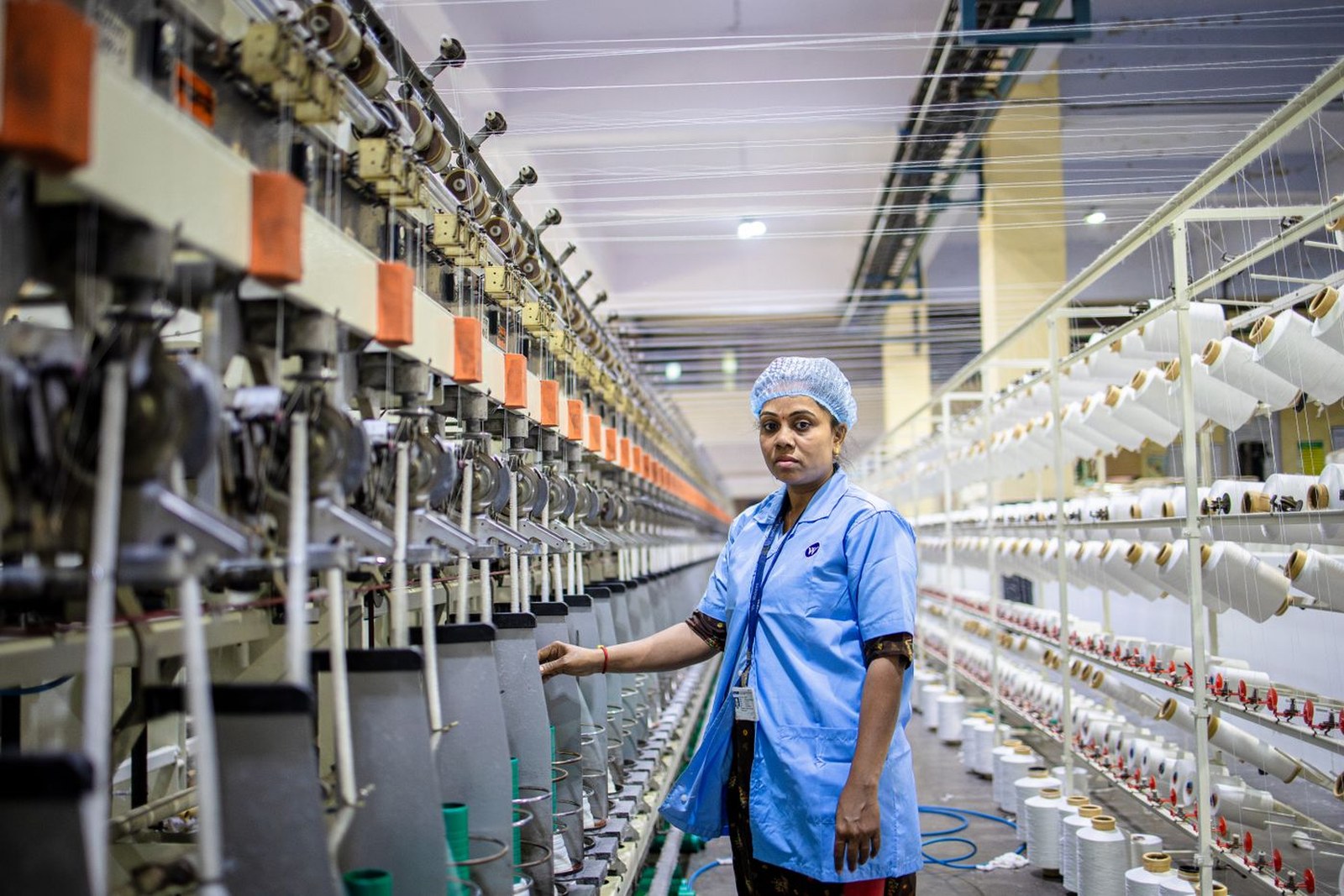
Live shot of a tow-winding station in a spinning workshop
Once thick foam builds up in the sizing bath, foam layers accumulate along the bushing plate and godet roll; end breaks in the winding section rise accordingly, and the tension and forming yield of the filaments decline batch by batch.
Chemi Tech launches the KM-430 series defoamer for the sizing-agent and spinning-oil systems of glass-fiber spinning, with the addition level set flexibly against sizing-agent concentration and spinning speed. This grade is a shear- and heat-resistant silicone defoamer whose foam breaking does not decay under the high shear of spinning, with stable high-temperature performance and compatibility with the sizing agent without phase separation. Based on measured bath-foam height and end-break counts, a suitable scheme for the KM-430 series can be given.
Chemi Tech Defoamer Advantages
The Chemi Tech KM-430 series defoamer is formulated for glass-fiber spinning systems. Its shear resistance is outstanding — foam-breaking ability does not decay under the high-shear spinning condition; its high-temperature stability is good, with no failure in the high-temperature bushing zone; defoaming is fast, removing bath foam before filament attachment at the bushing; its compatibility with the sizing agent is good, without demulsification or phase separation, and without affecting filament sizing; dosage is economical, switched with sizing-agent concentration, so the end-break rate benefits directly.
Industry Pain Points and Solutions
Foam problems in glass-fiber spinning mostly share one root cause: air entrainment by the sizing agent and foam-control components not resisting shear acting together, ending up in two places — bath-foam accumulation and winding end breaks.
Once bath foam accumulates, the sizing uniformity of the sizing agent declines accordingly. The KM-430 dosage, calibrated by sizing-agent concentration, keeps the bath foam stably pressed flat.
Foam carrying sizing agent attaches to the godet roll, fluctuating tension in the winding section and raising end breaks. KM-430's foam-breaking process does not bring impurities back onto the filament surface.
Losses from end breaks and downgrading ultimately convert into the cost per ton of filaments. Against changes in sizing-agent concentration and spinning speed, the dosage can be narrowed to an accountable range, directly lowering end-break loss.
Typical Conditions and Verification
Customer: a glass-fiber enterprise in Zhejiang, applied to the sizing-agent circulation bath in its spinning workshop.
The sizing bath built up thick foam; end breaks occurred from time to time in the winding section; filament tension occasionally fluctuated. Based on the comparison of bath-foam height and end-break counts, KM-430 was selected as the sizing-agent defoamer for this plant, with the dosage graded by sizing-agent concentration. After commissioning, the bath foam fell back, end breaks in the winding section dropped markedly, filament tension stabilized, and the forming yield recovered accordingly.
FAQ
Will adding a defoamer to the sizing agent affect the sizing and strength of the filaments?
Bath foam and end-break counts must be put side by side to see whether the defoamer really works. KM-430 has completed comparative tests on bath foam and end-break counts under glass-fiber spinning conditions; within the recommended range it does not affect filament sizing. Actual dosage is based on sizing-agent concentration, with spinning speed and bushing temperature as correction factors; Chemi Tech gives the suitable scheme from the side-by-side comparison of bath-foam height and end-break counts.