
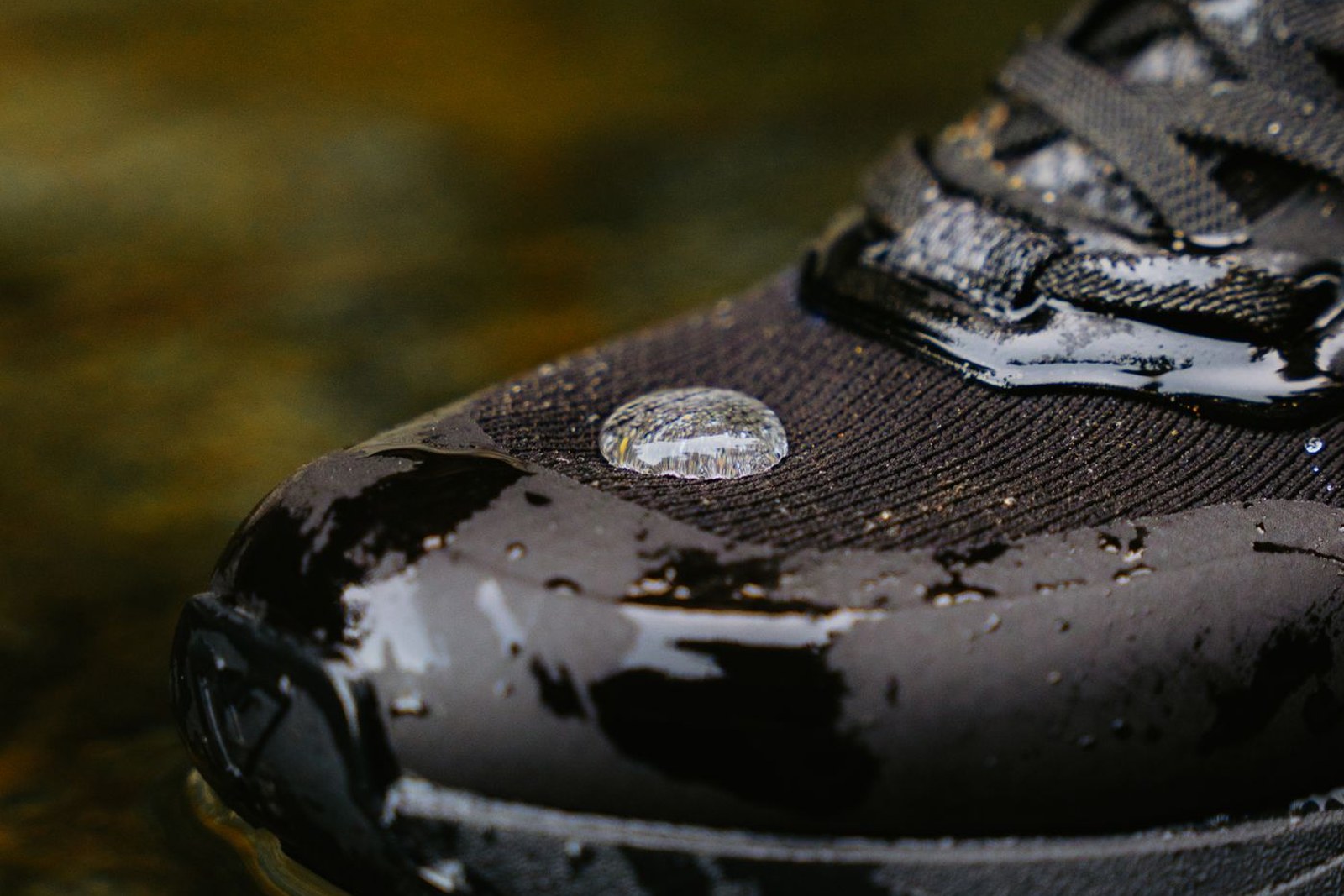
A real-shot of water beading on a shoe upper.
Once shoe-upper materials and textile substrates get wet, water quickly seeps along fiber gaps; the seams show large wet marks, the spray rating keeps dropping with each wash, and export orders stall at the fluorine-free testing and inspection stage, hard to release.
Chemi Tech builds the KMF-801 series waterproofing agent for shoe-material and textile repellency finishing bound by fluorine-free requirements, with dosage adjustable to substrate grammage and finishing concentration. This grade is a fluorine-free waterproofing agent free of perfluorinated compounds; its film on the fiber surface is continuous, so water beads stay on the fiber surface and do not penetrate inward. Against measured data of spray rating and wash cycles, the suitable concentration of KMF-801 can be determined.
Chemi Tech Waterproofing Agent Advantages
The KMF-801 series waterproofing agent from Chemi Tech is configured for shoe-material and textile repellency finishing systems. It is a fluorine-free formula free of perfluorinated compounds, better fitting export orders that must pass fluorine-free testing; its repellent film is continuous, forming an even repellent layer on the fiber surface where water beads roll off without penetrating; wash resistance is good, with the spray rating still stable in the pass band after multiple washes; the hand feel stays soft without stiffening, and the flexibility of the shoe upper is unaffected after finishing; it is compatible in the same bath with common adhesives and softeners, completing the finishing step in one pass; and dosage is flexible against substrate grammage, covering both thick and thin shoe materials.
Industry Pain Points and Solutions
The repellency problem in shoe materials and textiles, at root, comes from the combined action of discontinuous film formation on the fiber surface and the hard-to-meet fluorine-free index, finally concentrating in two places: declining spray rating and blocked fluorine-free testing.
Once the spray rating declines, the same batch of shoe upper material repeatedly fails the rain test. After the KMF-801 finishing concentration is set against substrate grammage, the repellent film on the fiber surface stays continuous.
Fluorine-containing finishing fails the fluorine-free test; switching to fluorine-free, the spray rating then drops with washes. KMF-801 forms a fluorine-free film, keeping the spray rating stable in the pass band after multiple washes.
The cost of repellency finishing is directly tied to rating stability. Against changes in substrate grammage and finishing concentration, the dosing range can be set to secure both fluorine-free compliance and repellency.
Typical Conditions and Verification
Customer: a shoe-material enterprise in Sichuan, applied to the repellency finishing line for athletic-shoe upper materials.
The shoe upper material let water through on contact, with the seams showing large wet marks. The export order stalled at the perfluorinated-compound testing item, so fluorine-containing options were ruled out first. The fitting points then became clear: the finishing-liquor concentration was set against substrate grammage, the agent was unified to KMF-801, and both pad and dip processing methods could be adapted. After that, water beaded and rolled off the shoe upper surface; the spray rating stayed stable after multiple washes; the perfluorinated index was held down, and the export order passed and released smoothly.
FAQ
After applying a fluorine-free waterproofing agent, will the shoe upper material feel stiff and rough?
Whether the repellent film is continuous and whether the hand feel stiffens directly decides the direction of the finishing result. KMF-801 is designed to balance repellency and hand feel; after finishing the shoe upper stays soft without stiffening or roughness, and the spray rating stays stable after multiple washes. Actual dosage is set against substrate grammage and finishing concentration as the baseline; Chemi Tech determines the suitable concentration by parallel comparison of spray rating and wash cycles.