
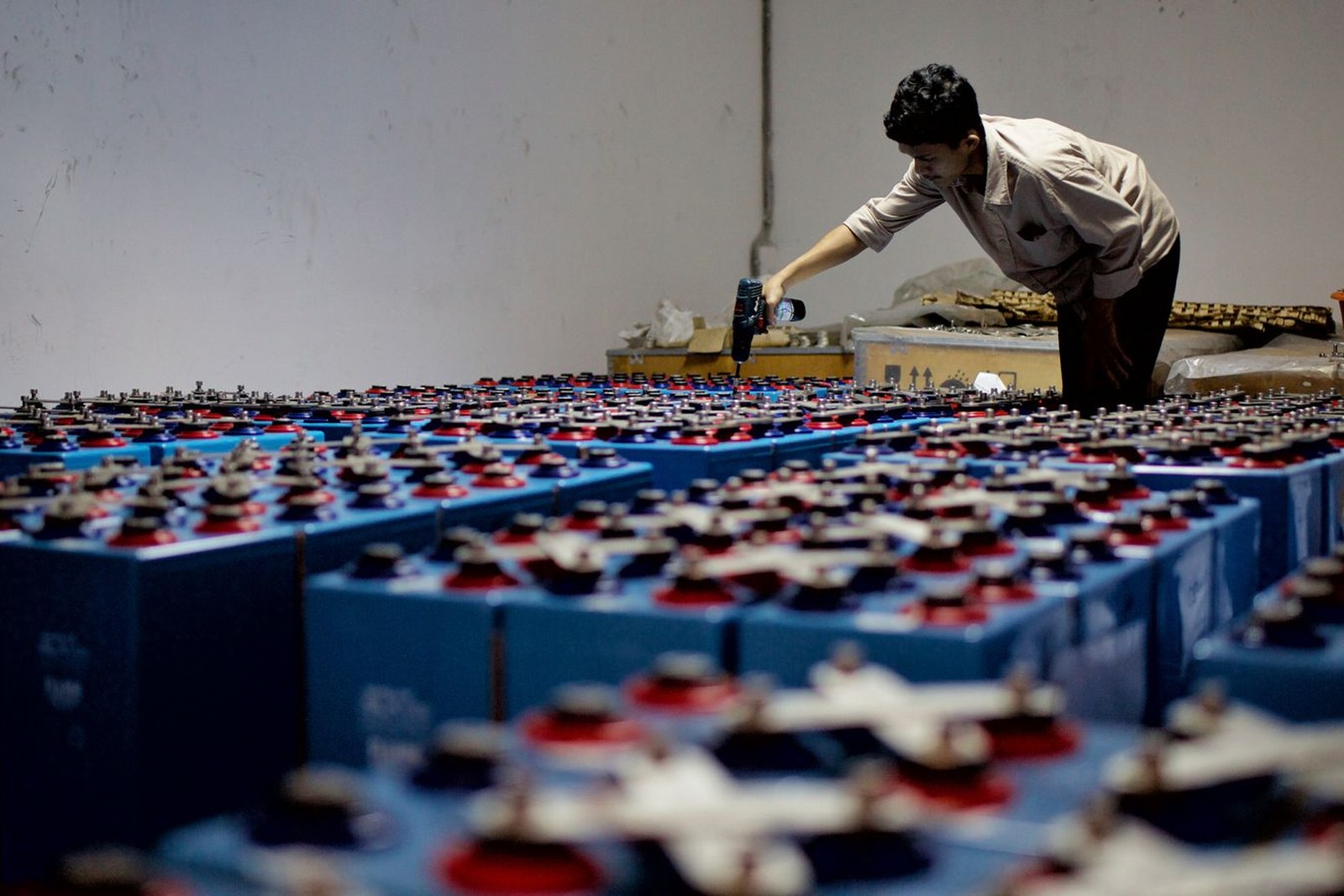
A real-shot of lithium-battery cells stacked and inspected.
Once lithium-battery slurry enters the bead mill, high shear drives the active material to re-agglomerate; the fineness reading bounces repeatedly near the pass line, the tank bottom cakes after standing, and electrode coating and batch consistency slide batch by batch.
Chemi Tech builds the KMK-409 series dispersant for lithium-battery slurry dispersion systems, with dosage adjustable to slurry solids content and grinding intensity. This grade is a dispersant for lithium systems; it wets and anchors the active material fully, does not detach under high-shear grinding, and keeps slurry viscosity and fineness stable together. Against measured data of grinding current and slurry fineness, the suitable dosage of the KMK-409 series can be set.
Chemi Tech Dispersant Advantages
The KMK-409 series dispersant from Chemi Tech is configured for lithium-battery slurry systems. Anchoring is firm, the active material does not re-agglomerate under high-shear grinding, and the fineness-down process is stable; viscosity reduction is significant, and the grinding current trends steady once slurry flow improves; dispersion stability is outstanding, with no settling or caking within storage; it is compatible with the active material, covering both cathode and anode slurries; coating adaptability is good, with an even electrode surface and consistent batches; and dosage is economical, set against slurry solids content, achieving one-pass grinding to spec.
Industry Pain Points and Solutions
The dispersion problem in lithium-battery slurry, at root, comes from the combined action of the specific-surface-area difference of active materials and insufficient grinding shear, finally concentrating in two places: fineness rebound and electrode-consistency fluctuation.
Fineness bouncing repeatedly slows the grinding tempo, and the batch stability of the slurry drops with it. The KMK-409 dosage set against grinding intensity can drive fineness down to the target in one pass.
Slurry settling and caking make the coating areal density drift, and electrode consistency fluctuates with it. KMK-409's stable-anchoring property keeps the active material evenly dispersed through both storage and coating.
Rework in the grinding and coating stages both land on equipment occupancy and material loss. Against changes in slurry solids content and grinding intensity, the dosing range can be delineated to secure stable, non-settling slurry within storage.
Typical Conditions and Verification
Customer: a lithium-battery enterprise in Fujian, applied to the bead-milling and coating section of cathode slurry.
The slurry tank bottom caked. The fineness reading rebounded across batches. Coating areal density varied between batches. After comparing fineness and coating consistency, Chemi Tech set this plant's dispersant to KMK-409, with dosage set against slurry solids content. As a result, the fineness reading fell into the target range in one pass, the tank bottom no longer caked, inter-batch coating areal density converged, and the grinding current stayed steady.
FAQ
After raising solids content in lithium-battery slurry, should the dispersant dosage be adjusted accordingly?
The key lies in whether the dispersant anchors without detaching under high-shear grinding and drives fineness down in one pass. KMK-409 has completed comparative measured data on grinding and storage across multiple slurry grades, with stable fineness and coating consistency within the recommended range; Chemi Tech determines the suitable dosage by parallel comparison of grinding current and slurry fineness.