
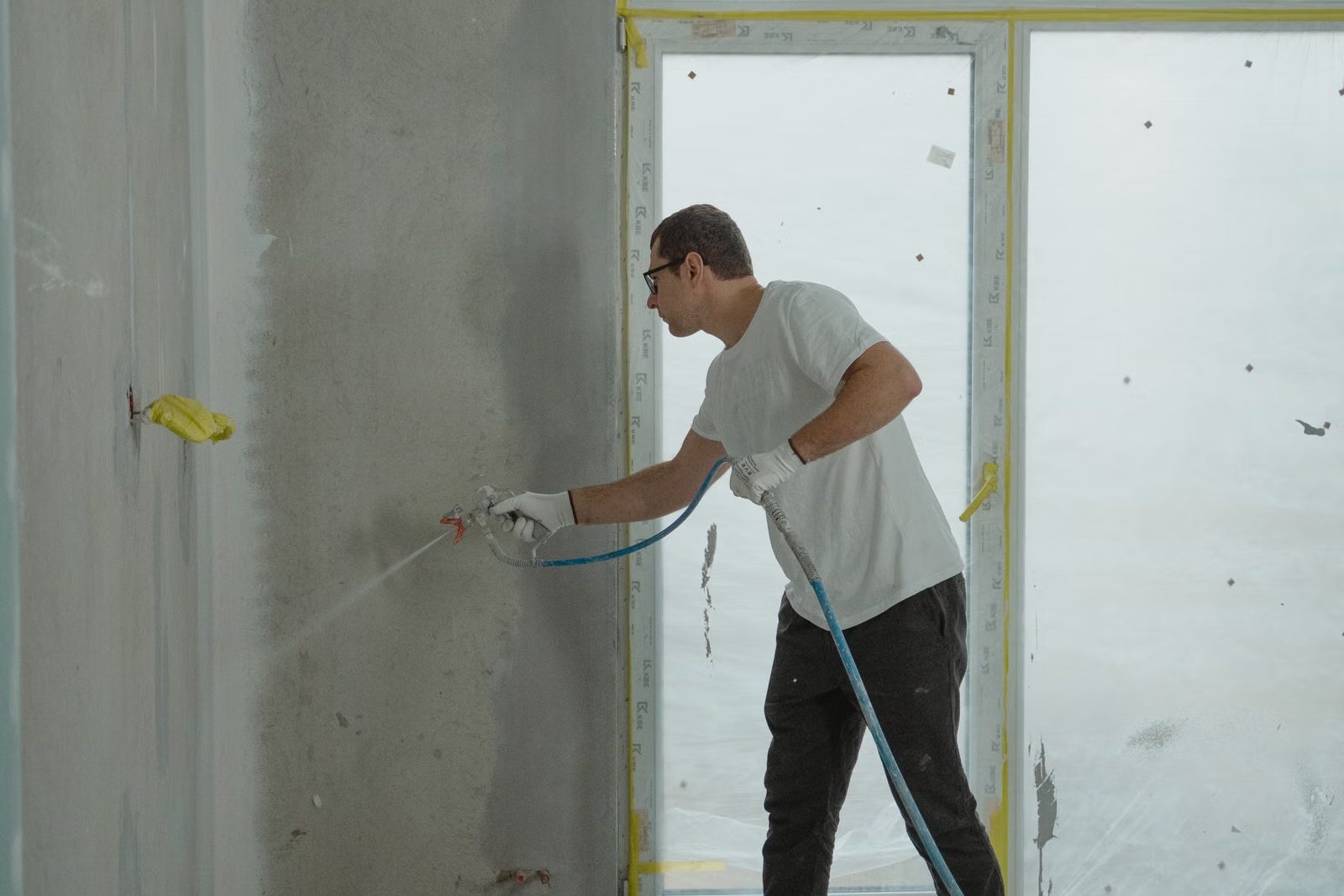
A worker carrying out coating work in a light-coloured clean workshop
Air is entrained in the emulsion polymerisation reactor during stirring and vacuum pumping; the foam layer inside the reactor rises batch by batch, the particle-size distribution widens accordingly, the amount of filter residue rises during the discharge filtration of the emulsion, and batch consistency in the polymerisation and post-treatment stages is compressed.
Chemi Tech supplies the KM-730 series of defoamers for the foam conditions in water-based resin emulsion polymerisation reactors; the dosage is adjusted flexibly by monomer ratio, stirring speed and reaction temperature. This grade is a high-molecular-polymer type, low-COD, non-volatile and resistant to acids and alkalis, causing no interference with emulsion particle size and film-forming performance. The measured data on the height of the foam layer inside the reactor and the width of the particle-size distribution are recorded side by side for two batches in the same reactor, and the fitted dosage of the KM-730 series is determined accordingly; the dosage of that reactor is set only after monomer polarity and reaction temperature are checked in grades.
Advantages of Chemi Tech Defoamers
The Chemi Tech KM-730 series defoamer is configured for water-based resin emulsion polymerisation reactors. It is a high-molecular-polymer type, low-COD and non-volatile, so the effluent index is not dragged down; it resists acids and alkalis, keeping its foam-suppressing ability from decaying under acid-base fluctuations in the polymerisation system; it breaks foam fast, clearing the fine bubbles entrained by stirring within the settling section; its compatibility is excellent, so the emulsion particle size and film-forming performance do not drop due to dosing; its foam-suppressing duration is long-lasting, so no stage-by-stage top-up is needed in long-cycle polymerisation; and the dosage is economical, rated by monomer ratio and stirring speed, so the additive cost of polymerisation batches is easy to account.
Industry Pain Points and Solutions
The root of foaming in emulsion polymerisation lies mostly in the combined effect of air entrained by a too-high stirring speed and surface-active components in the monomer ratio, while a rising reaction temperature stabilises the fine bubbles at the liquid surface inside the reactor, finally concentrating in two places: a rising foam layer and a widening particle-size distribution.
After the stirring speed is raised, fine bubbles are pressed into the emulsion inside the reactor and the foam layer rises first. KM-730 resists acids and alkalis and takes effect fast; once the two readings of speed and temperature are cleared, its dosage is re-rated by the polarity of that emulsion batch, and the height of the foam layer falls accordingly.
After the monomer ratio is switched, the same dosage performs differently across two emulsion batches and the width of the particle-size distribution differs markedly; with a low-polarity monomer and a high-polarity monomer compared side by side, the distribution width narrows from 0.28 to 0.11, and the dosage is rated to the fitted grade of that reactor.
The consumption of the foam-suppressing margin in long-cycle polymerisation leaves stable fine bubbles at the liquid surface inside the reactor. The KM-730 series adds no extra top-up frequency on this item; once speed, ratio and temperature are all checked through, the dosage of that reactor is graded and the polymerisation shift doses at that grade.
Typical Operating Conditions and Verification
Customer case: the emulsion-polymerisation workshop of a water-based resin enterprise in Jiangsu, applied to the polymerisation-reactor stage of styrene-acrylic emulsion.
At this plant the height of the foam layer inside the reactor differed markedly between two emulsion batches, the particle-size distribution width widened markedly in one of the batches, and the amount of filter residue in the discharge filtration rose batch by batch. KM-730 was selected as the defoaming grade for the polymerisation reactor after comparison of speed and monomer ratio, with the dosage rated by reaction temperature and monomer polarity. Reading changes after commissioning: the height of the foam layer of the two emulsion batches converged; the particle-size distribution width narrowed into the same interval; the amount of filter residue in the discharge filtration fell back; and the top-up frequency of the polymerisation batches fell from once per stage to once per day.
Frequently Asked Questions
For a defoamer used in a polymerisation reactor, will raising the dosage affect the particle size and film formation of the emulsion?
First check whether the stirring speed and monomer ratio fall within the assessed range of that reactor. The KM-730 series is a high-molecular-polymer type, low-COD, non-volatile and resistant to acids and alkalis; the measured data on the height of the foam layer and the width of the particle-size distribution are given side by side by Chemi Tech from the records of two emulsion batches, and dosing at the rated magnitude does not disturb the film formation of the emulsion. The actual dosage is corrected by reaction temperature and monomer polarity; Chemi Tech derives the fitted dosage from the comparison of the two reactor batches.