
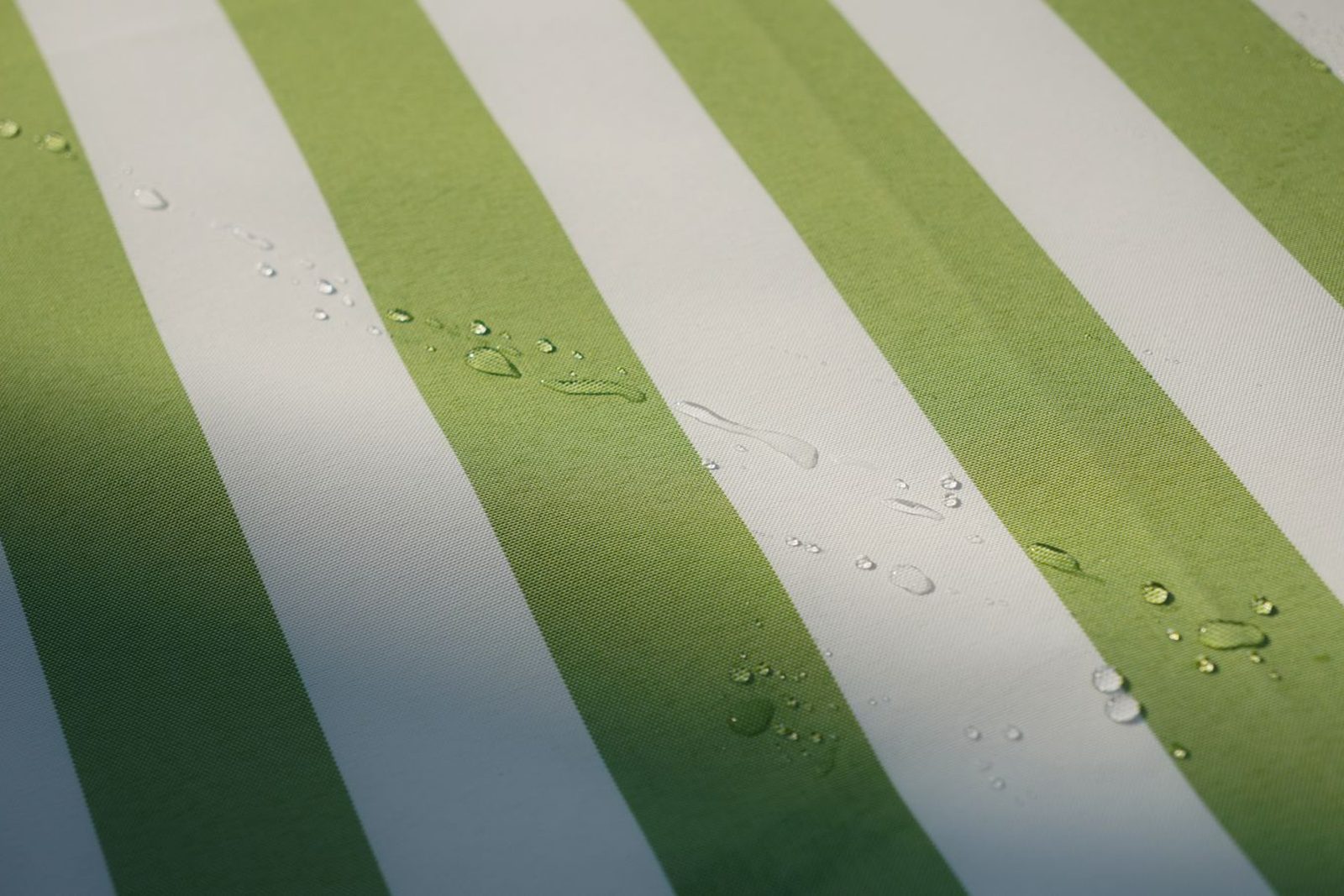
Water beads distributed on the surface of a green-and-white striped fabric
Outdoor fabrics lose spray rating grade by grade after repeated washes; water beads spread across the surface instead of rolling off, wet patches appear first at the cuffs and shoulder seams, and re-finishing batches keep increasing.
Chemi Tech supplies the KMF-603 series water repellent for the water-repellent finishing of polyester and nylon outdoor fabrics. It forms a continuous film on the fibre surface, balances spray rating with hand feel, and is compatible with common softeners and resins in the same bath. The dosage can be adjusted flexibly according to fabric weight, wet pick-up and curing temperature, and measured data on rating decay after repeated washes are available. The finishing bath concentration is set by fabric type and curing conditions, and the dosage lands in that grade.
Advantages of Chemi Tech Water Repellents
The Chemi Tech KMF-603 series water repellent is designed for the water-repellent finishing of polyester and nylon outdoor fabrics. The film on the fibre surface is continuous, the spray rating stays in the passing grade, and the hand feel remains soft without stiffness or harshness; wash durability is strong, with rating decay slowing after multiple washes; it is compatible with softeners and resins in the same bath; the curing temperature window is wide, so the existing curing conditions of the fabric mill can be retained.
Industry Pain Points and Solutions
Low wet pick-up, insufficient curing crosslinking and mechanical friction during washing: when these three come together, the integrity of the finishing film drops round by round, and the result lands on the spray rating and on visible wet patches.
With low wet pick-up, the film on the fibre surface is not continuous and the spray rating falls by one grade within the first few washes. KMF-603 forms a continuous film; once wet pick-up and curing temperature are checked, the dosage is rated anew by fabric type and the spray rating stays in the passing grade.
When the curing temperature is set too low, crosslinking is insufficient and the spray rating falls with each wash cycle, leaving spreading wet patches on the face of the cuffs. Comparing curing at one hundred and twenty degrees Celsius with curing at one hundred and fifty degrees Celsius side by side, rating decay narrows from three grades to one, and the finishing bath concentration is rated by the curing conditions.
Mechanical friction in the wash section puts one more strain on the finishing film. The KMF-603 series is wash durable, so the number of re-finishing rounds can stay as it is; once fabric weight, wet pick-up and curing temperature have been checked, the dosage for this batch of fabric can be released to the finishing workshop and continued by grade; in the wash rounds where detergent alkalinity runs high, decay is faster.
Typical Operating Conditions and Verification
Customer case: the water-repellent finishing workshop of an outdoor fabric processor in Fujian, applied to the curing section for polyester and nylon fabrics. The processor came to Chemi Tech because of a customer complaint photo: wet patches at the cuff, while the body of the garment was still dry. In the follow-up notes, the wet patches spread over a wider area on polyester batches than on nylon batches, and re-finishing rounds were rising month by month. Comparing fabric weight and wash conditions, KMF-603 was selected as the water-repellent grade for this fabric, with the finishing bath concentration rated by wet pick-up and curing temperature. The records after finishing show the decay of the cuff rating converging with that of the body, wet patches no longer spreading to the reverse side of the fabric, the spray rating staying in the passing grade after repeated washes, and fewer re-finishing rounds.
Frequently Asked Questions
It is often said that a water-repellent finish stops holding after a few washes. Is that so?
It is governed by wash cycles, wash temperature and detergent alkalinity, so it cannot be generalised. The KMF-603 series forms a continuous film on the fibre surface and is wash durable; Chemi Tech works out the measured data on spray rating and wet-patch rating together from the wash records of the same fabric type, so the decay trend can be traced as a curve over the wash cycles, with the actual figures subject to that mill's own conditions. Wet pick-up has to be corrected in the dosage and the curing temperature adjusted accordingly; once fabric weight and curing conditions are provided, Chemi Tech can give a reference first on the basis of lab samples and line trials; as for the limit over repeated washes, that is left to the mill's own wash records to trace.