
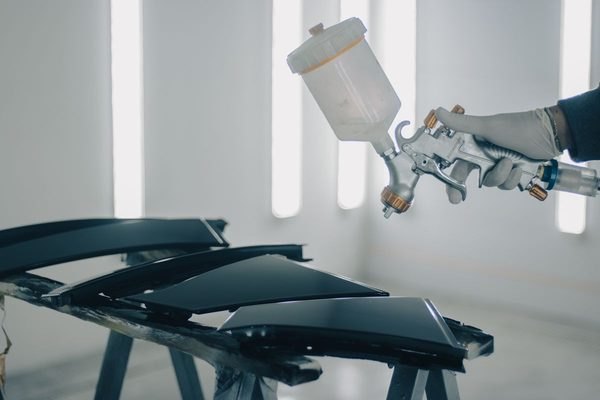
Craters and orange peel on an industrial baking enamel mostly come out of the formulation and the bake curve: insufficient substrate wetting, the wrong solvent evaporation gradient, an oven ramp that is too fast. Stack a few of those together and the film will not flatten.
Leveling agents are one of Chemi Tech's core lines, aimed at coil coatings, metal part baking enamels and water-based industrial paints. The KMT series covers both silicone and acrylic routes, matched to system polarity.
Business Advantages
First, it flattens orange peel and holds both long-wave and short-wave in check. Waviness after the film dries is smaller and gloss is more uniform.
Second, it resists craters and wets the substrate more fully. It is less sensitive to oil and adhesive residue, and panel edges are less likely to pull back.
Third, compatibility is controllable: no haze and no recoat problems. Within the dosage window the surface does not float out and recoat adhesion is unaffected.
Fourth, it works in water-based and solvent-based alike, so changing the solvent system does not mean changing the additive. The same product finds a usable addition point in both.
Boundary on these figures: the behaviour is based on conventional baking enamels and coil coating lines. Change the resin or the solvent system and it differs. Run test panels before going into production.
Industry Pain Points and Solutions
Surface defects on baking enamel are hard to handle because craters and orange peel have similar causes, over-dosing an additive backfires, and the substrate and the bake curve both have to be looked at. Several threads pull at once.
Pain point one: craters keep coming back. The spray booth has been cleaned and stray craters still appear. The answer is to choose the type from substrate wetting and surface state.
Pain point two: orange peel will not flatten. Raise the dosage and gloss starts to swing instead. The answer is to separate long-wave from short-wave and adjust leveling and the evaporation gradient together.
Pain point three: adding more additive produces side effects. The surface floats out and recoat adhesion gets worse. The answer is to define the dosage boundary and find the window before adding more.
The three-step benchmarking routine on this line is: measure the substrate surface state and the bake curve first, then compare test panels on the same paint, and finally fix the addition point and the dosage range.
Typical Conditions and Verification
Coil coating lines run fast with a quick oven ramp, and metal part enamels mostly cure between one hundred and forty and one hundred and eighty degrees Celsius. Craters and orange peel usually show on the first part and on the first few metres after a colour change.
Four failure signals are worth watching: regular crater patterns on the panel; a high long-wave reading; haze in the clearcoat; adhesion dropping after recoat. Hit two and it is back to test panels for re-verification.
Test panel data and line records at the same resin system are archived by the technical team and available for comparison.
FAQ
Q1: Why can't a leveling agent and a defoamer be chosen together?
The two act in different directions on the paint surface state. A poor combination pushes craters or foam to the other side, so the types should be fixed separately and then checked together inside the same formulation.
Q2: Will extra leveling agent affect recoat and intercoat adhesion?
That risk exists; past the window the surface additive tends to enrich. Run a gradient panel series first and set the upper limit from recoat adhesion rather than adding by feel.
Q3: What verification order should a switch from an imported leveling agent follow?
Record the original product's panel gloss, long-wave reading and recoat adhesion as a baseline first, reproduce them on the domestic system under the same process, and reach a conclusion after a period of running the two in parallel.