
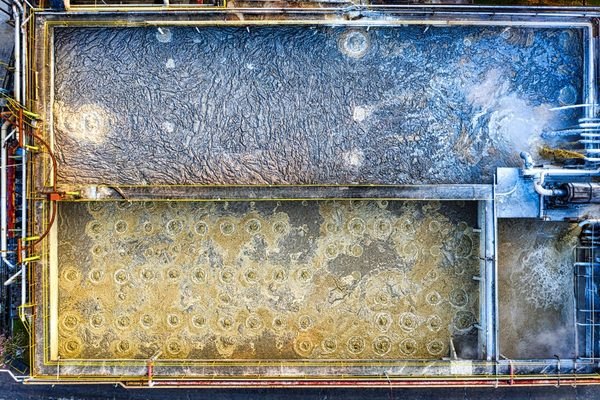
Leachate foam is not quite the same problem as ordinary wastewater. The liquor is high in salt and heavy in organic load, the treatment train is long and a membrane stage sits in the middle of it. Foam stacks up in the biological basin, carries sludge over the wall and drives blower discharge pressure up with it.
Around high-salinity, high-load water bodies such as landfill leachate, Chemi Tech keeps three defoamer families, silicone-polyether, polyether and silicone, matched separately to the biological stage and the membrane stage. Aeration and evaporation conditions are covered from the KM series defoamer line.
Business Advantages
First, it tolerates salt without separating and holds up in high-salinity water. As salt content rises the emulsion does not break and defoaming capability varies little with water quality swings.
Second, it does not panic at a shock load and holds the line when the influent spikes. When concentration surges, foam returns slowly, so dosage does not have to be pushed up reactively and the operator makes fewer trips to the basin.
Third, foam hold is longer and dosing frequency comes down. The foam layer on the basin thins out and the dosing pump cycles less.
Fourth, it adds little trouble of its own: it neither blinds the diffusers nor plugs ahead of the membranes. The components do not clump in the system, so diffuser plates and pre-membrane filters are harder to foul.
Boundary on these figures: from Chemi Tech's site records, the behaviour above comes from typical leachate conditions. Change the water quality or the process and the data has to be recalculated. Run a small-scale trial before dosing.
Industry Pain Points and Solutions
Foam on the leachate route is awkward: high salinity, large swings in organic load and a long treatment train, all tangled together.
Pain point one: foam builds in the biological basin, carries sludge over the edge and the water surface disappears. The answer is a salt-tolerant component, with water quality parameters as the screening prerequisite.
Pain point two: when influent concentration surges the foam doubles and the dose gets pushed up reactively. The answer is to work from foam hold and cut reactive top-ups.
Pain point three: foam ahead of the membrane affects flux and pressure differential climbs early. The answer is to treat defoaming and membrane protection as one problem so less residue is left upstream of the membrane.
On site Chemi Tech follows three-step verification: reproduce the water quality on your own samples first, then run a bench defoamer trial, and close by fixing the type and the dosing method.
Typical Conditions and Verification
The biological stage of a leachate plant varies in temperature with the season, and retention time is often extended to suit the water quality. Foam on the basin rises fastest after an influent spike and after blower load is adjusted.
Failure signals usually show up in four places: a foam layer thick enough that no water is visible; top-up frequency rising; blower discharge pressure running high; membrane pressure differential climbing fast. Two of those and a site trial should be arranged before anything is changed.
Operating data at the same water quality and the same process train still differs between sites and has to be compared plant by plant. The relevant records can be requested from Chemi Tech.
FAQ
Q1: Why can't leachate treatment copy what municipal wastewater does?
That class of defoamer formulation tends to fail under high salinity and high load, foam comes back repeatedly, and residue is left ahead of the membrane.
Q2: Does the chemistry affect biological activity?
It has to be verified on site. Microbial populations differ in sensitivity to chemistry, so the site trial decides, with effluent parameters watched at the same time.
Q3: How many steps does replacing an imported product take?
Record the original product's dosing rate and the basin condition as a comparison baseline first, reproduce it equivalently on the same water samples, and scale up after running in parallel for one cycle.