
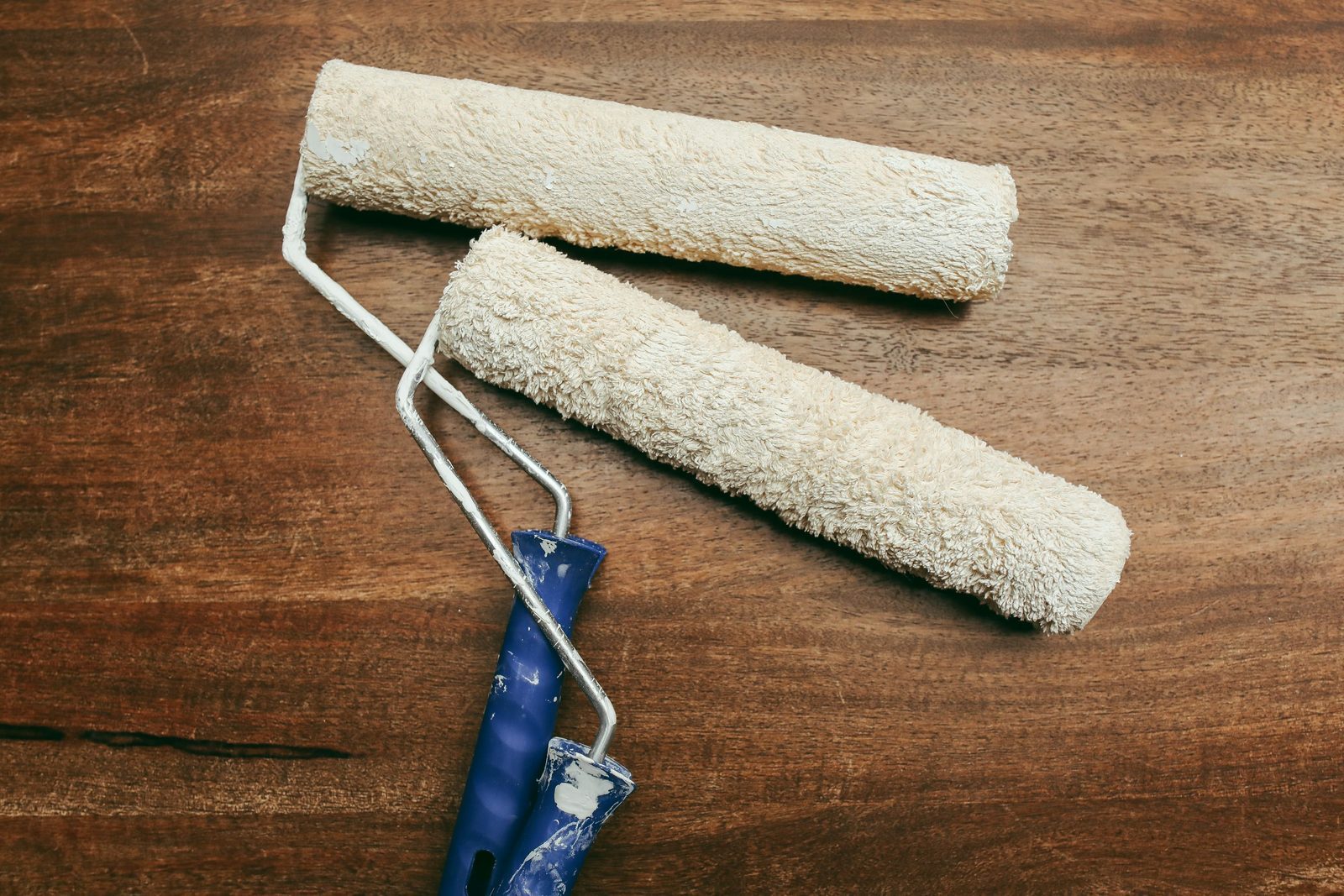
A paint roller and coating material on a wooden bench, the coating spread evenly
Nothing much shows while the paint is being stirred in the tank, but once it goes onto the curtain head or the coating roller, pinholes and craters come out in patches, and after baking the touch-up hours exceed whatever the earlier stages saved.
Chemi Tech makes defoamers for water-based architectural coatings, wood and furniture coatings and industrial paints, from the defoamer KM-502 series. Which grade to add depends on the resin system, the pigment and filler loading and the application method. Where the coating must stay clear, KM-502 is the right match, a modified polysiloxane in a transparent emulsion form; in polyether-compatible systems, KM-1040, a high-efficiency polyether, holds both its defoaming performance and its clarity. Send the system type and the application method to our technical department and we will set the addition points for you across the grind and let-down stages and recommend the process parameters.
Advantages of Chemi Tech Defoamers
The Chemi Tech KM-502 series grades are well compatible: added in, they do not cause craters and leave no fish-eye defects on the film surface. The effect on gloss is small as well, so a clearcoat system stays clear after dosing, with no hazing or clouding. Suppression of micro-foam is solid too, catching the fine bubbles you cannot see and carrying them out, so the curtain head no longer shows a sheet of pinholes. Foam suppression also lasts, holding from let-down through to the end of application with no mid-run top-up needed. There is further heat resistance through to the baking stage, so the oven no longer throws bubbles back out.
A note from Chemi Tech: the behaviour above comes from a typical water-based wood coating let-down condition. Change the resin system or the pigment and filler loading and the results move. Confirm on a small trial before scaling up.
Industry Pain Points and Solutions
Foam in coatings is not troublesome where it can be seen. It is troublesome because it hides in the coating and only appears at the film-forming step.
The first thing to go wrong is adding the defoamer at the wrong stage. Some plants take the easy route and tip the whole pail into the let-down tank; the product never disperses properly and brings in a sheet of craters itself. Chemi Tech splits the dosing into two stages: one grade at the grind to hold down mechanical foam, another at let-down to take out the fine, tight foam.
Compatibility is what surfaces next. If the defoamer is not compatible with the emulsion, a film of oil floats up after the paint stands overnight and the surface carries a sheet of defects once it goes on the roller. What a workshop fears most is exactly this: nothing visible that evening, and the problem only found the next morning when the roller starts, with a whole shift's output riding on it. Chemi Tech's approach is to verify compatibility under both standing and heated conditions first, and only scale up once both pass.
Once on line there is one more point that does not hold: what works in the lab does not necessarily work on site. Lab stirring speed is far from a production line's, and the dynamic foam volume is a completely different matter. Chemi Tech's approach is to run dynamic foam comparisons against the customer's actual application method and shear conditions.
The heat storage data comes from us. Compatibility, dynamic foaming and heat storage stability are worked through in sequence, and adding two lines to the let-down record is all it takes to run with.
Typical Conditions and Verification
Customer: a water-based wood coating producer in Zhejiang, for the let-down and roller-coating stages of furniture coatings.
The plant's furniture coatings had been showing too many pinholes on the test panel, and after roller coating a few boards out of every batch needed rework, with the rework hours all landing on the coating line. The solution Chemi Tech defoamers provided was this: working from the resin system and the pigment and filler loading, KM-502 was selected from the KM-502 series, the addition points were split between the grind and let-down stages, and the dosage was re-banded to the application method. After the change the pinhole count on roller-coated boards came down noticeably, and the rework station went from running every day to running on demand. The standby pail of defoamer in the let-down workshop was later halved in use.
FAQ
Will adding too much defoamer actually cause craters?
It can. Problems of that kind are usually not the defoamer itself being poor, but it going in concentrated and never dispersing; a locally high concentration pulls the surface tension into a gradient. The KM-502 we supply to coating plants is dosed in stages and does not cause craters at normal use levels. Give the resin system, the pigment and filler loading and the application method to our technical engineers, and we will run the compatibility and dynamic foaming comparisons and come back with the results together with the recommended stage-by-stage dosage.