
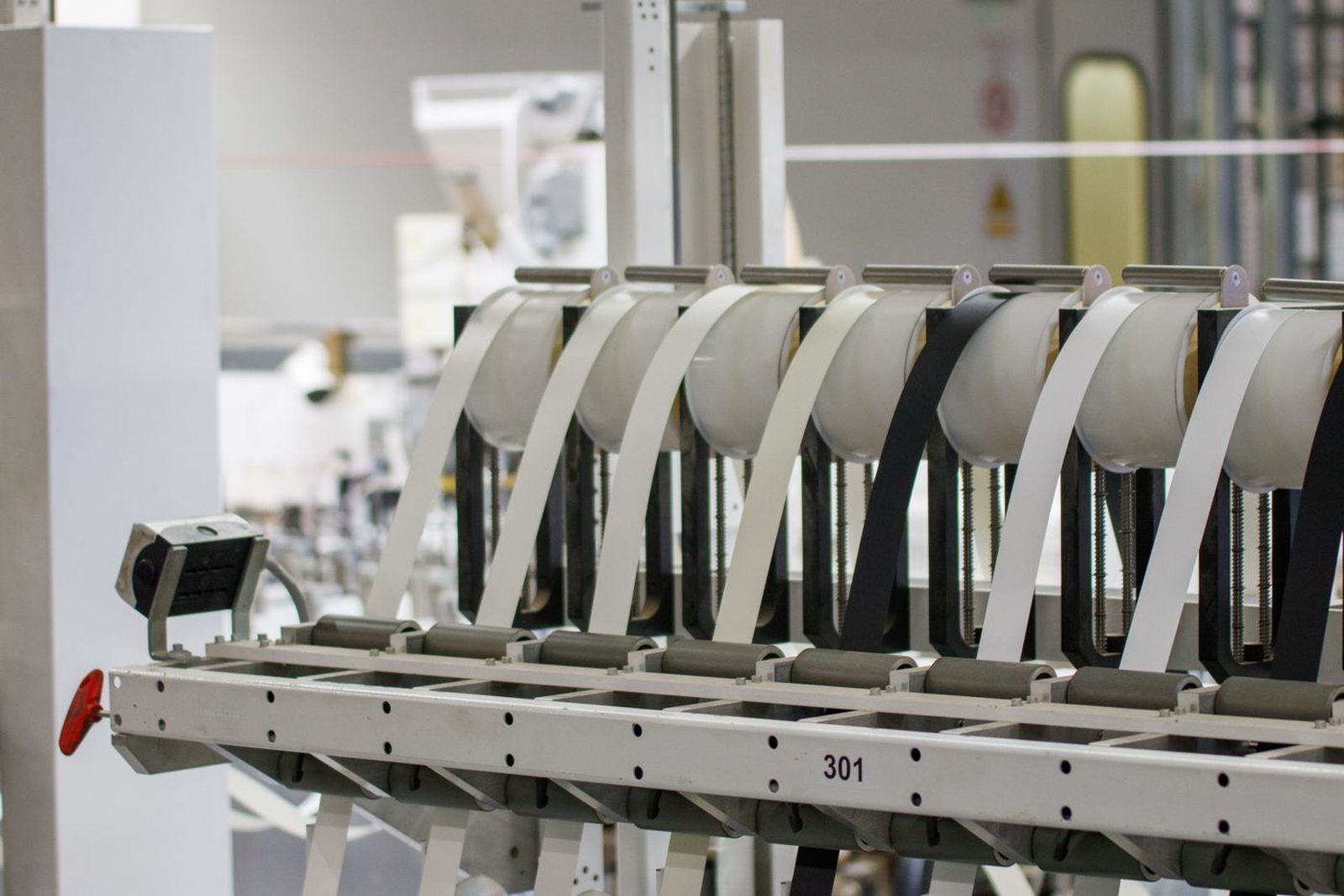
Rolls of material and rollers being conveyed on a production line
Cathode slurry is ground to spec on fineness, yet the particles re-agglomerate on standing, leaving particles and scratches on the electrode sheet during coating; the areal density then fluctuates and the consistency of the finished product suffers with it.
Chemi Tech supplies dispersants for lithium battery cathode slurries and battery material systems, drawn from the dispersant KMK-409 series; the addition level varies with the specific surface of the powder, the solids content of the slurry and the mixing process. KMK-409 is designed for the dispersion stability of the particles in the slurry, holding back re-agglomeration while the slurry stands and is conveyed; KMK-209 in the same series is banded by solids content, for different formulations to draw on. Chemi Tech compares dispersion performance against the powder parameters and the mixing process, and matches the dispersant that fits.
Advantages of Chemi Tech Dispersants
Chemi Tech dispersant KMK-409 series is designed for the dispersion stability of the slurry, so it does not readily coarse up on standing after grinding; further, viscosity stays within a controllable range and the coating areal density is steady with it; it adapts well to high-solids formulations, and the slurry still flows when the solids content is raised; storage behaviour is stable, and the slurry at the coating station is close to its state when mixing was finished.
Industry Pain Points and Solutions
Particle problems in cathode slurry are mostly not a matter of insufficient grinding capacity but of the dispersant's coverage of the particle surface failing in later process stages; the consequence is particles and scratches on the electrode sheet and fluctuation in the areal density.
The first problem to show up is re-agglomeration after standing. The particle size distribution narrows just after grinding, but once the slurry stands for a while the particles draw close again and the particle size climbs back. Chemi Tech's approach is to add KMK-409, whose dispersing action is stable, at the start of mixing, so that the agent is already attached when the powder is first wetted.
The second is viscosity rising with the solids content. Once the slurry solids content is raised its flow falls, the resistance to mixing and conveying grows, and the coating thickness fluctuates with it. Chemi Tech compares dispersion against the specific surface of the powder and the solids content, and calibrates the addition level and the mixing time as one.
In addition, the storage state of the slurry tends to drift. Once mixed, the slurry settles and separates after standing for a while, and by the time it reaches the coating station its state differs from what it was at testing. Chemi Tech compares stability over the storage period, so that the slurry holds a consistent state up to conveying and coating.
Typical Conditions and Verification
Customer: a lithium battery cathode material producer in Hunan, for the mixing and coating sections of the cathode slurry.
The slurry this plant produced coarsened up again after standing following grinding, coating threw particles and scratches onto the electrode sheet, the areal density fluctuated widely, and the consistency of the finished product was long constrained. The solution Chemi Tech dispersant gave for this was: against the specific surface of the powder and the solids content, KMK-409 was selected, the dosing point was set at the start of mixing, and the addition level was banded by solids content. After the solution was in place, the particle size held steady after standing, particles and scratches on the electrode sheet were noticeably reduced, and the fluctuation in areal density narrowed.
Frequently Asked Questions
If the dispersant addition level is raised, will it weaken the adhesion or the conductivity of the electrode sheet?
That concern is not unfounded, since a few categories leave residues inside the electrode sheet while dispersing the powder. KMK-409 has been put through dispersion and coating comparisons at Chemi Tech across different addition levels, and only levels that keep both slurry and electrode sheet steady are recommended. The addition level depends on the specific surface of the powder, and Chemi Tech gives its recommendation after comparison of mixing and coating.