
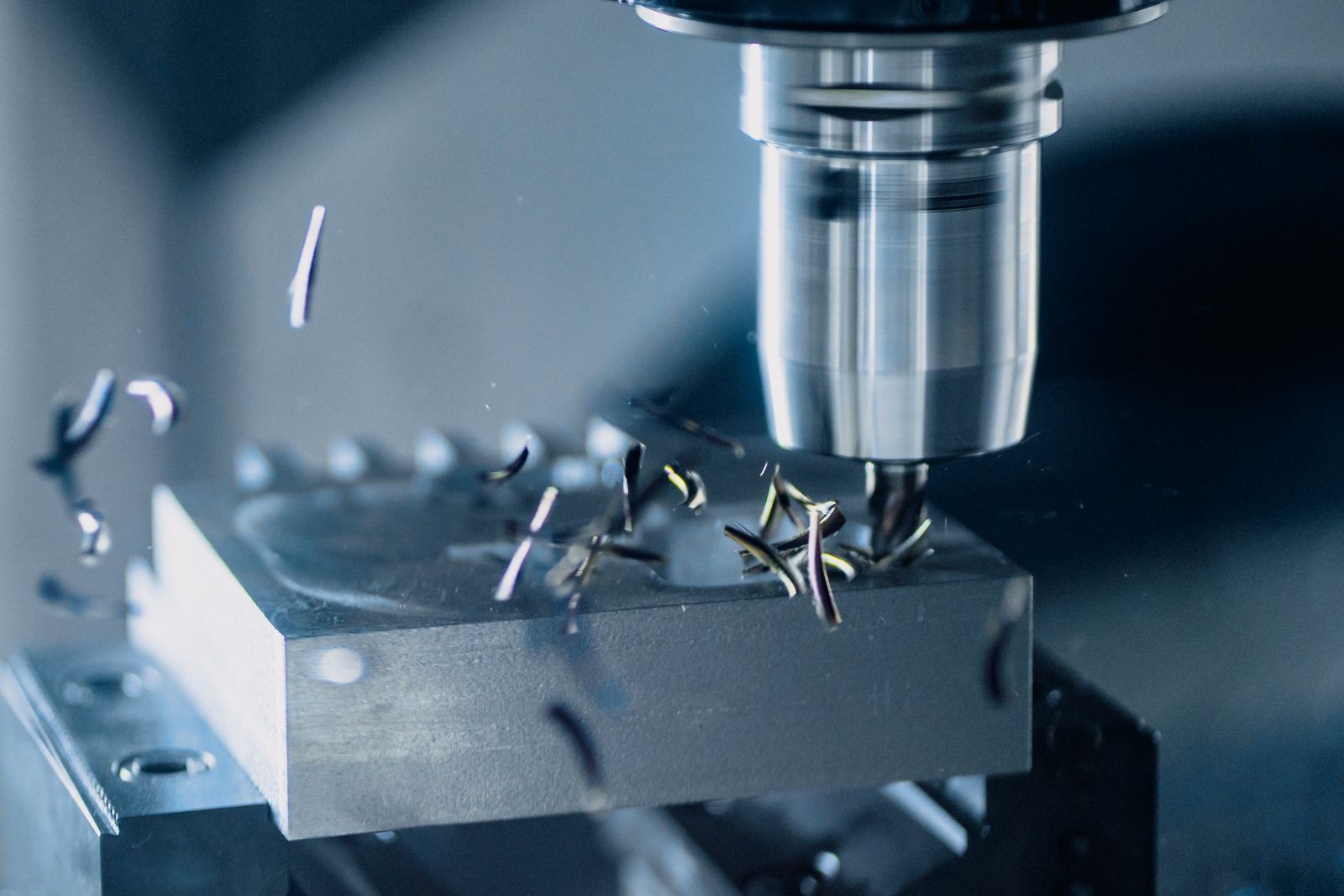
Close-up of a metalworking machine cutting a workpiece
Emulsion circulates in the machine tank for long stretches; once foam piles up to the tank rim, the pump inlet draws air with it, the supply pressure swings back and forth, and the machined surface roughness and the tool life suffer together.
For metalworking fluid and cutting fluid systems, Chemi Tech supplies the KMT-485 series defoamer; the dosage is set by the cutting fluid type, the dilution ratio and the circulation rate. This grade benchmarks Momentive SAG 4865, with a more controllable supply cycle and response; Chemi Tech runs measured comparisons of the foam layer height and the supply pressure, and matches a fitted grade for the customer.
Advantages of Chemi Tech Defoamers
Chemi Tech KMT-485 series defoamer breaks foam quickly, and the floating foam on the tank surface is cleared within a few circulation rounds; at the same time, it resists acid, alkali and hard water, and fluctuations in the pH of the diluted fluid do not affect its foam suppression; moreover, it is compatible with emulsion and semi-synthetic fluids, and after dilution it neither separates nor throws oil; and it is shear-resistant, with its foam suppression not decaying under the machine's high-pressure flushing and long circulation; compared with imported grades, KMT-485 is more stable in supply cycle and response time and can serve as a replacement.
Industry Pain Points and Solutions
Foam in cutting fluid usually stems from the tank circulation volume and the additive compatibility rather than from choosing an over-large circulation pump; the consequence is supply pressure fluctuation and rising machined surface roughness.
Trouble often starts at the tank make-up inlet. When fresh fluid is added, the fall and splash carry air in, and the foam already held down in the tank is stirred up again. Chemi Tech fixes the KMT-485 dosage by the cutting fluid type, and the foam is broken before the fluid returns to the pump inlet.
What shows up next is the instability of the diluted fluid. Hard water and pH fluctuation pull apart the dispersion state of the diluted fluid, and the filter burden grows with it. KMT-485 resists acid, alkali and hard water, and the dispersion state stays even after dilution.
The remaining point lies in fully synthetic systems. A fully synthetic fluid itself has a higher foaming tendency, so the dosage of an ordinary defoamer has to be pushed up and the cost rises with it. Chemi Tech checks grade by grade against the cutting fluid type and the dilution ratio: the semi-synthetic system keeps KMT-485, while the fully synthetic grade switches to KMT-1226; after the recommended dosage range is re-set, the supply pressure reading no longer swings.
Typical Operating Conditions and Verification
Customer: an auto-parts machining enterprise in Jiangsu, for the centralized fluid supply system of a machining center.
After continuous machining, this plant's emulsion foam piled to the tank rim, the supply pressure gauge needle swung back and forth, chatter marks appeared on the machined surface, and the tool-change frequency rose. An imported grade had been tried before but failed to hold the foam down steadily. Chemi Tech turned instead to the cutting fluid type and the dilution ratio: the grade was set as KMT-485, the dosage was graded by the circulation volume of the centralized supply system, the dosing followed the existing process, and it served as an import replacement. After the switch, the floating foam on the tank surface was essentially cleared and the supply pressure reading no longer swung; the chatter marks on the machined surface disappeared with it, the tool-change cycle returned to normal, and the performance matched that of the imported grade.
Frequently Asked Questions
Will adding a defoamer to metalworking fluid cause the diluted fluid to separate or the filter to clog?
Whether the diluted fluid separates depends on the compatibility between the defoamer and the system. Chemi Tech KMT-485 has completed dedicated compatibility tests in three systems — emulsion, semi-synthetic and fully synthetic — and within the recommended dosage range the diluted fluid neither separates nor throws oil. If you currently use an imported grade, Chemi Tech can run a dedicated comparison first and give a replacement dosage; the actual dosage must be fixed together with the cutting fluid type, the dilution ratio and the circulation volume.