
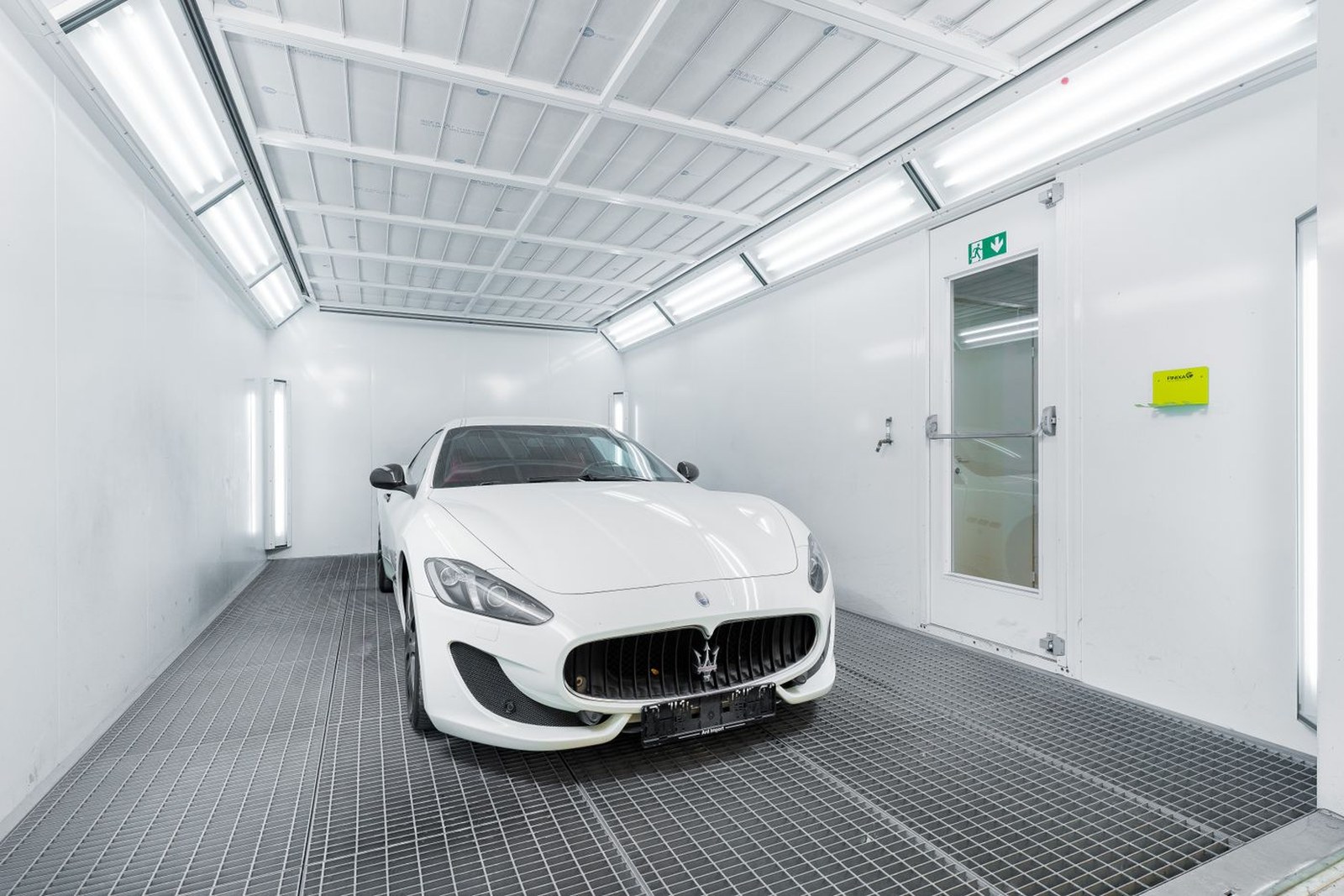
Automotive bodies being sprayed inside a paint booth
Once the topcoat line for automotive parts speeds up, the drying window of the waterborne paint narrows with the line speed; the paint cures into film before it has flowed flat, orange peel repeats on every part, waves show clearly on the panel under side light, and rework batches rise with them.
Chemi Tech has introduced the KMP-4500 series leveling agent for automotive coatings and waterborne industrial coatings, with the dosage adjusted flexibly according to paint solids and spray line speed. This grade is a waterborne leveling agent with a significant effect on lowering surface tension; dynamic surface tension in waterborne systems is held down as well, so the leveling window opens up accordingly, and intercoat adhesion is not affected. Taking measured data on panel orange-peel grade and gloss readings as the basis, an adapted KMP-4500 solution can be selected.
Advantages of Chemi Tech Leveling Agents
Chemi Tech KMP-4500 series leveling agent is configured for waterborne systems in automotive coatings. The effect on lowering surface tension is significant, so the paint spreads fully across the panel and orange peel is gradually leveled out; dynamic surface tension is held down as well, leaving ample leveling window after atomised spraying; compatibility is outstanding, so no craters are triggered and intercoat adhesion and recoatability are unaffected; the influence on gloss is small, so topcoat gloss readings do not swing with additive dosage; and the dosage is adjusted flexibly to paint solids, fitting both topcoats and their matching primers.
Industry Pain Points and Solutions
Leveling problems in automotive topcoats arise mostly from the combined action of atomisation shear during spraying and a mismatch of paint surface tension, and the consequences are concentrated in two places: repeated orange peel and unstable intercoat adhesion.
Orange peel is copied part after part along the spray path, and is especially obvious on light-coloured panels under side light. After the KMP-4500 dosage is pinned down by spray line speed, the panel orange-peel grade is pressed down accordingly.
Unstable intercoat adhesion exposes two-pass spraying to a risk of delamination, and the pull-off value in the adhesion test fluctuates near the critical line. KMP-4500 has outstanding compatibility and leaves margin for intercoat adhesion.
Rework batches occupy spray line hours and slow the delivery rhythm of the whole paint shop. By tying the dosage to changes in paint solids and spray line speed, an additive range can be defined that secures a panel passing first time out of the oven.
Typical Operating Conditions and Verification
Customer case: an automotive parts coating plant in Anhui, for the waterborne spraying stage of bumper topcoat.
After the plant switched to waterborne topcoat, the panel orange-peel grade rose noticeably, waves ran together under side-light inspection, and the adhesion test occasionally fluctuated at the critical line. After a comparison test on panel orange-peel grade and gloss readings, the plant adopted KMP-4500 as its topcoat leveling agent, with the dosage pinned down by spray line speed. After the change, the orange-peel grade fell back to the qualified band; gloss readings stayed steady; intercoat adhesion in two-pass spraying passed consistently, and rework batches fell noticeably.
Frequently Asked Questions
When waterborne spraying speeds up, does the leveling agent have to be dosed up in step?
Put dynamic surface tension and the leveling window side by side and read them together. KMP-4500 has completed orange-peel and adhesion comparison tests across several line-speed bands, and within the recommended range leveling performance stays stable and controllable. The actual dosage takes paint solids and spray line speed as the baseline, then balances the drying curve as a further correction; Chemi Tech pins down an adapted solution through a parallel comparison of panel orange-peel grade and gloss readings.