
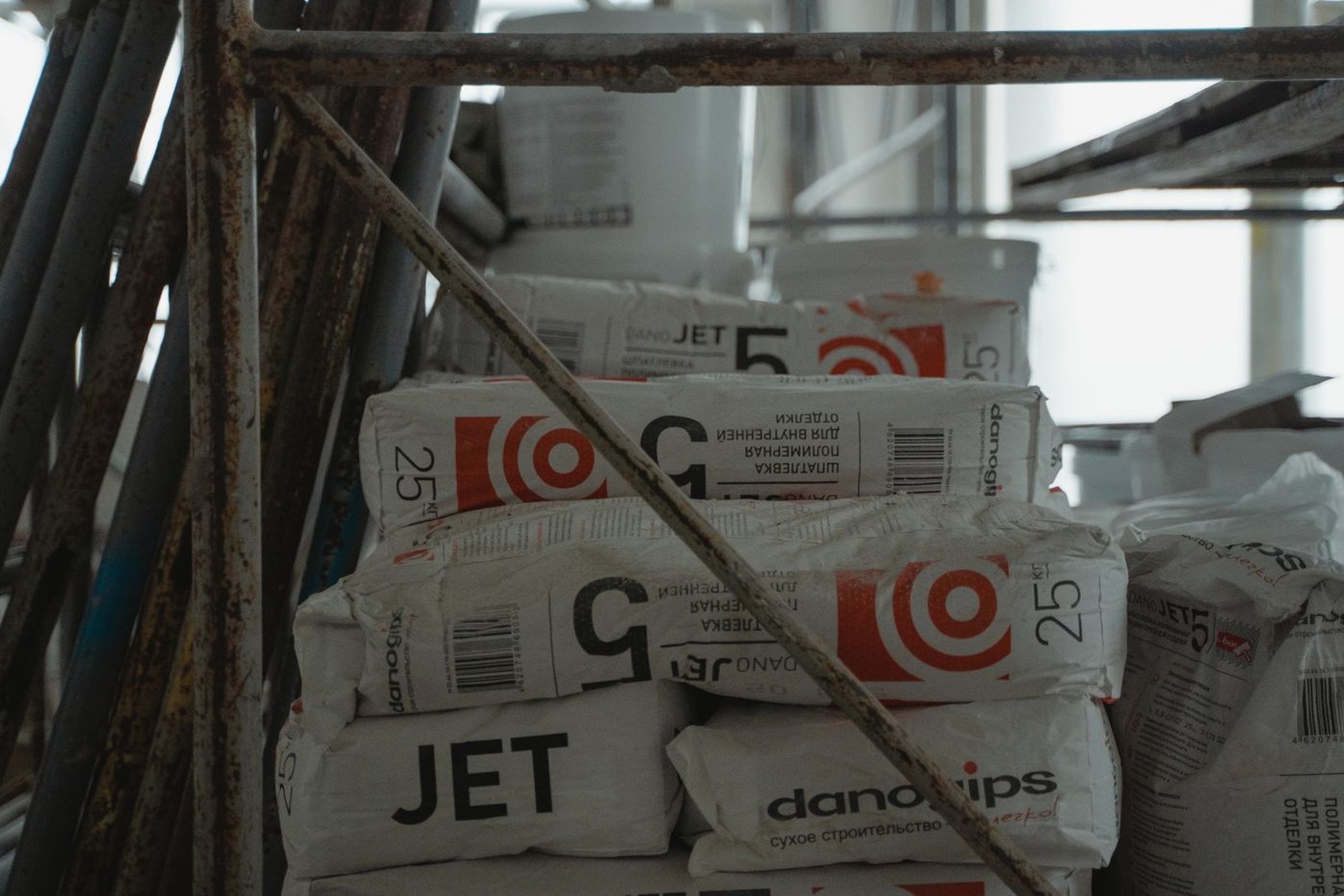
Cement bags stacked inside a warehouse
Once a dry-mix mortar line raises output, air entrained in the powder grows in the mixing drum, voids break out on the surface of press-formed boards, surface density slides, and both compressive strength and appearance acceptance come under pressure.
Chemi Tech has introduced the KM-955 series powder defoamer for dry-mix mortar and powder formulations, configured in silicone and silicone-free grades and added in dry mix together with the powder. This grade comes in powder form, disperses evenly in dry-mix systems and does not affect the workability of the mortar. Taking measured data on surface density and press-form void count as the basis, an adapted KM-955 dosage can be defined.
Advantages of Chemi Tech Defoamers
Chemi Tech KM-955 series powder defoamer is configured for dry-mix powder systems. The powder form can be metered in directly with the dry powder, with no extra process step; dispersibility is good, distributing evenly in dry-mix systems without caking or wall build-up; silicone and silicone-free grades are both available, fitting different formulation systems; the antifoaming effect lasts, keeping the mortar low-foam throughout once water is added; and the dosage is economical, adjusted flexibly to the powder ratio, with voids in press-formed products noticeably reduced.
Industry Pain Points and Solutions
Foam problems in dry-mix mortar arise mostly from the combined action of air entrained during powder mixing and air introduced by admixtures, and the consequences are concentrated in two places: press-form voids and a porous surface.
Voids on demoulded boards directly pull down product strength, and the compressive value of sampled test blocks fluctuates near the critical line. With the KM-955 dosage pinned down by powder ratio, voids on demoulding are noticeably reduced.
A porous surface makes vibration and trowelling labour-intensive, and the time workers spend finishing the surface is repeatedly stretched. KM-955 in powder form disperses evenly and can effectively reduce air entrainment during mixing.
Rework on finished product and compensation for insufficient strength both convert into cost per tonne of material. By tying the dosage to changes in powder ratio and mixing intensity, a dosage band can be locked in that secures a conforming form in a single pass.
Typical Operating Conditions and Verification
Customer case: a dry-mix mortar manufacturer in Henan, for the dry-mix mixing stage of masonry mortar.
After the plant raised output, voids on demoulded boards increased noticeably, the compressive value of test blocks came under pressure repeatedly, and rework batches rose with them. After a comparison test on surface density and press-form void count, KM-955 was set as the plant's replacement solution, with the dosage pinned down by powder ratio. After the change, voids on demoulded boards fell noticeably; surface density returned to normal; the compressive value of test blocks met specification steadily, and rework batches fell noticeably.
Frequently Asked Questions
Will adding a powder defoamer into the dry mix affect the workability of the mortar?
Read powder fineness and entrained air after mixing as two lines of evidence together. KM-955 has completed workability comparison tests on dry-mix mortar conditions, and within the recommended range it has no adverse effect on mortar workability. The actual dosage takes the powder ratio as the baseline, with mixing intensity and mixing time as corrections; Chemi Tech pins down an adapted dosage through a parallel comparison of surface density and press-form void count.