
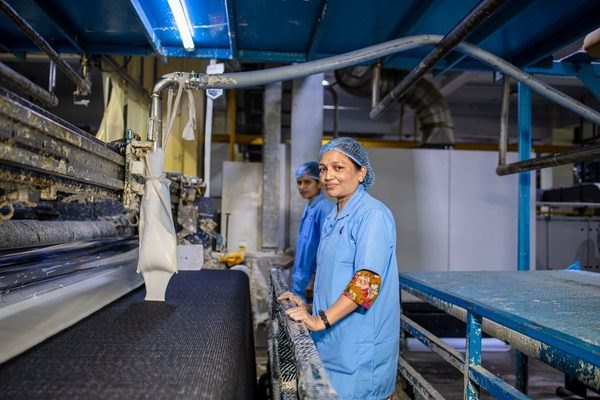
Water-repellent finishing on nonwovens runs fast, the fabric is light in grammage, and the treatment liquor in the circulating bath draws in air as soon as it is agitated. Once there is foam on the surface, water repellent deposits unevenly across the web, the rating changes batch to batch and downstream processing is affected with it.
For nonwovens and textile finishing, Chemi Tech keeps a fluorine-free water repellent range, matched to fibre type and finishing method. Continuous padding and spray application both connect to it, with the crosslinker component adjusted alongside.
Business Advantages
First, continuous finishing runs without drift and the repellency is even across the web. Wet pick-up stays stable as line speed goes up, so the spread of the rating narrows.
Second, it does not fall a grade on washing and repellency survives laundering. With crosslinking complete the film adheres firmly, the drop after repeated washes is small, and the service life of the finished article is longer.
Third, the hand does not go stiff and softness stays where it was. The web does not turn brittle after finishing, so wear comfort on protective products is not compromised.
Fourth, it does not fight its bath partners. The liquor resists separation and does not gel or settle in the trough.
Boundary on these figures: the results come from typical nonwoven finishing conditions. Change the fibre and process combination and the conclusions may not carry over. Run a small-scale trial before switching.
Industry Pain Points and Solutions
The difficulty in nonwoven repellent finishing is that high line speed, low grammage and a foaming liquor all arrive at once.
Pain point one: foaming liquor deposits unevenly and streak marks appear on the web. The answer is to keep the liquor stable and deal with the foam in the same move.
Pain point two: the repellent rating drops quickly after washing and the finished product does not last. The answer is a system with more stable crosslinking, treating wash durability as a hard specification.
Pain point three: hand and repellency pull against each other, and stiffness costs comfort. The answer is to adjust the proportions of the companion components so both are judged together rather than sacrificing one for the other.
Chemi Tech's habit here is a three-step verification: reproduce the finishing conditions on your own fabric first, then run a machine trial, and finally fix the dosage and the process sequence.
Typical Conditions and Verification
Nonwoven finishing lines commonly run around fifty metres a minute, with wet pick-up adjusted by grammage. The liquor surface is least stable at start-up, at formulation changes and when circulation is sped up.
Failure signals generally come out in four places: foam building up on the trough surface; streaks and missed repellency points on the web; a marked drop in rating after laundering; a stiff hand on the finished article. Two of those and the line should be stopped for a machine trial.
Measured results at the same grammage and the same finishing method are on record at Chemi Tech for comparison, with ratings before and after washing both available.
FAQ
Q1: Why should nonwovens go the fluorine-free route?
A fluorine-free system is more secure against regulation and order requirements, and it avoids the supply chain uncertainty that comes with fluorinated raw materials.
Q2: Will a water repellent affect softness and breathability?
That needs separate verification. Change the fibre or the finishing method and the results differ, so the on-site trial decides, with hand and moisture transmission assessed together.
Q3: How do you move from an imported repellent to a domestic one?
Draw a baseline from the original product's dosage and repellent rating, reproduce it equivalently on the same fabric batch, and switch once a full order run has been completed.