
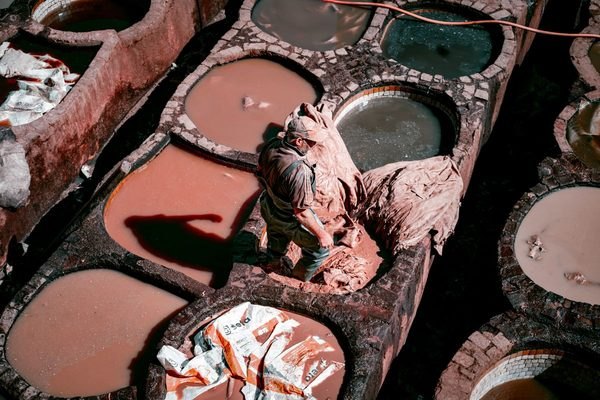
Leather wet processing runs through foaming conditions almost the whole way. Liming liquor is high in alkali, degreasing liquor carries saponified matter, and surfactant goes into the dye bath as well. Foam builds in the drum and spills out carrying hides and auxiliaries with it.
After years supplying tannery auxiliaries, Chemi Tech covers liming, degreasing, retanning and dyeing with three routes: silicone, polyether and silicone-polyether. They are matched to bath alkalinity and medium type, and long soaks in strong alkali are covered from the KM series defoamer line.
Business Advantages
First, it holds up in caustic and does not lose activity in a strongly alkaline bath. Once liming liquor alkalinity rises the active components are not readily carried off by saponified matter and the speed of foam break stays steady.
Second, it resists soiling and does not blind: it holds down foam even with heavy saponified content. Grease and protein mixed together in the degreasing liquor do not readily encapsulate the components, so foam returns more slowly.
Third, foam suppression lasts through the cycle and a treatment run needs fewer additions. There is no need to keep topping up during a single drum treatment, so drum openings for charging are fewer.
Fourth, it is compatible with the hide surface: no colour drag, no grease marks. It does not affect dyeing uniformity in the following stage and leaves little residue on the grain.
Boundary on these figures: a note from Chemi Tech. The behaviour above comes from typical tannery conditions and line feedback. Change the bath formulation or the hide type and the result differs. Run a small-scale trial before changing grades.
Industry Pain Points and Solutions
Foam in tannery baths is hard to treat because high alkalinity, dirty media and tightly coupled process stages stack on top of each other.
Pain point one: foam carries material out of the liming stage and the surface climbs over the drum edge quickly. The answer is a component that resists salting out in alkali, with alkalinity as the front-end screening condition.
Pain point two: degreasing foam returns fast and the surface is up again after standing a while. The answer is an anti-soiling defoamer type that reduces the components being encapsulated and deactivated at the source.
Pain point three: residue between stages causes secondary foaming, and the next bath foams before anything has been added. The answer is to assess compatibility across the whole sequence at once.
Chemi Tech uses a three-step benchmarking method: reproduce the alkalinity and temperature on the site bath first, then run a drum trial, and finally settle the type and the dosing method.
Typical Conditions and Verification
Liming runs mostly from ambient to thirty-five degrees Celsius over a soak of more than ten hours, with alkalinity adjusted for hide type. Foam stacks highest after the drum turns and after a liquor change.
Four failure signals: a thickening foam layer at the drum mouth carrying hide fragments; liquor spilling onto the floor; top-up intervals getting shorter each time; grease marks on the hide after degreasing. Match two of them and a site trial is due.
Site records at comparable hide type and alkalinity are held by Chemi Tech as measured data and can be requested for comparison.
FAQ
Q1: Why must tannery stages use a dedicated product?
General-purpose defoamers are mostly designed for neutral or mildly alkaline conditions and cannot hold up against a medium like liming liquor. The foam comes down and is back shortly afterwards.
Q2: Does a tannery defoamer affect dyeing and finishing?
That one has to be verified separately. Hide type and float ratio differ and the performance differs widely, so the site trial result decides rather than how fast the foam height drops.
Q3: Which steps matter when replacing an imported product?
Record the original product's top-up volume and foam level as a baseline first, reproduce it equivalently on the same bath batch, and scale up once the grain is free of grease marks and dyeing is even.