
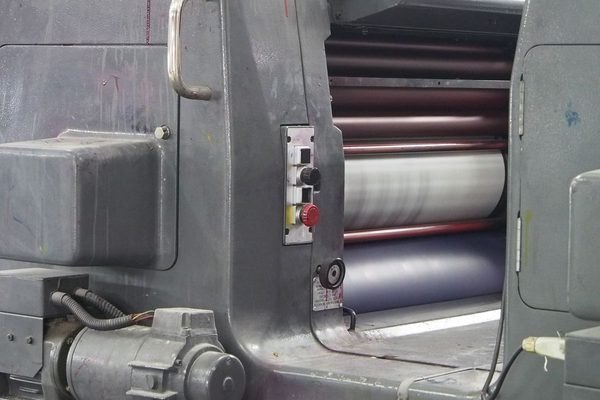
Foam in water-based ink mostly comes out of the ink supply system. When the pump returns ink to the tray it draws air in, and if resin and additives are not lined up the foam stacks up in the tray, with pinholes and white spots following on the print.
In printing inks, Chemi Tech has long supplied polyether, silicone and silicone-polyether systems for water-based gravure, flexo and overprint varnish, matched to resin type and press speed. High-speed circulating systems are covered from the KM series defoamer line, including high-shear-tolerant grades.
Business Advantages
First, it is compatible and does not float out: the tray does not separate. It mixes with the resin system and leaves no oil film or particles on the ink surface after standing.
Second, foam is held down and does not come back: the circulation loop stays clear. Air drawn in by the pump does not accumulate and the tray level stays stable.
Third, it adds nothing to the printed surface: pinholes and white spots are fewer. The ink film spreads more evenly and drying speed keeps to its original setting.
Fourth, it does not block the plate on press: no residue is left in the cells. Cleaning intervals do not stretch, build-up on the roller and doctor blade is reduced, and the number of stops to wipe the plate comes down.
Boundary on these figures: the judgement comes from typical water-based ink press conditions. Change the resin system or the press speed and the conclusion has to be looked at again. A trial print before running on press is advisable.
Industry Pain Points and Solutions
Foam sources in water-based ink are scattered, and the difficulty is that foaming points are many, compatibility is hard to judge and press speeds keep rising.
Pain point one: air drawn in by pumping floats foam up in the tray and the level reads falsely high. The answer is to reduce air entrainment at the supply end while strengthening foam hold.
Pain point two: the defoamer fights the resin and craters appear in the ink film. The answer is a more compatible type, with compatibility made a front-end screening criterion.
Pain point three: foam is carried through the cells onto the plate and prints drop out. The answer is to move the addition point so foam is broken before the ink reaches the plate.
Chemi Tech's three-step adaptation runs in three parts: sample the ink on site and reproduce the foaming conditions first, then run a press trial, and finally settle the type and the addition point.
Typical Conditions and Verification
Water-based inks commonly run around one hundred metres a minute, with tray temperature following the press room. Foam in the tray is most likely at start-up, at colour changes and at high running speed.
Failure signals cluster in four places: a layer of fine foam on the tray; pinholes and white spots on the print; slower ink film drying; more residue on the roller at cleaning. More than two of those and a press trial belongs on the schedule.
Records at the same press speed and the same resin system are held by Chemi Tech as comparison data and can be requested.
FAQ
Q1: Why can't water-based ink use a general-purpose defoamer?
General-purpose products separate easily in a resin system, hold foam only briefly, and can leave craters on the printed surface.
Q2: Will adding a defoamer change ink film adhesion and gloss?
That needs separate verification. Change the resin or the substrate and the conclusion changes, so it should be judged from trial print results rather than a single measurement.
Q3: What should be watched when moving from an imported defoamer to a domestic one?
Record the original product's dosage and the tray level as a baseline first, reproduce it equivalently, and scale up only after running in parallel on press for a period.