
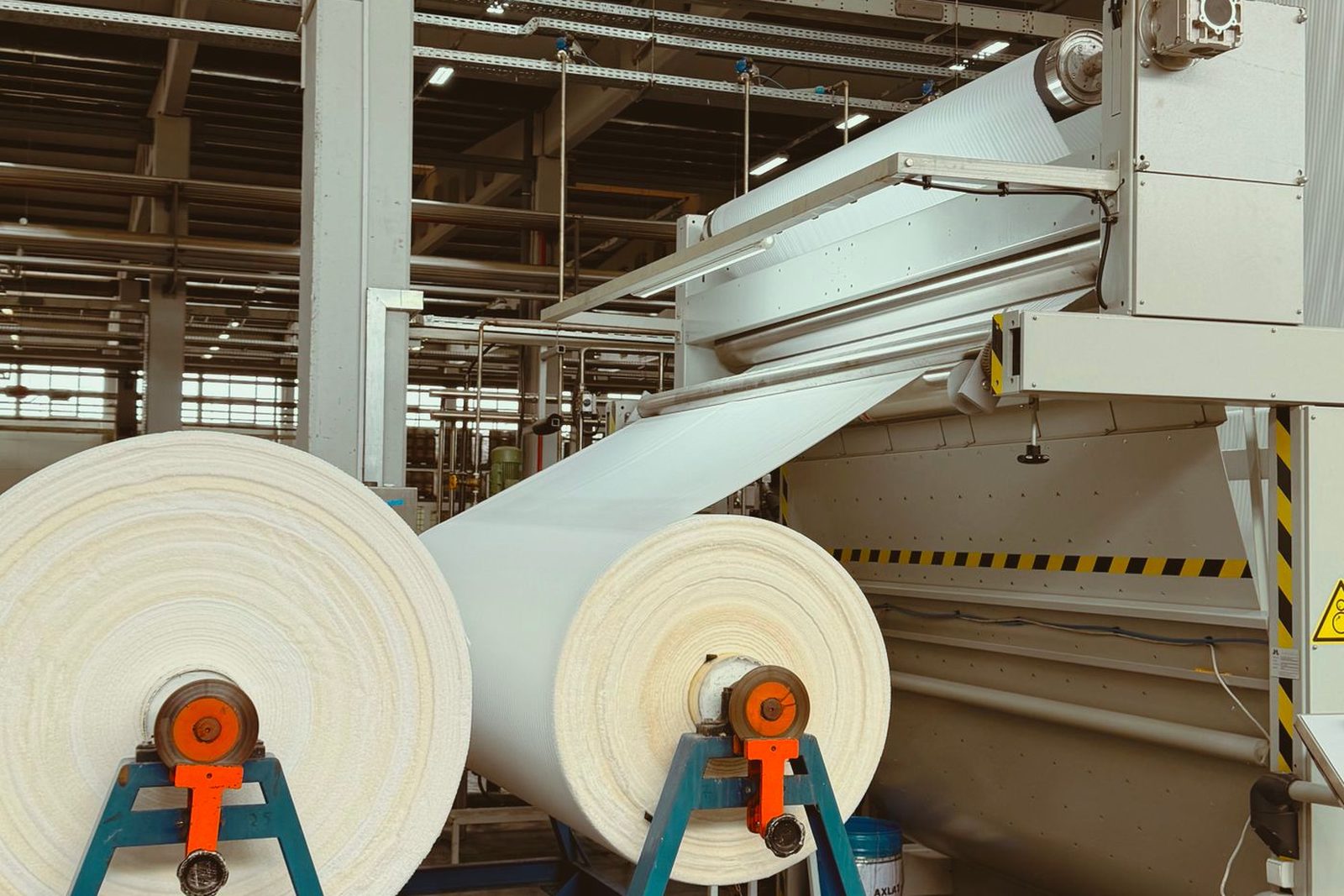
Rolls of white fibre and winding equipment inside a workshop
The sizing is stirred continuously by pumps in the circulation tank, and once the foam on the tank surface is carried by the liquor flow to the drawing bushings, filament breaks and fuzz multiply and the full-cake rate of a single winding machine falls with them.
Chemi Tech makes defoamers for glass fibre drawing and sizing formulation systems, drawn from the defoamer KM-430 series. How a grade is matched depends on the emulsifier type of the sizing, its solids content and the circulation temperature. KM-430 is designed around shear resistance and high temperature tolerance: its structure is not easily broken down by the repeated shear of the circulation pump, so the foam-breaking action is maintained; in a hot tank liquor it does not break emulsion, and once added it neither layers out nor floats oil, so the bundling and lubrication of the fibres are not disturbed. Chemi Tech completes shear and compatibility comparisons against the sizing formulation and the drawing condition, and selects the defoamer that fits on that basis.
Advantages of Chemi Tech Defoamers
Chemi Tech defoamer KM-430 series is designed around shear resistance and high temperature tolerance, so its defoaming action does not decay under the continuous shear of the circulation pump; on top of that, once added to a hot tank liquor it neither layers out nor floats oil and the liquor stays uniform; and the foam-breaking speed matches the drawing rhythm, so no foam is entrained at the bushings; it suits both sizing and drawing oil systems, and the workshop does not need to keep separate stock for different tanks.
Industry Pain Points and Solutions
The foam in glass fibre drawing is rarely caused by the sizing formulation; it is the circulation and spraying carrying air into the tank liquor, and the consequence is foam entrained at the bushings with more filament breaks.
The first problem to show is foam on the tank surface entering the bushings with the liquor flow. The circulation pump sends the tank liquor to the spraying station, a layer of foam is raised where it falls, and the foam drops onto the bushings along with the sizing, taking filament breaks and fuzz up with it. Chemi Tech's approach is to add shear-resistant KM-430 at the return end of the circulation tank, so the chemical disperses before the foam accumulates.
What follows is the stability of the sizing itself. The hot tank liquor circulates continuously and shear and temperature act together; once a defoamer with insufficient compatibility breaks emulsion, the oil phase separates out and clings to the bushings and the guide rollers. KM-430 does not break emulsion or layer out in hot sizing, and the tank liquor stays uniform.
The last problem is how long the suppression lasts. An ordinary defoamer works briefly after addition, is broken down within a few passes of the circulation pump, and the surface soon foams again. Chemi Tech runs durability comparisons against the sizing solids content and the circulation ratio, calibrating the dosage and the topping-up points together, and so reduces the topping-up frequency of the mixing station.
Typical Conditions and Verification
Customer: a glass fibre sizing producer in Jiangsu, applying it to the sizing circulation system in the drawing workshop.
After circulation, the sizing tank liquor at this plant ran thick with foam, foam was entrained at the bushings, the break rate and fuzz level stayed high over the long run, and the topping-up frequency would not come down either. The solution offered by Chemi Tech defoamer was: against the sizing solids content and the circulation temperature, KM-430 was selected, the dosing point was moved to the return end of the circulation tank, and the addition level was graded by tank liquor flow. After the changeover the foam on the tank surface thinned noticeably, foam was no longer entrained at the bushings, the break rate came down with it, and the topping-up frequency fell as well.
Frequently Asked Questions
Will a defoamer added to the sizing affect the bundling and lubrication of the fibres?
It does have an effect in some cases, since certain categories separate out an oil phase as they knock down foam, which works back against the wetting of the fibre by the sizing. For glass fibre sizing systems, Chemi Tech has completed compatibility comparisons with KM-430, and at normal addition levels bundling and lubrication are not affected. The specific addition level depends on the sizing solids content, and Chemi Tech gives a fitting recommendation after the shear and compatibility comparisons.