
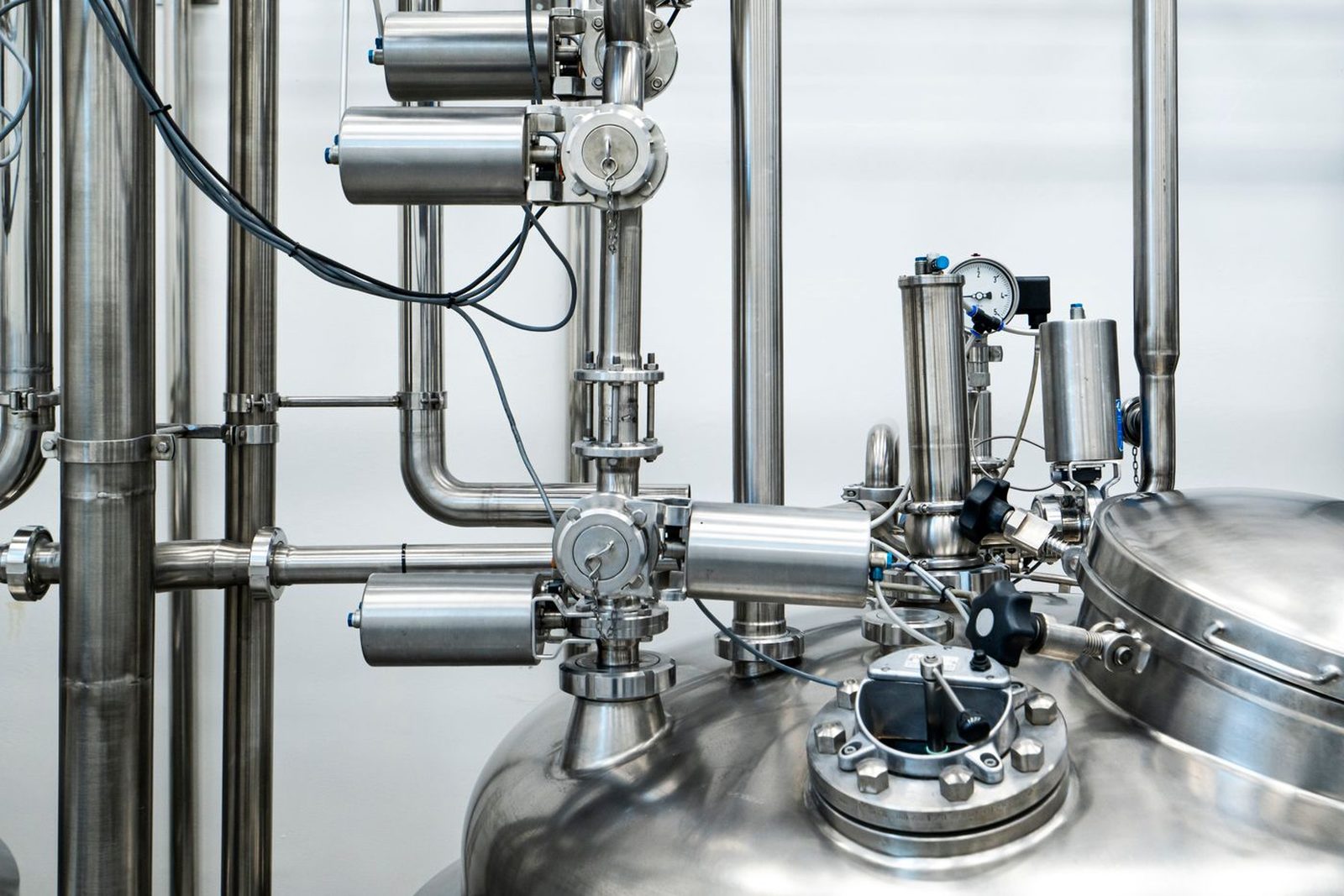
Stainless steel tanks, pipelines and valves in a batching workshop
Micro-foam entrained in waterborne adhesives inside the batching tank does not escape readily after filling, and at coating it leaves sheets of pinholes in the adhesive layer, so both the bonding strength and the stability of the coat weight are affected.
Chemi Tech makes defoamers for waterborne adhesives and waterborne dispersion systems, drawn from the defoamer KMT-628 series. This grade is benchmarked against BYK BYK-028; it can be added directly to a polyurethane dispersion without affecting the finished product, and supply and response are more timely than through import channels. The addition level is adjusted with the solids content, the viscosity and the order of addition; KMT-628 is a polysiloxane system with broad compatibility and simple addition, and while it removes micro-foam it does not change the film-forming behaviour of the glue. Chemi Tech completes defoaming and compatibility comparisons against the resin system and the batching process, and recommends the defoamer that fits.
Advantages of Chemi Tech Defoamers
Chemi Tech defoamer KMT-628 series has broad compatibility and can be added directly to a polyurethane dispersion, so no extra dilution is needed at the batching stage; moreover, addition is simple and it can be introduced at either the batching or the glue-mixing stage; foam removal is steady, and pinholes in the adhesive layer are reduced once it dries; interference with the film-forming behaviour of the glue is small, so the bonding and laminating steps are unaffected. Compared with imported grades, KMT-628 is supplied steadily and restocked promptly, and as a substitute it is more economical.
Industry Pain Points and Solutions
Foam in waterborne adhesives is mostly not caused by stirring speed being too high; it is batching and pumping carrying air into the glue continuously, and the direct consequence is pinholes in the adhesive layer and a coat weight that swings with them.
The trickiest is air entrainment at the batching stage. Powder dosing and high-speed dispersion run together, air is wrapped into the glue, the micro-bubbles are small in diameter and weak in buoyancy, and even standing does not clear them. Chemi Tech's approach is to add the broadly compatible KMT-628 at the feed end of the batching tank, so the chemical is already working at the peak of entrainment.
Next comes pumping and filling. The glue leaves through the pump, shear and fall bring air in again, the foam is sealed inside the drum after filling, and the state on opening the drum does not match the factory test. KMT-628 has broad compatibility and simple addition, and is topped up at the discharge stage to control secondary foaming.
The last item is pinholes in the adhesive layer. The wet film sets to touch quickly, unbroken micro-bubbles burst during film formation, sheets of fine pores are left in the layer, and the bonding strength weakens with them. Chemi Tech defoamer removes these defects at the source, and pinhole count and adhesive-layer appearance are the focus of Chemi Tech's comparison and verification.
Typical Conditions and Verification
Customer: a waterborne adhesive producer in Zhejiang, applying it to the batching section for emulsion adhesives and polyurethane dispersions.
The glue at this plant still carried micro-foam after batching, a foam layer was visible as soon as the filling drum was opened, downstream customers reported pinholes at coating, and imported grades used before had not fully solved it either. The solution offered by Chemi Tech defoamer was: against the system solids content and the order of addition, KMT-628 series, benchmarked against the equivalent overseas grade, was selected as an import substitute, the dosing points were set at both the feed end and the discharge stage, and the addition level was graded by solids content. After switching to this approach the micro-foam in the standing glue was noticeably reduced, pinholes in the adhesive layer came down with it, and the state on opening the drum became consistent.
Frequently Asked Questions
Will a defoamer added to the glue weaken the bonding strength?
An effect does exist, since certain categories migrate to the interface as they break foam and interfere with bonding and curing. Chemi Tech has completed defoaming and adhesion comparisons on KMT-628 across resin systems, and at normal addition levels the initial and final tack are unaffected. If you are currently using an imported grade, Chemi Tech can first run a dedicated comparison against the system solids content and the batching process and give an addition recommendation for the substitute.