
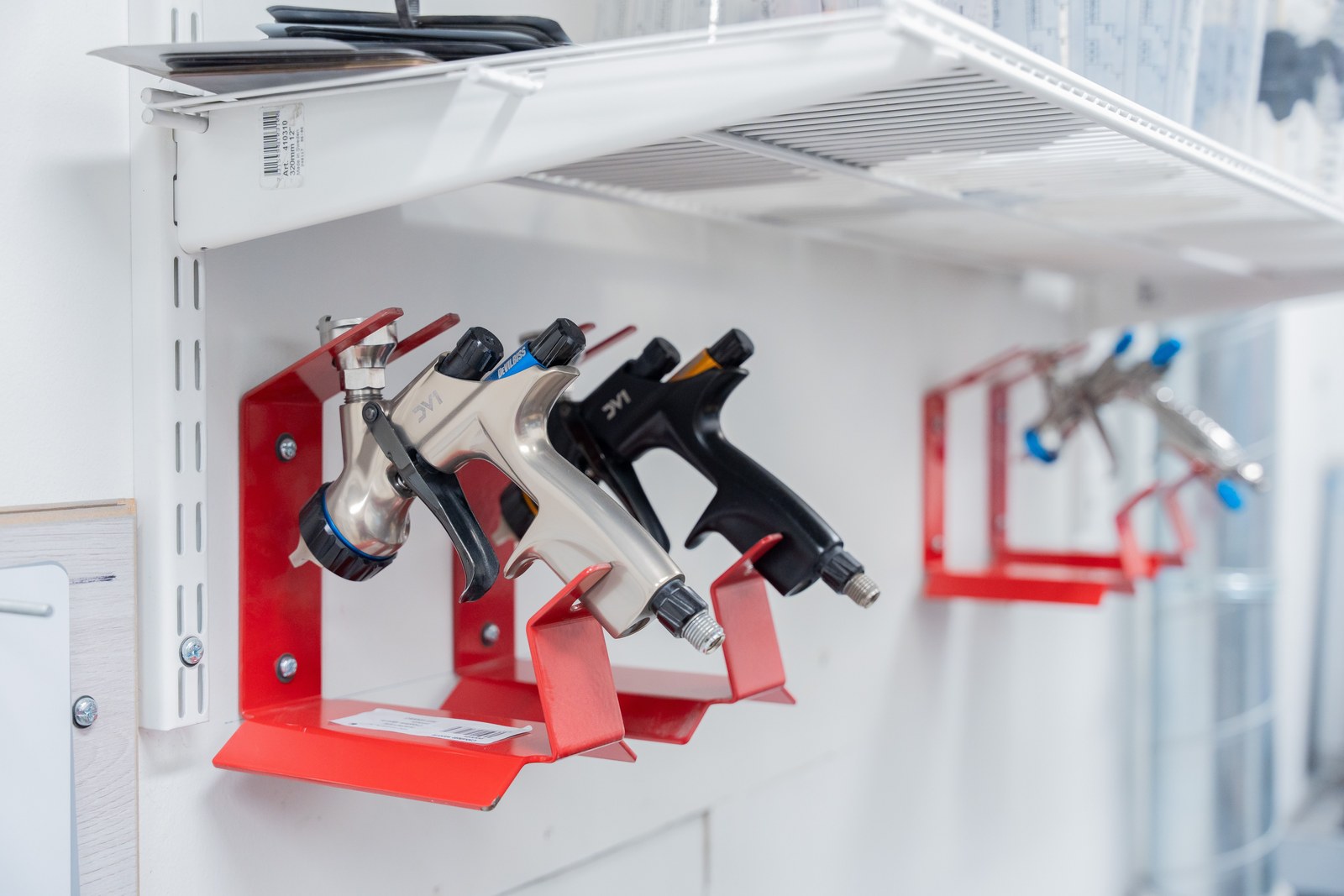
Spray guns on a rack in a coating line
If a water-based wood topcoat does not spread in time after spraying, the film leaves orange peel before it surface-dries; after drying the panel blushes and gloss turns patchy, and the finish quality and first-pass yield of the furniture fall together.
Chemi Tech supplies leveling agents for wood furniture coating systems, drawn from the leveling agent KMP-4100 series; the dosage is set by coating viscosity, film thickness and spraying takt. KMP-4100 lowers surface tension markedly and dynamic surface tension is likewise controllable, so after spraying the film spreads fully before surface dry, and it is compatible without causing cratering. Chemi Tech runs leveling comparisons against the coating system and spraying takt, and gives the customer a fitted leveling agent.
Advantages of Chemi Tech Leveling Agents
Chemi Tech leveling agent KMP-4100 series lowers surface tension markedly and dynamic surface tension is likewise controllable, so after spraying the film spreads fully before surface dry and orange peel and blushing are eased with it; the effect on gloss is small and panel gloss is even; it is compatible without causing cratering, and the film surface carries no pinholes or fish eyes; it is heat stable to the drying stage, does not decompose and does not yellow, so the colour of the panel stays consistent out of the line.
Industry Pain Points and Solutions
Leveling problems in water-based wood coatings mostly come from the film surface-drying earlier than leveling completes; the consequence is orange peel and blushing, and uneven gloss across the panel.
The most intractable point is pressing out orange peel. The film surface-dries too fast, sets before it has spread, and orange peel is left on the panel. Chemi Tech's answer is to add the markedly surface-tension-lowering KMP-4100 at the paint let-down stage, so that the film completes its spreading before surface dry.
The hardest point is controlling blushing. Film thickness varies across the panel, gloss turns patchy after drying, and colour deviation shows with it. Chemi Tech runs a leveling comparison against the spraying takt, and calibrates the dosage of KMP-4100 together with the point of addition.
Weakened intercoat adhesion is likewise a major pain point. When the leveling agent is dosed on the high side it enriches at the film surface and weakens the bond between recoats. KMP-4100 from Chemi Tech is compatible and leaves margin for recoatability, and intercoat adhesion stays stable at normal dosage.
Typical Operating Conditions and Verification
Customer: a furniture coating manufacturer in Zhejiang, for the spraying line that finishes wood door topcoats.
At the plant the wood topcoat came out with heavier orange peel after spraying, the panel blushed after drying, and the rework rate stayed high. The solution Chemi Tech leveling agent gave for the situation was: taking coating viscosity and spraying takt into account, choose KMP-4105, recalibrate the dosage and the point of addition against the spraying takt, and adjust the drying temperature curve alongside. Once the adjustment was complete, the orange peel grade on the panel rose by one step, gloss evenness returned to the acceptable range, and the rework rate fell with it.
Frequently Asked Questions
Once a leveling agent is added, will it affect recoating and repair of the wood topcoat?
It does warrant attention, since a leveling agent dosed on the high side weakens the bond between recoats. For KMP-4100, Chemi Tech has run leveling and adhesion comparisons across dosage levels, and recommends only the range where both perform stably. The dosage depends on spraying takt and film thickness, and Chemi Tech gives its fitted recommendation against the on-site drying curve.