
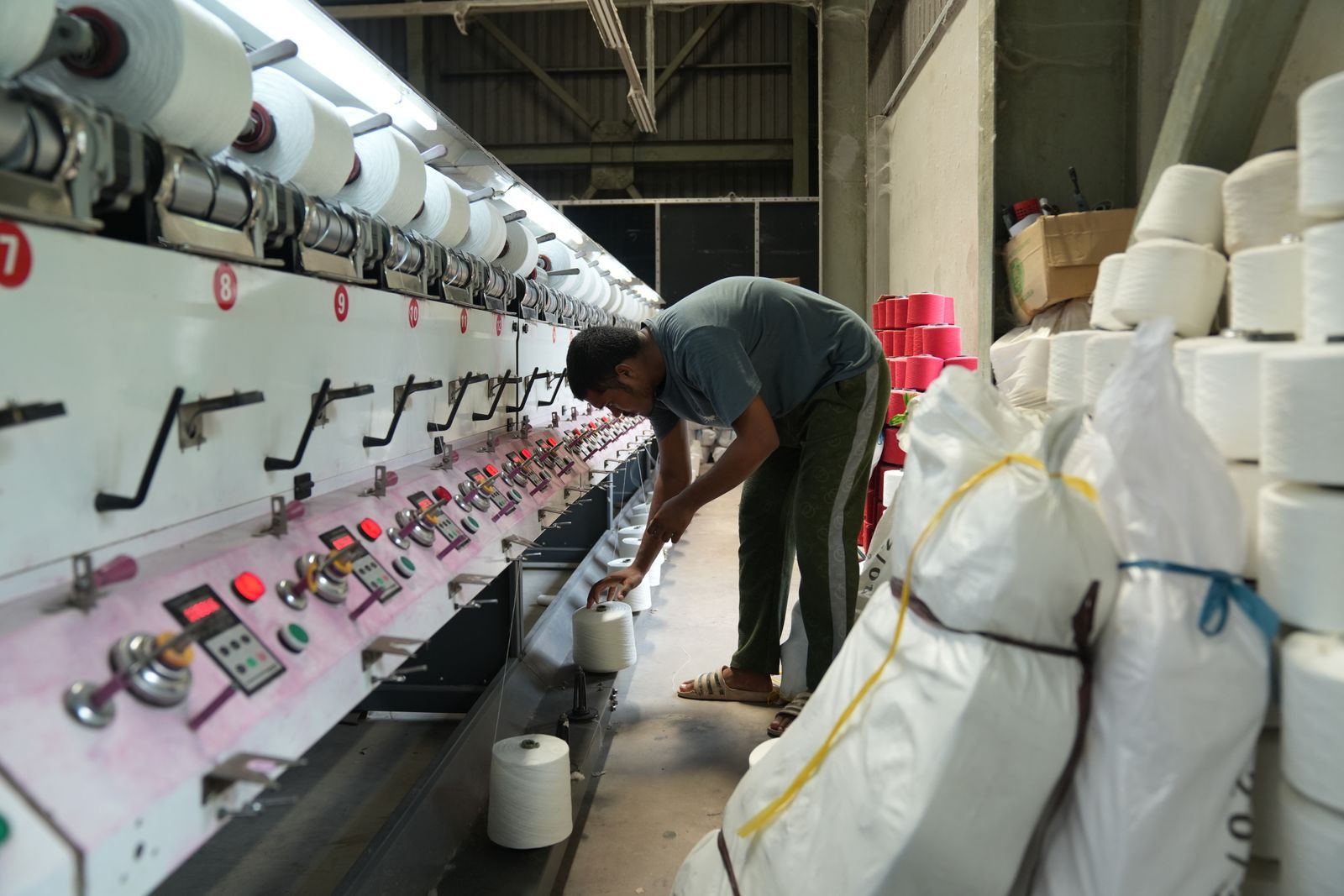
Winding machine and yarn packages on a textile mill floor
In an overflow dyeing machine, polyester heated to one hundred and thirty degrees Celsius carries a layer of foam that piles up against the vessel wall, the needle on the nozzle pressure gauge drifts downwards with it, patches of colour spotting appear across the fabric, and one correction pass costs an entire extra dyeing cycle.
Chemi Tech supplies defoamers for high-temperature and high-pressure dyeing of polyester and blended fabrics, drawn from the defoamer KM-4110 series; the dosage is set flexibly by liquor ratio and heating profile. KM-4110 is a modified polyether defoamer; it does not break emulsion or separate at high temperature, and its foam suppression lasts over time. From measured data on foam height inside the vessel and colour spotting on the fabric, Chemi Tech grades the fitted dosage for the KM-4110 series step by step.
Advantages of Chemi Tech Defoamers
Chemi Tech defoamer KM-4110 series is configured for overflow machines and package dyeing equipment. High-temperature resistance is good, so the defoaming component is not consumed after the bath reaches the upper limit of the process; foam suppression lasts over time, so no secondary foam builds up inside the vessel within one dyeing cycle; shear resistance is good, so the foam-breaking capacity holds after circulation through the main pump and injection at the nozzle; it works in the same bath as dispersing agents and levelling agents, leaving the dyestuff exhaustion curve undisturbed; it does not soil the fabric, so the residue left after foam breaking leaves no dye-rejecting spots; and the dosage is economical, graded by liquor ratio, so spending on dyestuffs and auxiliaries for correction cycles falls with it.
Industry Pain Points and Solutions
The foam problem in a high-temperature dyebath mostly has its root in the combined action of surface-active substances from dyestuffs and auxiliaries and air drawn in by the main pump circulation, and it finally concentrates in two places: foam inside the vessel and colour spotting on the fabric.
Once the heating stage passes one hundred degrees Celsius, the foaming power of surface-active substances climbs with it, and foam on the bath surface presses against the fabric as it runs. KM-4110 resists high temperature well, so its foam-breaking capacity holds at the upper temperature limit of the process.
Foam at the nozzle is broken into fine bubbles by high-speed shear and sprayed onto the fabric with the liquor, and dyestuff uptake is no longer uniform. KM-4110 resists shear well, so its foam-breaking capacity does not decay after circulation and injection.
One correction pass takes a complete dyeing cycle, with dyestuffs, auxiliaries, steam and labour all stacking up at once. Grading the dosage by liquor ratio and heating profile keeps chemical spending inside a calculable range, and the colour-difference corrections between dyeing cycles drop with it.
Typical Operating Conditions and Verification
Customer case: a dyeing and printing enterprise in Zhejiang, applied to the high-temperature and high-pressure overflow dyeing section for polyester knit fabrics.
After grading by liquor ratio and heating profile, Chemi Tech set the plant's dyeing defoamer to KM-4110, with the dosage graded step by step against dyestuff concentration. Before this, once heating reached the upper process limit, foam on the bath surface covered the dye liquor, the pressure gauge needle drifted downwards, and colour spotting on the fabric had to be corrected in a fresh cycle. After the defoamer went in, foam inside the vessel was already suppressed during the heating stage; the pressure gauge reading settled down; colour spotting no longer appeared in patches; and the number of correction cycles fell.
Frequently Asked Questions
With defoamer added to the dyebath, will dyestuff exhaustion be affected?
It all depends on whether the liquor ratio and heating profile fall inside that grade's high-temperature window. KM-4110 has completed comparative measured tests of foam height inside the vessel and colour spotting on the fabric in polyester overflow and package dyeing; within the recommended range the dyestuff exhaustion curve is undisturbed and no dye-rejecting spots appear on the fabric. In practice the dosage is based on liquor ratio, with dyestuff concentration and holding time as correction terms; Chemi Tech verifies by comparing foam height against colour-spotting counts, and gives the fitted dosage.