
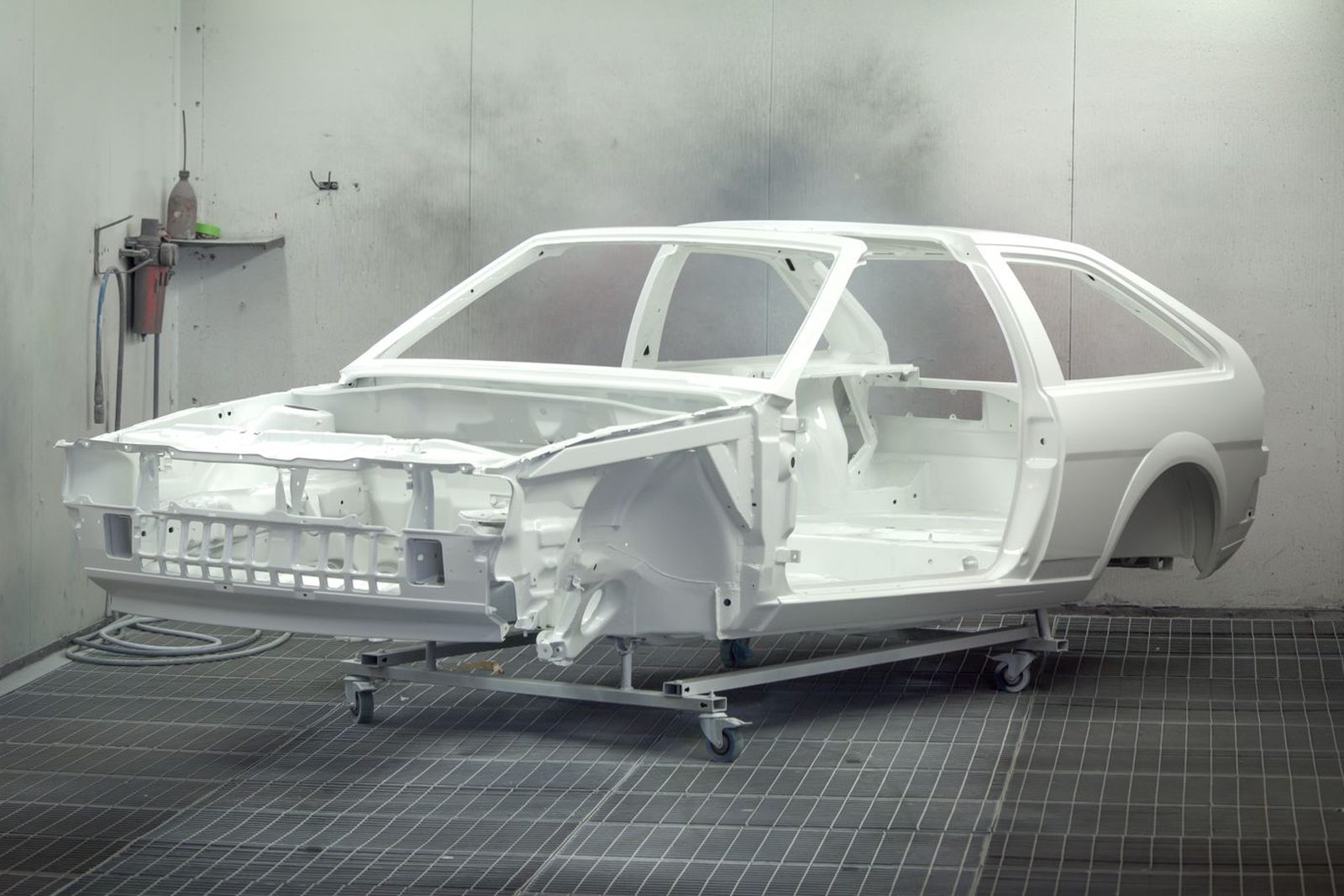
White car bodies on wheeled trolleys inside a paint booth
Waterborne automotive refinish paint runs both the colour coat and the clearcoat in a wet-on-wet process. As the colour coat spreads, its edge pulls back first, the aluminium flake arranges in disorder at the boundary, and after the part leaves the oven the clearcoat carries a faint yellow cast; one recoat takes up an extra oven slot.
Chemi Tech supplies the KMP-4500 series of levelling agents for the colour-coat and clearcoat systems of waterborne automotive paint; the dosage is set flexibly by application viscosity and flash-off time. KMP-4500 is a levelling agent for waterborne systems; it holds dynamic surface tension stably low, with good thermal stability that does not decompose or yellow in the baking stage. Set the measured DOI readings and cross-cut intercoat-adhesion results side by side, and the fitted dosage for the KMP-4500 series becomes clear.
Advantages of Chemi Tech Levelling Agents
The Chemi Tech KMP-4500 series levelling agent is configured for the colour-coat and clearcoat stages of waterborne automotive paint. It lowers surface tension markedly, holding down the dynamic surface tension of the waterborne system; compatibility is excellent, so it does not disturb intercoat adhesion and cross-cut results stay at their original grade; it leaves room for recoatability, so the old film is not bitten up on recoating; its effect on gloss is small, so the distinctness-of-image reading of the clearcoat is not pulled about; thermal stability is good, so it does not decompose or yellow within the bake temperature window; and the dosage is economical, graded by application viscosity, so the oven slots taken up by recoating fall.
Industry Pain Points and Solutions
The spreading problem of waterborne automotive paint has its root mostly in the combined action of water's high surface tension and a narrow flash-off window, while the aluminium flake orientation at the shrinking boundary is thrown into disorder, finally concentrating in two places: colour-coat retraction and clearcoat yellowing.
When the colour coat is sprayed onto the panel, water flashes off first, the surface-tension gradient at the edge pulls the wet film back, and a ring of edge retraction appears at the boundary. KMP-4500 lowers surface tension markedly, opening the wet-film spread window so the retraction is held within an acceptable width.
The aluminium flake re-orients with the shrinking liquid flow at the boundary, widening the lightness difference between face and flop. By grading KMP-4500 against application viscosity and flash-off time, the flake arrangement tends toward uniformity.
When the clearcoat runs too hot in the bake it yellows easily, and one recoat takes up an oven slot. With the dosage graded by application viscosity, the number of panels reworked for colour difference falls, and oven slots are no longer eaten by recoating.
Typical Operating Conditions and Verification
Customer case: an automotive coatings enterprise in Guangdong, applied to the formulation and panel-verification stages of waterborne colour coat and clearcoat.
After the colour coat was sprayed, a ring of retraction showed at the edge, the aluminium flake bloomed at the boundary, and the face-flop lightness difference exceeded the internal control range; the clearcoat yellowed after the bake, and the same batch of panels had to be resprayed. Taking application viscosity and flash-off time as the reference, KMP-4500 was set as the levelling agent for this system, with the dose taken separately by the solid content of the colour coat and the clearcoat. After it went in, the wet-film spread window opened and the retraction width narrowed; the flake arrangement tended toward uniformity and the lightness difference fell back within the internal control band; the clearcoat no longer yellowed in the bake, and the number of panels sent for recoat came down.
Frequently Asked Questions
With a levelling agent added, will intercoat adhesion between the clearcoat and the colour coat be weakened?
The extent of surface-tension reduction and the bake-temperature window must be brought into the same comparison. KMP-4500 has completed comparative measured tests of panel DOI readings and cross-cut intercoat adhesion in waterborne automotive paint systems; within the recommended range intercoat adhesion stays at its original grade and the old film is not bitten up on recoat. With application viscosity as the baseline and flash-off time and solid content as further calibrations, the spread-window and adhesion-grade comparison verifies and settles the dosage.